

What is Niobium Oxide Rotary Sputtering Target?
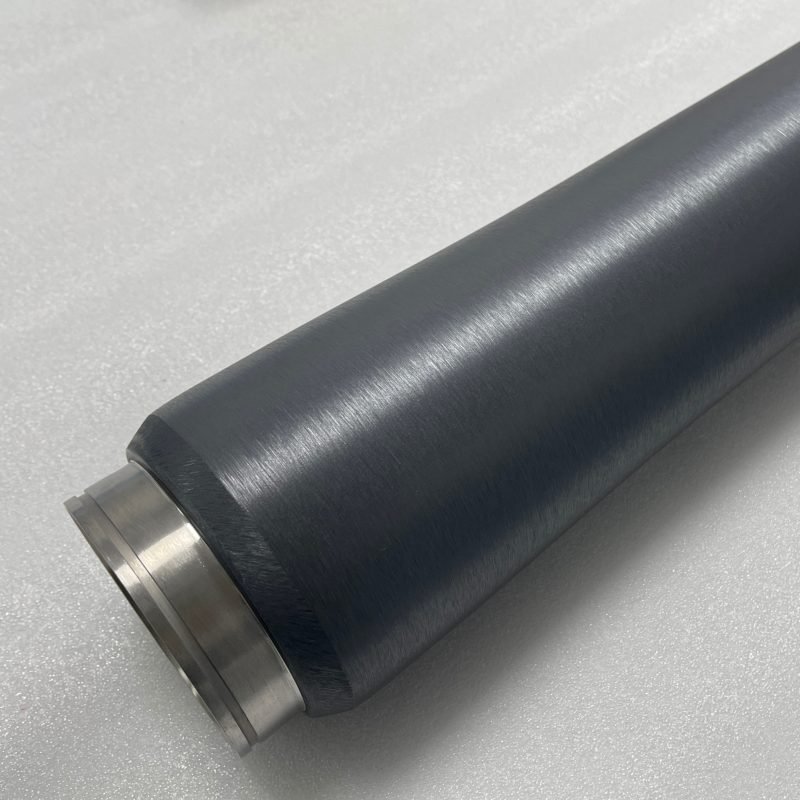
Niobium Oxide Rotary Sputtering Targets are cylindrical sputtering targets designed for large-area thin-film deposition, especially in optical coating applications requiring high film uniformity and stable production performance. Compared with conventional planar niobium oxide targets, rotatable tube targets offer improved material utilization, enhanced cooling efficiency, and longer continuous operating capability. These advantages make Nb₂O₅ Rotary Sputtering Targets suitable for anti-reflective (AR) coatings, optical lenses, architectural glass, and other advanced thin-film applications.
The Role of Niobium Oxide Rotary Sputtering Targets in Optical Coatings
In the rapidly developing optical coating industry, niobium pentoxide (Nb₂O₅) has become an important high-refractive-index material for multilayer thin-film structures. Due to its excellent optical transparency, relatively high refractive index, and low absorption characteristics in the visible wavelength range, Nb₂O₅ films are widely used in anti-reflective coatings, optical filters, precision lenses, and architectural glass applications.
Niobium Oxide Rotary Sputtering Target is specifically designed for continuous magnetron sputtering systems used in large-area coating production. Unlike traditional planar sputtering targets, rotatable tube targets utilize a cylindrical geometry that allows continuous rotation during deposition. This design improves target erosion uniformity, enhances cooling performance, and supports longer production cycles.For manufacturers producing high-performance optical coatings, selecting the appropriate sputtering target technology is essential for achieving stable film quality, efficient material usage, and consistent coating performance.
Why Niobium Oxide Rotary Sputtering Targets Are Preferred Over Planar Targets?
Both planar and rotary targets are used for niobium oxide thin-film deposition. However, their performance differs significantly in large-area industrial coating processes.
Nb2O5 Planar Sputtering Target vs Rotary Sputtering Target Comparison
| Performance Factor | Planar Nb2O5 Sputtering Target | Nb2O5 Rotary Sputtering Target |
| Target utilization | Typically limited by erosion profile | Higher utilization due to cylindrical erosion pattern |
| Cooling performance | Limited backside cooling area | Efficient heat dissipation through internal cooling |
| Deposition stability | May require more frequent target replacement | Suitable for long continuous operation |
| Film uniformity | Potential thickness variation caused by uneven erosion | More uniform erosion through 360° rotation |
| Production suitability | Laboratory and smaller-scale coating systems | Large-area industrial coating lines |
For applications such as architectural glass coating and optical film production, where coating uniformity across large substrates is critical, rotatable targets provide significant process advantages.
Technical Characteristics of High-Purity Niobium Oxide Rotary Sputtering Targets
1. High Purity and Consistent Material Composition
High-purity niobium oxide rotary sputtering targets are used for optical coating applications requiring stable film quality and sputtering performance.
Key characteristics include:
- High Nb₂O₅ purity: ≥99.95% purity grades for optical and thin-film applications.
- Low impurity levels: Helps maintain optical film performance.
- Uniform composition: Supports consistent deposition results.
Specifications can be customized according to coating requirements and sputtering systems.
2. Stable Sputtering Performance and Structural Reliability
The performance of niobium oxide rotary sputtering targets depends on material properties and fabrication quality.
Important factors include:
- Target density: Influences sputtering stability and utilization.
- Microstructure uniformity: Ensures consistent erosion.
- Bonding quality: Provides reliable target-backing tube connection.
- Thermal conductivity: Supports high-power sputtering operation.
- Oxygen control: Affects film properties and deposition behavior.
3. Efficient Thermal Management for Large-Area Coating
The cylindrical structure of niobium oxide rotary sputtering targets provides advantages for continuous magnetron sputtering.
Key benefits include:
- Uniform erosion: Improves target utilization.
- Efficient cooling: Reduces heat accumulation during operation.
- Stable operation: Supports long-term large-area coating processes.
These features make niobium oxide rotary sputtering targets suitable for AR coatings, optical lenses, Low-E glass, and other thin-film applications.
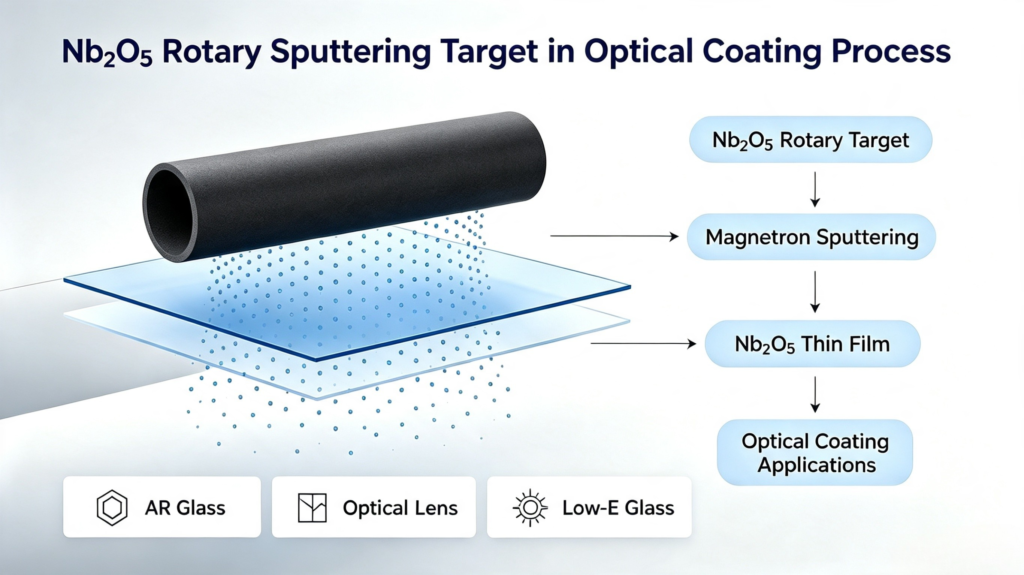
Optical Applications of Niobium Oxide Rotary Sputtering Targets
Niobium oxide (Nb₂O₅) is a high-refractive-index oxide material widely used in optical thin-film coatings. Combined with low-index materials such as SiO₂, Nb₂O₅ can be used to control light reflection and transmission in multilayer coating structures. Niobium oxide rotary sputtering targets are commonly used in coating systems that require stable sputtering performance and uniform film deposition.
Anti-Reflective (AR) Coatings:Nb₂O₅ is widely used as a high-index layer in AR coating systems. Together with SiO₂ and other dielectric materials, Nb₂O₅ films help reduce surface reflection and improve light transmission. Applications include solar glass, display cover glass, architectural glass, and optical windows.
Optical Lens Coatings:Due to its high refractive index and optical stability, Nb₂O₅ is commonly used in multilayer coatings for optical components. Nb₂O₅/SiO₂ coating structures are applied in camera lenses, laser optics, optical filters, and imaging systems.
Low-E Glass Coatings:Nb₂O₅ can be used as a dielectric layer in Low-E glass coating structures to adjust optical performance and support high visible light transmission. It is applied in energy-efficient architectural glass and large-area glass coating processes.
Thin-Film Solar Applications:Nb₂O₅ thin films are used in photovoltaic coating research and optical management structures due to their high refractive index and chemical stability. Applications include anti-reflective layers, optical enhancement films, and protective thin-film coatings.
Optical Properties of Nb2O5 Thin Films
The optical properties of Nb₂O₅ films depend on deposition conditions and film structure. Typical values are shown below:
| Property | Nb2O5 Value | Comparison / Application |
|---|---|---|
|
Refractive index @550 nm |
2.2–2.4 |
Higher than SiO₂ (~1.46), suitable as a high-index layer |
|
Visible light transparency |
High transparency range |
Used in optical and AR coating applications |
|
Optical role |
High-index coating material |
Commonly combined with SiO₂ in multilayer interference coatings |
How to Select a Suitable Niobium Oxide Rotary Sputtering Targe
The selection of a niobium oxide rotatable tube target depends on the coating application, sputtering system, and required film performance.
Key factors include:
- Purity and composition: High-purity Nb₂O₅ with controlled impurities is preferred for optical coating applications.
- Target dimensions: Diameter, length, backing tube design, and bonding method should match the sputtering equipment.
- Process requirements: Target specifications should be selected according to sputtering mode, power conditions, and oxygen process parameters.
Proper target selection helps ensure stable sputtering performance and consistent coating quality.
Conclusion
Niobium oxide rotary sputtering targets are widely used in optical thin-film applications where high refractive index, stable sputtering performance, and uniform film deposition are required. With their advantages in continuous coating processes, these targets are suitable for applications including AR coatings, optical lenses, Low-E glass, and photovoltaic thin films.Selecting the appropriate niobium oxide target specification, including purity, dimensions, and sputtering compatibility, is essential for achieving consistent coating performance. For customized Nb₂O₅ rotary sputtering target solutions, ULPMAT provides high-purity materials and technical support according to customer requirements.
FAQs
Niobium Oxide Rotary Sputtering Target is a cylindrical sputtering material used in magnetron sputtering systems to deposit niobium oxide (Nb₂O₅) thin films. It is mainly used for optical coatings, anti-reflective (AR) coatings, Low-E glass, and other large-area thin-film applications requiring uniform deposition.
Niobium oxide (Nb₂O₅) has a high refractive index and good optical transparency, making it suitable for multilayer optical coatings. Rotary sputtering targets provide stable material supply and uniform erosion, which are important for producing consistent optical films.
Niobium Oxide Rotary Sputtering Targets are used in AR glass coatings, optical lenses, architectural glass coatings, Low-E glass, and photovoltaic thin-film applications. They are commonly selected for large-area coating processes based on magnetron sputtering technology.
High-purity Niobium Oxide Rotary Sputtering Targets are typically supplied with Nb₂O₅ purity of 99.95% or higher. The required purity depends on the coating application, film quality requirements, and sputtering process conditions.
Rotary sputtering target uses a cylindrical geometry that enables continuous rotation during sputtering. Compared with planar targets, rotary targets generally provide more uniform erosion, improved cooling performance, and better suitability for long-duration large-area coating processes.
The selection depends on several factors, including Nb₂O₅ purity, target dimensions, backing tube design, bonding method, and compatibility with the sputtering system. The correct specification helps ensure stable deposition and consistent thin-film performance.
Related Resources
Products
- Niobium Oxide Rotary Sputtering Target
- Niobium Oxide Sputtering Target
- Silicon Sputtering Target
- Other Rotary Sputtering Targets
Articles
- Titanium Rotary Target Selection Guide: How to Improve Sputtering Efficiency and Coating Quality
- 7 Reasons Silicon Rotary Targets Are Used in Modern Thin Film Deposition
- ITO Rotary vs Planar Target: Which Delivers Better Coating Performance?
- Why Low Oxygen Matters in Chromium Rotary Targets
- High-Purity Niobium Oxide Rotary Target for Thin Film and Industrial Coatings
References
- 1. Society of Vacuum Coaters (SVC). Technical resources on vacuum coating and sputtering technologies.
- 2. Chen, K. N. et al. Investigation of Antireflection Nb₂O₅ Thin Films by the RF Magnetron Sputtering Method.
- 3. The Optical and Structural Properties of Amorphous Nb₂O₅ Thin Films. Thin Solid Films.
- 4. A Simple Growth Method for Nb₂O₅ Films and Their Optical Properties. Optical Materials.
- 5. Xi’an Fangke New Material Technology Co., Ltd. Niobium Pentoxide Target: Properties, Applications, and Benefits.