

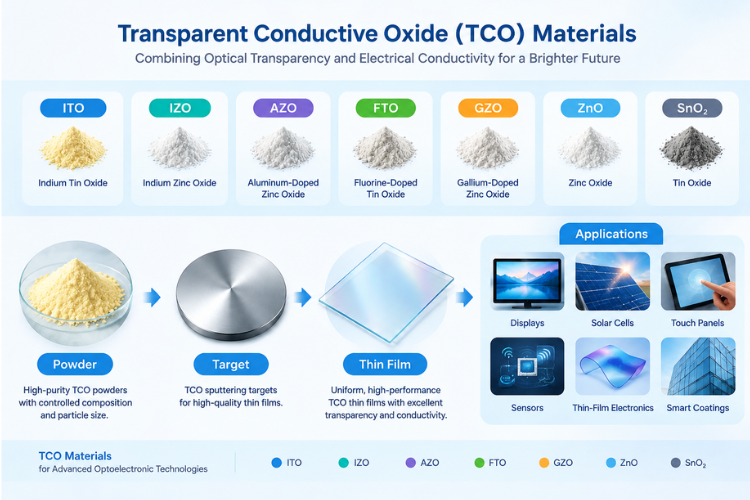
Transparent conductive oxide (TCO) materials are functional semiconductor oxide materials that combine two important properties: optical transparency and electrical conductivity.Unlike conventional metals, which provide electrical conductivity but block visible light, TCO materials can transmit visible light while allowing electrical charge transport. This unique combination makes them essential materials for optoelectronic technologies, including displays, touch panels, photovoltaic devices, transparent electrodes, thin-film electronics, and sensors.
Common TCO materials include Indium Tin Oxide (ITO), Indium Gallium Zinc Oxide (IGZO), Zinc Oxide (ZnO), and Tin Oxide (SnO₂). These materials can be processed into powders, thin films, and sputtering targets depending on the requirements of the final application.
Why Are TCO Materials Transparent and Conductive?
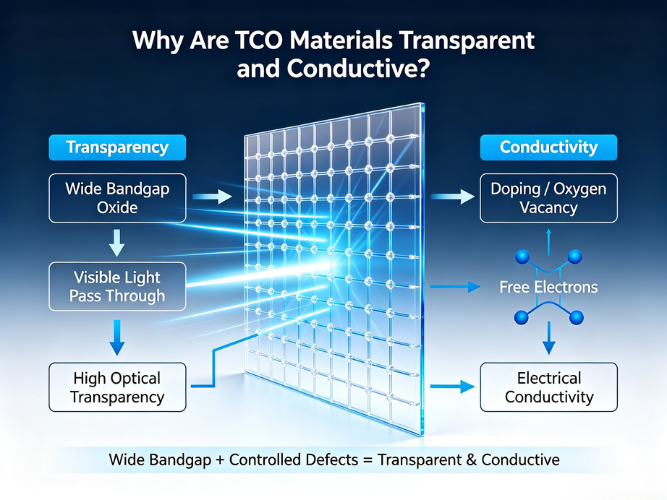
Transparent conductive oxide (TCO) materials combine two normally conflicting properties: high optical transparency and electrical conductivity. This unique performance comes from their wide bandgap structure and controlled carrier generation through doping and defect engineering.
Why Are TCO Materials Transparent?
Most TCO materials are wide-bandgap metal oxides with limited absorption in the visible wavelength range. Because visible photons generally do not have enough energy to excite electrons across the bandgap, light can pass through the material with minimal absorption.As a result, TCO materials can maintain high visible-light transparency while providing electrical functionality for optoelectronic applications.The optical transparency of TCO materials is affected by several factors, including:
- Bandgap energy
- Material composition
- Film thickness
- Crystal structure
- Defect concentration
Why Are TCO Materials Conductive?
Although many metal oxides are naturally electrical insulators, TCO materials can achieve conductivity through controlled doping and defect engineering.Dopants and oxygen vacancies generate free carriers, mainly electrons, which improve electrical transport within the oxide structure.The electrical conductivity of TCO materials depends on:
- Carrier concentration
- Electron mobility
- Dopant type and concentration
- Oxygen vacancy concentration
- Deposition and processing conditions
Role of Dopants in TCO Conductivity
Different dopants are used to modify the electrical properties of metal oxides:
- Indium Tin Oxide (ITO): Tin doping increases the electron concentration of indium oxide (In2O3), enabling high electrical conductivity while maintaining optical transparency.
- Aluminum-Doped Zinc Oxide (AZO): Aluminum incorporation improves the conductivity of zinc oxide (ZnO) and provides a cost-effective TCO option.
- Fluorine-Doped Tin Oxide (FTO): Fluorine doping enhances the conductivity of tin oxide (SnO2) and supports applications such as photovoltaic devices.
By controlling material composition, dopants, defects, and processing conditions, TCO materials can achieve a balance between optical transparency and electrical conductivity, which is essential for advanced optoelectronic applications.
Common Types of Transparent Conductive Oxide (TCO) Materials
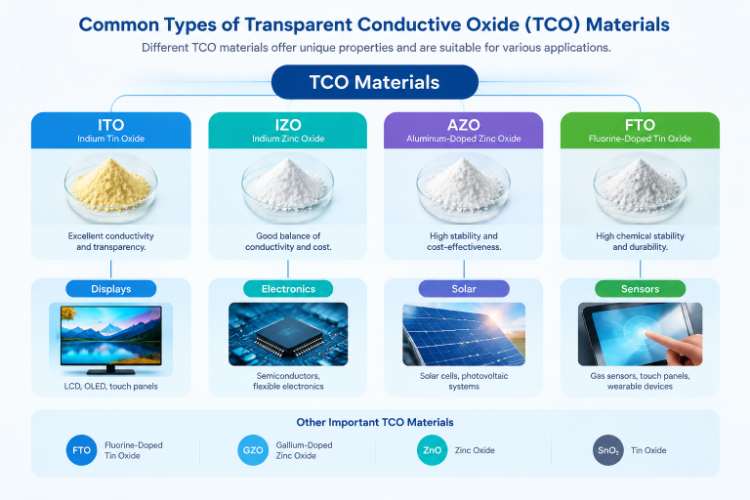
Several oxide semiconductor systems are used as transparent conductive oxide (TCO) materials. Different TCO materials provide different combinations of electrical conductivity, optical transparency, stability, and processing compatibility.The most common TCO materials include ITO, IGZO, ZnO-based materials, and SnO₂-based materials. The suitable choice depends on the requirements of the final application, such as displays, photovoltaic devices, sensors, and thin-film electronics.
| TCO Material | Composition | Main Characteristics | Typical Applications |
| Indium Tin Oxide (ITO) | In₂O₃ doped with SnO₂ | High electrical conductivity, high visible light transparency, mature thin-film processing technology | Transparent electrodes, LCD displays, OLED devices, touch panels, photovoltaic devices |
| Indium Gallium Zinc Oxide (IGZO) | In-Ga-Zn-O oxide semiconductor | High electron mobility, good transparency, suitable for large-area electronics | TFT backplanes, high-resolution displays, thin-film electronic devices |
| Zinc Oxide (ZnO) | ZnO | Wide bandgap semiconductor, good optical transparency, abundant raw materials | Transparent electrodes, solar cells, sensors, optoelectronic devices |
| Aluminum-Doped Zinc Oxide (AZO) | Al-doped ZnO | Lower-cost alternative to ITO, improved conductivity compared with pure ZnO | Solar cells, transparent conductive coatings, electronic devices |
| Gallium-Doped Zinc Oxide (GZO) | Ga-doped ZnO | Enhanced electrical properties and optical performance through gallium doping | Transparent conductive films and optoelectronic applications |
| Tin Oxide (SnO₂) | SnO₂ | High chemical stability, thermal stability, and transparency | Solar cells, gas sensors, functional coatings |
| Fluorine-Doped Tin Oxide (FTO) | F-doped SnO₂ | Conductive SnO₂-based material with good environmental stability | Photovoltaics, transparent electrodes, electrochemical devices |
Indium Tin Oxide (ITO)
Among commercial TCO materials, Indium Tin Oxide (ITO) remains one of the most widely used materials because it provides a good balance between electrical conductivity and optical transparency.Tin doping increases the carrier concentration of indium oxide (In₂O₃), improving electrical transport while maintaining high visible-light transmission.ITO is commonly deposited using sputtering processes, where high-quality ITO sputtering targets are used to produce transparent conductive films for electronic and optoelectronic devices.
Indium Gallium Zinc Oxide (IGZO)
Indium Gallium Zinc Oxide (IGZO) is an oxide semiconductor material mainly associated with thin-film transistor (TFT) technology.Compared with traditional amorphous silicon, IGZO offers higher electron mobility and good transparency, making it suitable for advanced display applications.Important factors affecting IGZO performance include:
- Chemical composition
- Impurity concentration
- Film uniformity
- Deposition conditions
IGZO materials are widely studied for high-resolution displays and next-generation thin-film electronics.
Zinc Oxide-Based TCO Materials
Zinc Oxide (ZnO) is an important alternative TCO material due to its wide bandgap, optical transparency, and abundant raw material availability.However, pure ZnO generally has lower conductivity than doped TCO systems. Therefore, doping elements such as aluminum and gallium are commonly introduced to improve electrical performance.Common ZnO-based TCO materials include:
- Aluminum-Doped Zinc Oxide (AZO)
- Gallium-Doped Zinc Oxide (GZO)
These materials are investigated for transparent electrodes, solar cells, sensors, and other optoelectronic applications.
Tin Oxide-Based TCO Materials
Tin Oxide (SnO₂) is another important oxide semiconductor used in transparent conductive applications.SnO₂-based materials are valued for their:
- Chemical stability
- Thermal stability
- Optical transparency
Fluorine-doped Tin Oxide (FTO) is one of the most widely studied SnO₂-based TCO materials, especially for photovoltaic and sensor applications.
Applications of Transparent Conductive Oxide Materials
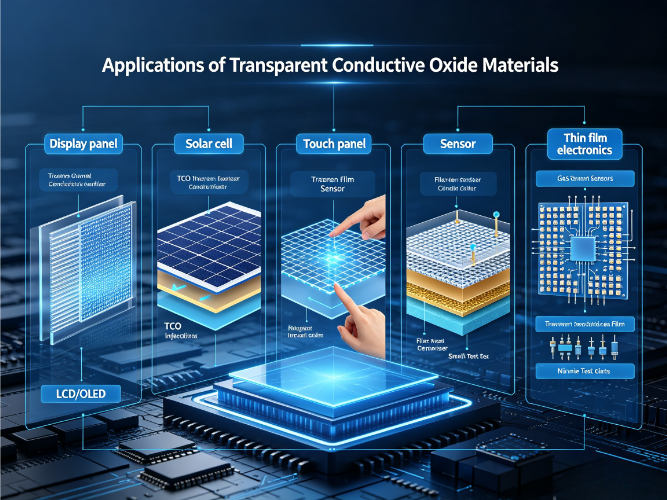
The combination of optical transparency and electrical conductivity makes transparent conductive oxide (TCO) materials important functional materials for optoelectronic devices, energy systems, and thin-film electronics.
Transparent Electrodes for Displays and Touch Devices:TCO films are widely used as transparent electrodes in LCD displays, OLED panels, and touch screens. Indium Tin Oxide (ITO) remains the most common choice due to its high conductivity, transparency, and mature sputtering process, while ZnO-based and SnO₂-based materials are also studied as alternatives.
Solar Cells and Photovoltaic Devices:In photovoltaic devices, TCO layers serve as transparent conductive films that transport electrical charges while allowing light to reach the active layer. ITO, FTO, and AZO are commonly investigated materials, with selection depending on conductivity, optical performance, stability, and device requirements.
Thin-Film Transistors and Advanced Electronics:Indium Gallium Zinc Oxide (IGZO) is an important oxide semiconductor used in thin-film transistor (TFT) technologies. Its high mobility and transparency make it suitable for high-resolution displays, display backplanes, and transparent electronic devices.
Sensors and Functional Coatings:ZnO and SnO₂-based materials are widely studied for sensors and functional oxide coatings because their electrical properties can respond to surface interactions and environmental changes.
Emerging Applications:New TCO applications include flexible electronics, transparent heaters, and next-generation photovoltaic systems, with ongoing research focusing on improved conductivity, stability, and processing compatibility.
How to Select TCO Materials?
Selecting a suitable transparent conductive oxide material depends on electrical performance, optical requirements, deposition process, and application conditions.
| Selection Factor | Key Parameters | Considerations for TCO Material Selection |
| Electrical Performance | Electrical resistivity, carrier concentration, electron mobility | High conductivity is essential for transparent electrodes and electronic devices. ITO is widely selected for high-performance applications, while ZnO-based materials are studied as alternative TCO systems. |
| Optical Performance | Visible light transmittance, bandgap energy, film thickness, surface quality | The selected TCO material should provide sufficient conductivity while maintaining high optical transparency for the intended device. |
| Deposition Compatibility | Sputtering process, CVD, substrate type, deposition temperature | Material properties such as purity, composition uniformity, density, and target quality can influence thin-film performance. |
| Chemical and Thermal Stability | Chemical resistance, thermal stability, environmental durability | Stability requirements vary by application. FTO is valued for photovoltaic applications, while ITO remains widely used for high-performance transparent conductive films. |
| Cost and Material Availability | Raw material availability, manufacturing cost, supply considerations | ZnO-based TCO materials are widely investigated as alternatives where resource availability and cost are important factors. |
| Customization Requirements | Composition, doping ratio, purity, shape, dimensions, particle size, density | Specific applications may require customized TCO specifications, including dopant concentration, material composition, target dimensions, or powder characteristics to meet different processing requirements. |
TCO Materials from ULPMAT
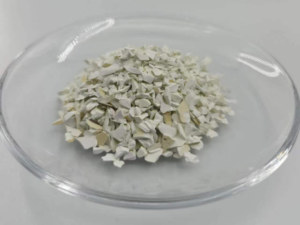
ULPMAT supplies high-purity transparent conductive oxide (TCO) materials in different forms, including powders, sputtering targets, and granules, for optoelectronic, semiconductor, and thin-film applications.
Available TCO materials include:
- Indium Tin Oxide (ITO) — available as powder and sputtering targets for transparent conductive film applications.
- Indium Zinc Oxide (IZO) — available as powder and sputtering targets for transparent electrode and thin-film electronic applications.
- Aluminum-Doped Zinc Oxide (AZO) — available as powder and sputtering targets for photovoltaic and transparent conductive coating applications.
- Fluorine-Doped Tin Oxide (FTO) — available as powder and sputtering targets for transparent conductive and photovoltaic applications.
- Gallium-Doped Zinc Oxide (GZO) — available as powder and sputtering targets for oxide semiconductor and transparent conductive applications.
- Zinc Oxide (ZnO) — available in powder, granule, and sputtering target forms for optoelectronic devices, sensors, and transparent conductive applications.
- Tin Oxide (SnO₂) — available in powder, granule, and sputtering target forms for sensors, coatings, and transparent conductive systems.
ULPMAT supports customized TCO material solutions according to specific requirements, including composition, doping ratio, purity, particle size, morphology, shape, dimensions, and application conditions.
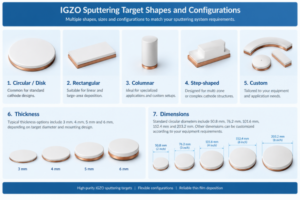
For sputtering applications, customized target solutions can be provided with controlled composition, purity, density, and bonding options to meet different deposition requirements.
Conclusion
Transparent conductive oxide (TCO) materials are important functional semiconductor materials that combine optical transparency and electrical conductivity for modern optoelectronic technologies. ITO remains one of the most widely used TCO materials due to its balanced conductivity, transparency, and mature thin-film processing technology, while ZnO-based and SnO₂-based materials continue to be developed for photovoltaic, sensor, and electronic applications.
The selection of a suitable TCO material depends on the required balance between electrical performance, optical properties, chemical stability, deposition process, and device requirements. Different materials, including ITO, IZO, AZO, FTO, GZO, ZnO, and SnO₂, provide different advantages for specific applications.
FAQs
Transparent conductive oxide (TCO) materials are semiconductor oxide materials that combine high visible-light transparency with electrical conductivity. They are important because they enable transparent electrodes and conductive layers in displays, solar cells, touch panels, sensors, and other optoelectronic devices.
Common transparent conductive oxide materials include Indium Tin Oxide (ITO), Indium Zinc Oxide (IZO), Aluminum-Doped Zinc Oxide (AZO), Fluorine-Doped Tin Oxide (FTO), Gallium-Doped Zinc Oxide (GZO), Zinc Oxide (ZnO), and Tin Oxide (SnO₂). The suitable material depends on the required balance between conductivity, transparency, stability, and processing conditions.
ITO remains widely used because it provides a good balance of electrical conductivity, optical transparency, and compatibility with thin-film deposition processes such as magnetron sputtering. It is commonly used for transparent electrodes in displays, touch panels, and photovoltaic devices.
ITO provides high conductivity and mature processing technology, while IZO is studied for oxide semiconductor and transparent electronic applications. AZO is considered an alternative ZnO-based TCO material with lower material cost, and FTO is valued for its chemical and thermal stability, especially in photovoltaic applications.
TCO materials are commonly supplied in forms such as powders, sputtering targets, and granules. Powder materials are often used for research and material development, while sputtering targets are used to deposit transparent conductive films. The required form depends on the manufacturing process and application requirements.
TCO material selection depends on several factors, including electrical resistivity, optical transparency, carrier mobility, deposition method, substrate compatibility, environmental stability, and cost requirements. For example, ITO is often selected for high-performance transparent electrodes, while ZnO-based and SnO₂-based materials may be considered for alternative requirements.
Yes. TCO materials can be customized according to application requirements, including composition, doping ratio, purity, particle size, morphology, dimensions, and material form. Customized specifications are often required for different sputtering processes, thin-film designs, and electronic device development.
TCO materials are widely used in transparent electrodes for displays and touch panels, photovoltaic devices, thin-film electronics, sensors, and functional coatings. Emerging applications include flexible electronics, transparent heaters, and next-generation optoelectronic devices.
Related Articles
- 1. Understanding Zinc Oxide Materials: From ZnO Powder and Granules to Sputtering Target Production
- 2. How to Choose IGZO Sputtering Target: Key Specifications and Buying Guide
- 3. IGZO vs ITO Sputtering Target: Key Differences, Applications, and Comparison
- 4. IGZO Sputtering Target Quality: How Purity, Composition, and Density Affect Thin Film Performance
- 5. What Is an Indium Zinc Oxide Rotatable Target? Applications, Advantages, and Sputtering Performance
- 6. ITO Rotary vs Planar Target: Which Delivers Better Coating Performance?
- 7. IZTO Sputtering Target: Why It’s Better Than ITO
Technical References
- 1. Stadler, A. *Transparent Conducting Oxides—An Up-to-Date Overview.* Materials, 2012.
- 2. Minami, T. *Transparent Conducting Oxide Thin-Film Development for ITO Substitutes.* Thin Solid Films, 2008.
- 3. Ellmer, K. *Development of Optically Transparent Electrodes.* Nature Photonics, 2012.
Need the Right TCO Material for Your Application?
Selecting the suitable transparent conductive oxide material depends on factors such as composition, doping level, purity, material form, and deposition requirements.
ULPMAT provides high-purity TCO materials including powders, sputtering targets, and granules, with customized solutions available for different research and industrial applications.