

Why ITO Rotary Targets Are Replacing Planar Targets?
ITO Rotary Target technology has become one of the most important developments in modern thin-film coating systems. In the early stages of thin-film coating technology, planar sputtering targets were the standard choice for most deposition systems.
They were relatively simple to manufacture, easy to install, and suitable for small coating areas. This structure underpinned the development of LCD panels, architectural glass, and semiconductor coatings. However, coating technology has undergone a dramatic transformation in the past two decades. Modern industry is no longer limited to small-batch production of small substrates. Today’s production lines need to operate continuously on ever-expanding surfaces while maintaining extremely high stability of film performance. In applications such as OLED displays, touch panels, low-emissivity glass, and photovoltaic coatings, even small variations in film thickness or conductivity can reduce product yield and increase manufacturing costs.
This shift in production scale is one of the main reasons why the industry has gradually moved toward the ITO Rotary Target.Unlike traditional planar targets, rotary sputtering targets rotate continuously during deposition. This structural change may appear simple from the outside, but from an engineering perspective it fundamentally changes how erosion, heat distribution, and plasma stability behave during sputtering. For manufacturers focused on coating consistency and long-term production stability, these differences are extremely important.
As a manufacturer of inorganic sputtering materials, we often see customers focus primarily on purity or target price when evaluating ITO targets. In practice, however, coating performance depends on many interconnected factors, including density, resistivity, bonding quality, thermal behavior, and utilization efficiency. The actual performance gap between rotary and planar targets becomes most visible not in laboratory testing, but in continuous industrial production.
Structure of ITO Rotary Target
Indium tin oxide (ITO) rotary targets are cylindrical ceramic sputtering targets primarily composed of indium oxide (In₂O₃) and tin oxide (SnO₂). Our most commonly supplied ratio is approximately 90 wt.% indium oxide and 10 wt.% tin oxide, a proportion that balances conductivity and optical transparency.
From a materials engineering perspective, ITO is not an easy ceramic material to manufacture. Precise control of powder particle size, sintering atmosphere, grain growth, and oxygen vacancy distribution is required. Even small variations in the manufacturing process can significantly affect the final resistivity and sputtering stability.
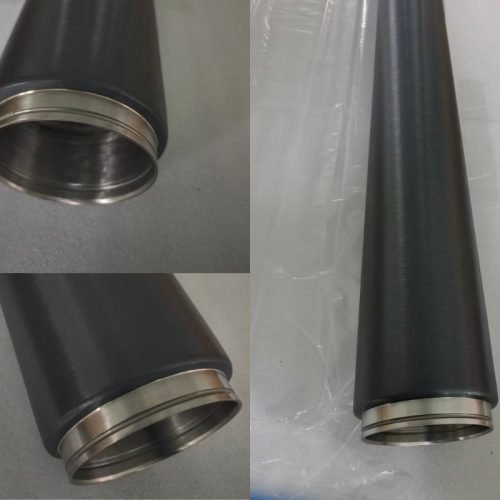
In a rotary system, the ceramic material is bonded to a metal backing tube, typically made of stainless steel or a copper-based alloy. During operation, the target rotates continuously, and the plasma erodes around its cylindrical surface. This rotational motion avoids the concentrated, racetrack-like erosion common in planar targets. The importance of this difference becomes increasingly apparent as coating linesizes and power densities increase.
Under optimized manufacturing conditions, the relative density of a rotating indium tin oxide (ITO) target can approach 99.9%, with a resistivity of approximately 0.12 mΩ·cm. This high-density structure is crucial for reducing arc discharge caused by porosity and maintaining stable plasma discharge during long coating cycles.
Why Large-Area Coating Systems Prefer Rotary Targets?
One of the biggest challenges in large-area sputtering is maintaining film uniformity over time.In smaller deposition systems, slight instability may only affect a limited area. In large industrial coating lines, however, a small fluctuation can influence meters of coated substrate. For display manufacturers and architectural glass producers, this can lead to major yield losses.
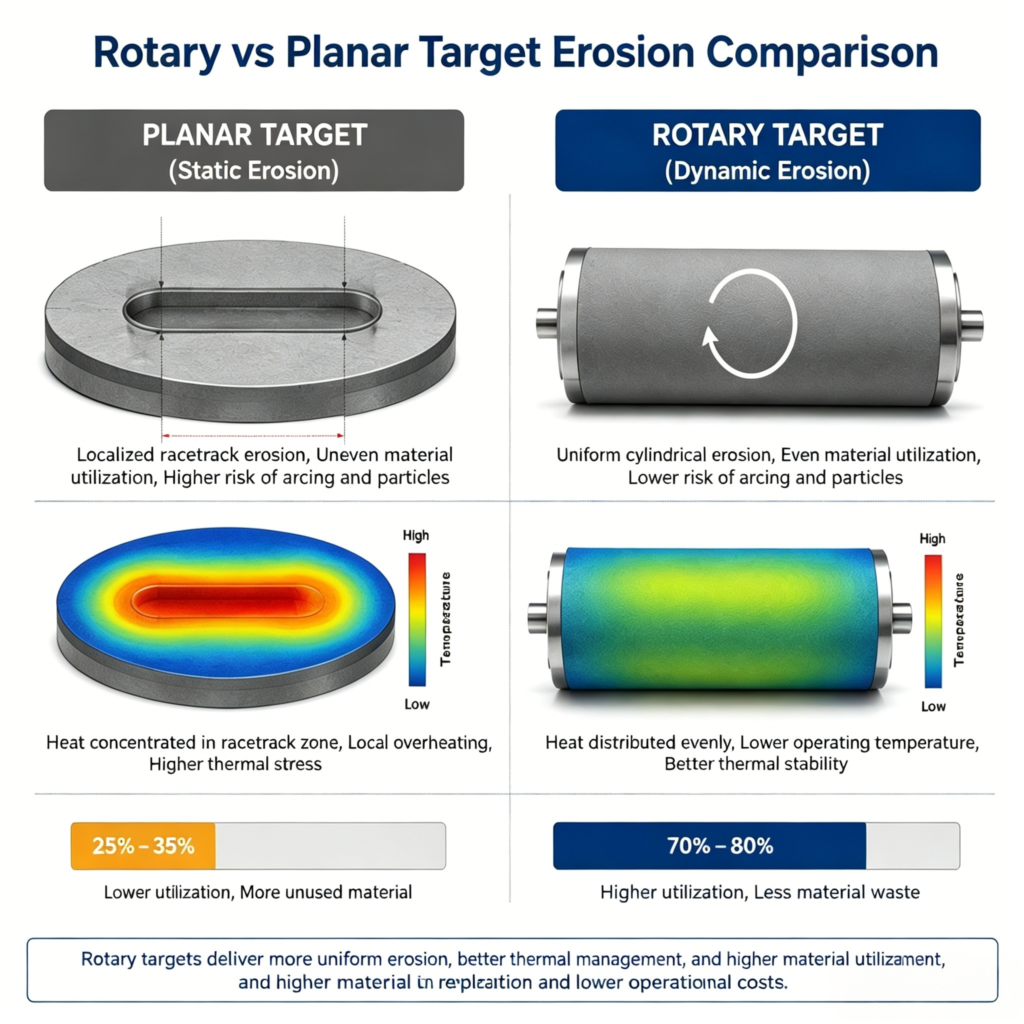
Planar targets naturally develop a deep erosion groove known as a racetrack. As sputtering continues, thermal energy becomes increasingly concentrated within this region. Over time, localized overheating can cause uneven erosion, nodule formation, plasma instability, and particle generation.
These issues become more severe when operating under high power conditions for extended production cycles.Rotary targets behave differently because the erosion zone constantly moves as the target rotates. Instead of concentrating thermal stress in one location, heat is distributed around the entire cylindrical surface. This improves thermal balance and helps stabilize plasma behavior throughout long deposition runs.
From an engineering perspective, the real advantage of rotary sputtering is not simply higher utilization. The larger benefit is production stability.Stable plasma conditions directly influence:
- Film thickness consistency
- Optical transmission
- Sheet resistance
- Defect density
- Production uptime
For high-volume manufacturers, stable production is often more valuable than the initial target cost itself.
The Real Economic Difference Between Rotary and Planar Targets
Many buyers initially compare targets only by purchase price. In reality, experienced coating engineers usually evaluate the total operational cost of the sputtering process.
ITO contains indium, which is a relatively expensive material. Because of this, target utilization becomes economically important.Traditional planar targets often achieve utilization rates around 25–35% because large portions of the material outside the racetrack remain unused. Rotary targets, by contrast, can often reach utilization rates above 70%.
This difference has a direct impact on:
- Raw material consumption
- Target replacement frequency
- Machine downtime
- Maintenance intervals
- Production continuity
In continuous production environments, replacing a target is not a simple material exchange. Shutdown procedures, vacuum recovery, chamber cleaning, and process recalibration all consume time and resources. When these indirect costs are included, the higher initial cost of rotary systems becomes much easier to justify.This is one reason why large OLED and solar coating lines increasingly rely on rotary cathode systems despite their higher equipment investment.
Why Density and Thermal Stability Define Film Performance?
In industrial sputtering production, target purity is often emphasized in marketing materials, but from a practical engineering perspective, density plays a more decisive role in both plasma stability and film quality.
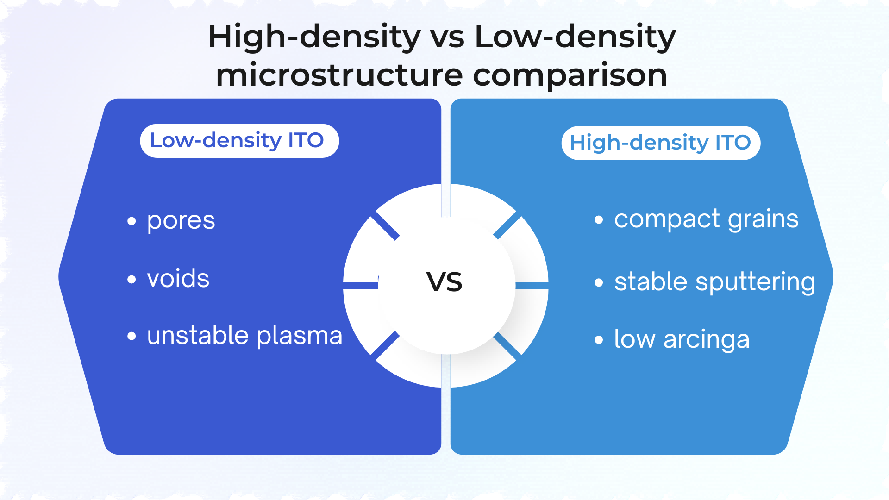
Low-density ceramic targets inherently contain pores and internal voids. Under plasma bombardment, these defects can trap gases and create localized electrical instability, which may eventually lead to arcing or particle generation. These issues are among the most critical factors affecting coating yield in transparent conductive oxide processes.
High-density ITO rotary targets reduce these risks by providing a more uniform and compact microstructure. In practical production systems, this stability directly improves plasma behavior, especially under high-power DC and pulsed-DC operating conditions where small instabilities tend to accumulate over long coating cycles.
At the same time, film uniformity is not only determined by the rotational motion of the target but also by thermal behavior during sputtering. In planar systems, heat tends to concentrate within the racetrack erosion zone, leading to uneven temperature distribution and gradual changes in deposition characteristics. In contrast, rotary targets distribute both erosion and thermal load more evenly across the cylindrical surface, helping maintain more stable operating conditions throughout the target lifetime.
This combined effect of structural density and improved thermal management leads to more consistent deposition performance, including better conductivity uniformity, optical stability, and surface quality. For large-area display and coating applications, even small improvements in stability can translate directly into higher production yield and reduced defect rates.
Are Planar Targets Still Relevant?
Despite the growing popularity of rotary systems, planar targets are not obsolete.
For smaller coating systems, R&D environments, and pilot-scale production, planar targets still offer several practical advantages. The equipment cost is lower, installation is simpler, and maintenance procedures are more straightforward.
Universities and research laboratories often prefer planar systems because flexibility matters more than production efficiency.
In lower-volume production, the economic advantage of higher rotary utilization may not fully offset the additional system cost.
From a manufacturing perspective, the decision between rotary and planar technology depends heavily on production scale and process goals.
Rotary vs Planar Target Comparison
| Factor | Rotary Target | Planar Target |
|---|---|---|
|
Utilization Rate |
Typically 70–80% |
Usually 25–35% |
|
Erosion Pattern |
Uniform cylindrical erosion |
Localized racetrack erosion |
|
Heat Distribution |
More balanced |
Thermal concentration in racetrack |
|
Film Uniformity |
Better for large substrates |
Less stable over long cycles |
|
Arcing Risk |
Lower |
Higher |
|
Production Downtime |
Reduced |
More frequent replacement |
|
Best Application |
Continuous mass production |
R&D and smaller systems |
|
Initial Equipment Cost |
Higher |
Lower |
The table above summarizes the most important operational differences observed in industrial coating systems. In practice, the performance gap becomes increasingly visible as production volume and substrate size increase.
Applications of ITO Rotary Targets
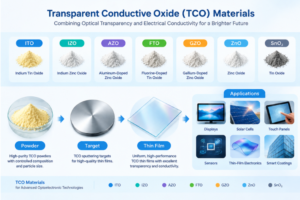
OLED & LCD Displays:ITO rotary targets are widely used for transparent conductive film deposition in OLED and LCD manufacturing, where stable conductivity and uniform optical transmission are critical for display performance.
Touch Panels & Smart Devices:In touch screen production, ITO coatings function as transparent electrodes, requiring low resistivity and highly uniform thin films across large substrates.
Low-E Architectural Glass:Large-area inline glass coaters use ITO rotary targets to deposit transparent conductive layers that improve thermal insulation and energy-saving performance in modern buildings.
Thin-Film Solar Cells:ITO rotary sputtering targets are used in photovoltaic coating systems to create transparent conductive oxide layers with stable conductivity and high light transmission.
Smart Glass & Electrochromic Coatings:ITO coatings are commonly applied in smart window technologies where electrically controlled transparency and optical stability are required.
Semiconductor & Precision Electronics:High-density ITO rotary targets are also used in semiconductor-related coating processes that require stable plasma behavior, low particle generation, and precise thin-film control.
Optical & Functional Coatings:ITO conductive films are used in anti-static coatings, optical filters, EMI shielding layers, and other advanced functional thin-film applications requiring transparent conductivity.
ITO Rotary Target Procurement Guide
For industrial coating applications, selecting an ITO Rotary Target is not only a specification evaluation process, but also a technical collaboration between customer requirements and supplier capability. To ensure stable performance and long-term reliability, both parties should exchange structured technical information before final confirmation.
1. Application (Customer Required)
Customers should clearly define the final application scenario (OLED, LCD, touch panel, Low-E glass, photovoltaic, or R&D) and provide coating system conditions such as power level, substrate size, and operating environment to ensure correct material selection.
2. System Compatibility Information (Customer to Supplier)
Customers are required to provide detailed equipment specifications, including cathode model, target dimensions, backing tube structure, and cooling system requirements to ensure full mechanical and operational compatibility.
3. Material Structure Evaluation (Supplier Provided)
We provide detailed material data including density (>99%), microstructure uniformity, and grain analysis reports to ensure stable plasma performance and low defect generation during sputtering.
4. Electrical Performance Data (Supplier Provided)
We supply resistivity test results and distribution consistency data to confirm stable plasma discharge behavior and ensure uniform film performance during production.
5. Bonding & Thermal Reliability Data (Supplier Provided)
We provide bonding strength reports and thermal cycling test results to verify ceramic-to-tube stability under long-term continuous operation.
6. Quality & Process Documentation (Supplier Provided)
We provide full technical documentation including density reports, resistivity measurements, SEM microstructure images, grain size analysis, composition certificates, and thermal stability test data.
7. Supplier Capability Assessment (Mutual Evaluation)
Both sides evaluate production capability, batch consistency, customization ability, and supply reliability to ensure stable long-term cooperation in large-scale manufacturing environments.
Final Collaboration Principle
In industrial procurement, the focus is not only on initial cost but on long-term process stability. Customers should provide accurate application and system data, while we ensure full material transparency and technical documentation to support stable, high-yield coating production.
FAQs About ITO Rotary Targets
Q1:What is an ITO rotary target used for?
A1:An ITO Rotary Target is mainly used for depositing transparent conductive thin films in applications such as LCD displays, OLED panels, touch screens, solar cells, smart glass, and Low-E architectural glass coatings.
Q2:Why are rotary sputtering targets more efficient than planar targets?
A2:Rotary targets rotate continuously during sputtering, allowing more uniform erosion across the target surface. This improves target utilization, reduces localized overheating, and extends operating lifetime compared with planar targets.
Q3:Why is high density important for ITO rotary targets?
A3:High-density ceramic structures contain fewer pores and internal defects, which improves plasma stability and reduces particle contamination during sputtering. High density also helps improve film uniformity and target lifetime.
Q4:What is the standard composition of an ITO target?
A4:The most common industrial composition is approximately 90 wt.% indium oxide (In₂O₃) and 10 wt.% tin oxide (SnO₂), although customized ratios are also available for specific coating applications.
Q5:How long does an ITO rotary target last?
A5:Target lifetime depends on sputtering power, coating process, substrate size, and utilization rate. In continuous industrial production, rotary targets generally last significantly longer than planar targets due to more uniform erosion behavior.
Conclusion
From a manufacturing perspective, the shift from planar targets to ITO Rotary Targets is driven by the increasing demand for stable large-area coating production, higher utilization efficiency, and lower defect rates.
In actual industrial operation, target performance is not determined by geometry alone. Factors such as ceramic density, grain uniformity, resistivity stability, and bonding reliability all directly influence plasma behavior, coating consistency, and long-term production stability.
For high-volume applications such as OLED displays, photovoltaic glass, touch panels, and architectural coatings, stable sputtering performance is increasingly important as production lines become larger and operate continuously for longer periods.
As an inorganic sputtering material manufacturer, we believe that the future of ITO Rotary Target technology will continue to focus on higher density structures, improved thermal stability, lower particle generation, and better process consistency. Beyond supplying materials, manufacturers are expected to provide complete technical support, process understanding, and reliable production quality to help customers achieve stable and efficient coating performance in industrial-scale applications.