

Why Low Oxygen Matters in Chromium Rotary Targets
In modern magnetron sputtering, target stability directly affects coating quality and production efficiency. Excess oxygen inside chromium rotary targets can cause oxide inclusions, unstable plasma, and abnormal arcing during high-power sputtering.
Low oxygen chromium rotary targets are designed to reduce these issues by improving target purity and structural stability. Compared with conventional chromium rotary targets, they offer more stable discharge behavior, fewer particles, and better coating consistency in large-area vacuum deposition systems.
Chromium is widely used in architectural glass coating, decorative PVD, and optical films because of its hardness, corrosion resistance, and reliable adhesion performance. With a melting point of about 1907 °C and density near 7.15 g/cm³, chromium is well suited for demanding industrial sputtering applications.
Why Oxygen Control Matters in Chromium Rotary Targets?
During chromium target manufacturing, oxygen contamination can originate from:
- Raw chromium powder
- Atmosphere exposure
- Thermal processing
- Improper storage conditions
- Incomplete vacuum control
When oxygen reacts with chromium, chromium oxide phases may form inside the target material. These oxide inclusions can negatively affect sputtering performance in several ways.
In practical coating operations, excessive oxygen content may cause:
- Increased arcing frequency
- Plasma instability
- Particle generation
- Non-uniform erosion
- Local overheating
- Film defects
- Reduced target utilization efficiency
For large-area coating systems operating continuously over long production cycles, these problems can significantly reduce process stability and coating yield.
Low oxygen chromium rotary targets are therefore preferred in high-throughput industrial sputtering because they help maintain stable discharge conditions under high power density operation.
Dense Structure Improves Rotary Target Performance
Besides oxygen level, density is another critical factor influencing chromium sputtering behavior.
A dense chromium rotary target typically provides:
- Lower porosity
- Improved thermal conductivity
- Better mechanical integrity
- More uniform erosion patterns
- Reduced crack propagation risk
Porosity inside the target body can trap residual gases and create localized thermal stress during sputtering. Under high-power conditions, these weak regions may contribute to arc formation or unstable erosion tracks.
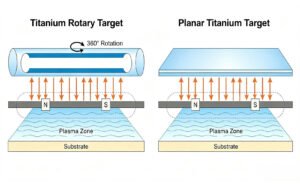
Rotary targets already offer significantly higher material utilization compared with conventional planar targets. Industry technical sources indicate that rotary sputtering targets can achieve utilization rates approaching 80%, while planar targets often remain closer to 30–40% utilization depending on process conditions.
For industrial coating manufacturers, higher utilization means:
- Lower downtime
- Reduced target replacement frequency
- Better production efficiency
- Lower coating cost per square meter
These advantages are one reason chromium rotary targets are increasingly used in:
- Architectural glass coating
- Roll-to-roll vacuum coating
- Decorative PVD systems
- Optical film deposition
- Flexible electronics manufacturing
Chromium Rotary Target Manufacturing
The manufacturing process directly influences oxygen content, density, grain structure, and sputtering stability. Currently, two primary production technologies are commonly used for chromium rotary targets.
1. Powder Metallurgy Chromium Rotary Targets
Powder metallurgy (PM) is one of the most common production methods for chromium tube targets.
Typical PM manufacturing process:
- Chromium powder preparation
- Powder purification
- Cold isostatic pressing (CIP)
- Vacuum sintering or hot isostatic pressing (HIP)
- Precision machining
- Rotary tube bonding
Advantages of Powder Metallurgy Processing
Powder metallurgy offers several manufacturing benefits:
- Flexible target dimensions
- Good compositional control
- Fine grain structure
- Scalable production for large rotary targets
HIP processing can improve chromium target density and reduce internal voids, helping achieve more stable sputtering performance.
For large-area inline coating systems, PM technology is often preferred because it supports manufacturing of long chromium rotary targets with controlled dimensional accuracy.
Oxygen Challenges in PM Chromium Targets
Despite its advantages, powder metallurgy also introduces oxygen control challenges.
Chromium powder has relatively high surface activity and can absorb oxygen during:
- Powder transportation
- Storage
- Mixing
- Sintering processes
If oxygen is not carefully controlled, oxide inclusions may remain trapped inside the final target body. These inclusions can become discharge initiation points during magnetron sputtering.
To produce a true low oxygen chromium rotary target, advanced PM manufacturing usually requires:
- High-purity chromium feedstock
- Vacuum processing environments
- Low dew point atmosphere control
- Controlled thermal cycles
- Optimized HIP parameters
The quality of oxygen control often determines whether the target performs reliably in high-power sputtering applications.

2. Vacuum Melted and Forged Chromium Rotary Targets
Another manufacturing route uses vacuum melting followed by deformation processing such as forging or rolling.
Typical process flow:
- Vacuum induction melting (VIM) or electron beam melting
- Chromium ingot casting
- Forging or rolling
- Heat treatment
- Rotary target machining
- Bonding assembly
Advantages of Vacuum Melted Chromium Targets
Compared with powder metallurgy, vacuum melted chromium targets can provide:
- Lower oxygen levels
- Better metallurgical cleanliness
- Reduced oxide inclusions
- Improved electrical conductivity
- Enhanced thermal continuity
Because the process starts from molten chromium rather than powder particles, oxygen pickup can often be reduced under properly controlled vacuum conditions.
Forged chromium structures may also provide:
- Better grain continuity
- Improved mechanical strength
- Reduced crack sensitivity
- Better resistance to thermal cycling
These characteristics are especially beneficial in high-power sputtering systems operating continuously for long production campaigns.
Manufacturing Challenges of Melted Chromium Targets
Chromium itself is difficult to process because of:
- High melting temperature
- Brittle behavior at room temperature
- Difficult deformation characteristics
Large-size forged chromium tubes are therefore technically demanding and more expensive to manufacture compared with standard PM targets.
As a result, vacuum melted chromium rotary targets are often selected for:
- High-end optical coatings
- Premium architectural glass lines
- Demanding industrial sputtering systems
- Applications requiring extremely stable plasma behavior
Applications of Low Oxygen Chromium Rotary Targets
Architectural Glass Coating:Used in Low-E glass production for adhesion layers, functional interlayers, and protective coatings. Helps reduce arc defects and improve coating stability.
Decorative PVD Coating:Suitable for metal appearance films, wear-resistant coatings, and automotive trim applications with stable surface quality.
Optical Film Deposition:Provides stable deposition rates, low particle generation, and uniform thin film thickness for optical coatings.
Industrial Vacuum Coating:Widely used in large-area inline sputtering and continuous roll-to-roll vacuum coating systems.
Key Practical Performance Indicators for Sputtering Targets
In real industrial applications, usually focus less on marketing purity numbers and more on operational stability.
Key parameters often include:
- Oxygen content consistency
- Density uniformity
- Arc suppression behavior
- Bonding reliability
- Thermal conductivity
- Erosion uniformity
- Mechanical stability
- Long campaign sputtering performance
For high-throughput coating manufacturers, stable operation and reduced downtime are often more valuable than simply achieving extremely high nominal purity values.

Procurement Guide for Chromium Rotary Targets
As a professional chromium rotary target manufacturer, we understand procurement teams prioritize supply stability, sputtering system compatibility and long-term cost efficiency over trivial material theories. We focus on delivering targets that support easy installation, stable running and consistent service life in mass production.
1. Key Procurement Requirements We Fully Meet
Dimensional accuracy: We strictly customize length, outer diameter, wall thickness and flange interface to perfectly fit your existing cathode system.
Reliable bonding: Our mature bonding technology ensures tight combination between chromium tube and backing tube, no delamination during long-term rotation and thermal cycling.
Batch stability: We maintain unified production standards to keep consistent dimension and sputtering performance across all batches.
Predictable service life: Controlled microstructure ensures stable erosion, convenient for your production plan arrangement.
Superior surface quality: Finished targets are clean, defect-free and well-treated for smooth ignition and stable startup.
Secure packaging & shipping: We adopt professional anti-deformation, anti-pollution packaging to avoid bending, surface damage and contamination in transit.
2. Supply Chain Risks We Help You Avoid
As a reliable manufacturer, we eliminate common industry risks: long lead time, unstable batch bonding quality, dimensional deviation, surface oxidation and incomplete inspection documents. With stable production capacity and strict full-process quality control, we guarantee consistent quality for repeat orders.
3. Complete Quality Assurance & Documents
We support industrial incoming inspection by providing full official documents:
COA certificate, dimensional inspection report, surface quality test record, bonding integrity verification and material traceability files. Standardized paperwork simplifies your inspection process and avoids production downtime caused by quality uncertainty.
4. Pre-Order Compatibility Support
Our technical team evaluates your on-site sputtering cathode model, target length demand, production mode and coating stability requirements in advance. We customize solutions to make our chromium rotary targets directly compatible with your production line without secondary modification.
5. Economic & Long-Term Value
We focus on your comprehensive production cost rather than simple unit price. Our chromium rotary targets feature high material utilization, low replacement frequency and reduced downtime loss. Stable long-term supply effectively cuts unplanned maintenance and improves overall coating line productivity.
6. Manufacturer Commitment
We believe qualified chromium rotary targets should achieve perfect equipment matching, stable batch supply, predictable service life and low operational risk. As a professional manufacturer, we insist quality consistency and supply reliability to create long-term stable procurement value for industrial customers.
Conclusion
Chromium rotary target improve plasma stability, reduce oxide-related arcing, and enhance long-term sputtering consistency in industrial vacuum coating systems. Compared with conventional chromium tube targets, low oxygen dense structures offer significant advantages in high-power deposition environments where stable coating quality and production efficiency are critical.
Both powder metallurgy and vacuum melted forging routes are commercially important, but each process affects oxygen content, density, grain structure, and sputtering behavior differently. Understanding these manufacturing differences is essential when selecting chromium rotary targets for demanding thin-film deposition applications.
As industrial sputtering systems continue moving toward larger substrates, longer production cycles, and higher power density, low oxygen chromium rotary targets will remain an important solution for advanced thin-film manufacturing.