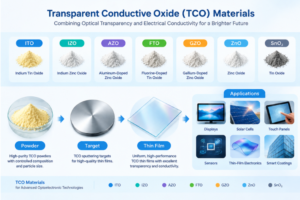

The TCO manufacturing process involves several connected stages, from raw material preparation and ceramic sputtering target fabrication to thin-film deposition and final film characterization. Transparent conductive oxides (TCOs), including indium tin oxide (ITO), aluminum-doped zinc oxide (AZO), zinc oxide (ZnO), and indium gallium zinc oxide (IGZO), are used in applications that require a combination of optical transparency and electrical functionality.
Although these materials share some processing principles, their manufacturing requirements are not identical. Composition, powder characteristics, target microstructure, deposition conditions, and post-deposition treatment can all influence the final result. Understanding how these stages interact is essential when selecting TCO materials and evaluating process quality.
Overview of the TCO Manufacturing Process
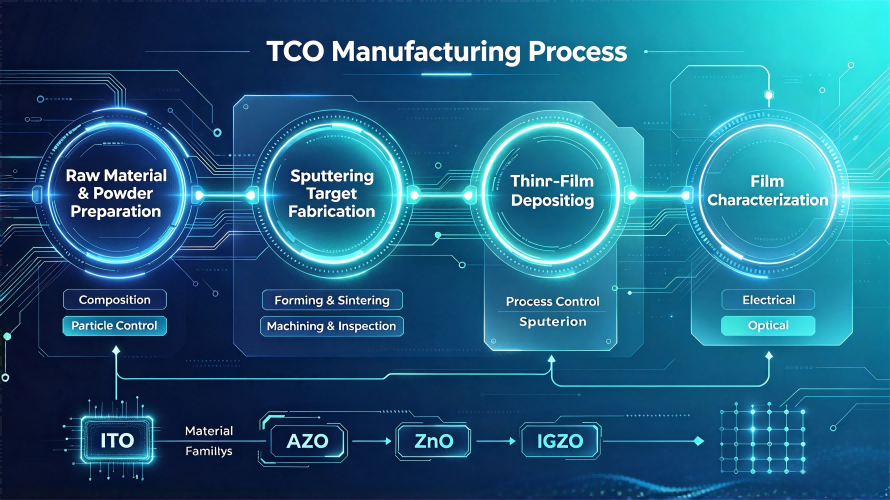
A typical ceramic TCO manufacturing route can be divided into four main stages:
Raw material and powder preparation: Select and characterize the starting materials, then control mixing, particle distribution, and powder homogeneity.
Sputtering target fabrication: Form and densify the ceramic body, followed by machining and inspection where required.
Thin-film deposition: Deposit the TCO material onto a substrate using sputtering or another suitable deposition technique.
Film characterization: Evaluate electrical, optical, structural, and thickness-related properties against the requirements of the intended application.
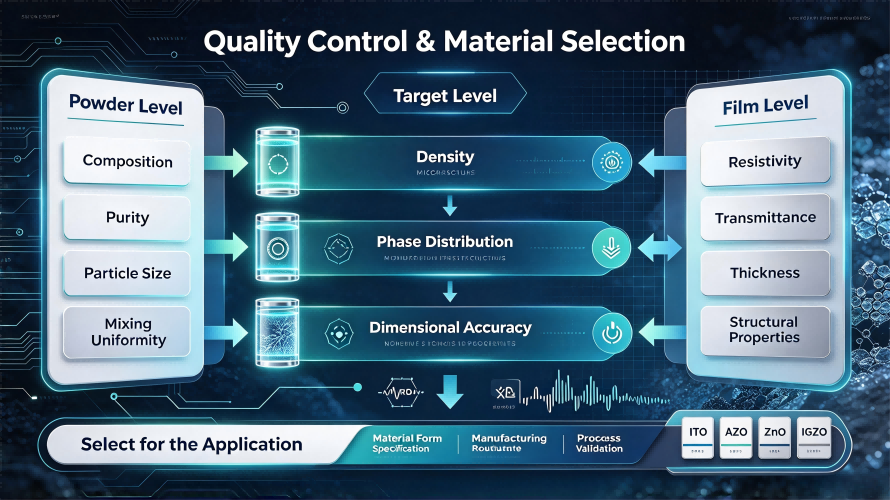
These stages are closely connected, but they should not be treated as interchangeable quality checks. A powder that meets its chemical specification does not automatically produce a high-density target, and a target that meets its density specification does not guarantee a film with the required resistivity or optical transmittance.For this reason, TCO manufacturing quality should be assessed at both the material and film levels.
Raw Material Preparation and Powder Processing
Powder preparation establishes the chemical and physical conditions for subsequent target fabrication. The main considerations include composition, purity, particle-size distribution, morphology, agglomeration, and mixing uniformity.
Composition and purity:The starting composition must be appropriate for the intended TCO material and application. For example, ITO is based on indium oxide and tin oxide, while AZO is based on zinc oxide with an aluminum-containing dopant. IGZO contains indium, gallium, and zinc oxides in a controlled composition.Chemical purity is important because unwanted impurities may affect phase formation, electrical behavior, or process consistency. However, a high nominal purity value alone does not fully describe material quality. The relevant impurity limits and analytical methods should be considered alongside composition and physical characteristics.
Particle size and morphology: Particle size can influence powder packing, mixing behavior, forming, and densification. Fine powders may offer a high surface area, but they can also agglomerate and become more difficult to disperse uniformly. Larger particles or broad particle-size distributions may affect packing density and the uniformity of the formed body.The appropriate powder characteristics depend on the manufacturing route. Powder intended for ceramic target production should therefore be evaluated against the forming and sintering process rather than selected on particle size alone.
Mixing and homogenization: Mixing is used to distribute the constituent oxides and dopants throughout the powder batch. Inadequate homogenization can produce local compositional variations, while excessive or unsuitable milling may introduce contamination or alter the powder characteristics.The mixing method, milling media, processing time, and contamination controls should be selected according to the material system. Where composition uniformity is critical, representative sampling and suitable chemical or structural characterization can help verify batch consistency.
Powder quality is the starting point for reliable target production, but the final ceramic properties also depend on forming, sintering, and subsequent processing.
Ceramic TCO Sputtering Target Fabrication
Ceramic sputtering target fabrication converts prepared powder into a body suitable for deposition. The main operations generally include powder conditioning, forming, sintering, finishing, and inspection.
Forming and densification: Depending on the target design and material system, forming may involve uniaxial pressing, cold isostatic pressing, or another suitable shaping method. The purpose is to produce a compact with sufficient integrity and a suitable density distribution before sintering. Sintering promotes bonding between particles and increases ceramic density. The temperature profile, atmosphere, holding time, and starting powder characteristics must be matched to the composition. Inappropriate processing can leave excessive porosity, cause grain or phase nonuniformity, or result in dimensional problems. Density is an important target specification, but it should be evaluated alongside other properties. Open porosity, phase distribution, mechanical integrity, and compositional uniformity can also matter for target performance.
Machining, bonding, and dimensional inspection: After densification, targets may require machining to meet specified dimensions, surface finish, and geometric tolerances. Depending on the target format and equipment, the ceramic may be bonded to a backing plate or prepared for a rotary target assembly.The appropriate inspection criteria depend on the target design and application. Dimensional accuracy, surface condition, bonding integrity where applicable, and the consistency of the ceramic body should be checked against the relevant specification.
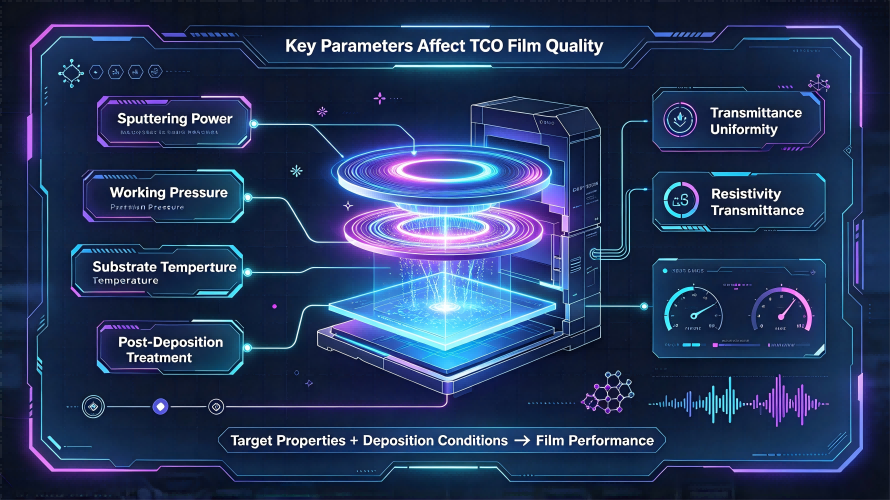
Why target quality affects thin-film performance:Target quality affects more than the mechanical integrity of a sputtering source. Density, open porosity, phase distribution, and compositional uniformity can influence discharge stability, erosion behavior, and the consistency of material transfer during deposition.However, target properties alone do not determine final film performance. Substrate temperature, oxygen partial pressure, sputtering power, working pressure, and post-deposition treatment can also change carrier concentration, resistivity, and optical transmittance. For this reason, TCO manufacturing quality should be evaluated at both the target and thin-film stages.
For material-specific considerations, see the relevant: ITO Materials, AZO Materials , and IGZO sputtering target on the ULPMAT website.
TCO Thin-Film Deposition Methods
TCO materials can be deposited using several techniques, including magnetron sputtering, pulsed laser deposition, chemical vapor deposition, and other methods suited to particular material systems and applications.
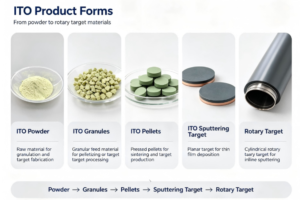
Magnetron sputtering is widely used for TCO thin films because it supports controlled deposition and can be adapted to different substrate sizes and production requirements. Ceramic planar targets and rotary target systems may be used depending on the equipment configuration and manufacturing objectives.
Magnetron sputtering
During sputtering, energetic ions bombard the target, releasing material that travels toward and deposits on the substrate. The film develops through the arrival, diffusion, and incorporation of deposited species, with the resulting microstructure depending on the process conditions.
Reactive sputtering may involve oxygen or another reactive gas to control film composition. This approach requires careful process control because changes in gas conditions can affect target-surface chemistry, deposition behavior, and film properties.
Industrial deposition from rotatable targets presents additional process-control challenges. In reactive magnetron sputtering, both global and local operating conditions must be controlled, and ITO and ZnO (AZO) systems may require different control strategies. Process settings developed for one TCO material should therefore not be transferred directly to another without validation.
Other deposition methods
Alternative deposition techniques may be suitable where specific requirements for substrate compatibility, film structure, equipment configuration, or research-scale flexibility take priority. The appropriate method depends on the material, substrate, desired film properties, and production environment.
The choice of deposition method should therefore be made in the context of the complete manufacturing process rather than from the material name alone.
Processing Parameters Affecting TCO Film Quality
The electrical and optical performance of a TCO film depends on several interacting variables. No single parameter reliably predicts the final result across all materials and deposition systems.
| Process parameter | Potential influence on the film | Important consideration |
| Sputtering power | Deposition rate, energetic-particle effects, and film growth | Excessive energy input may affect film stress or damage sensitive substrates |
| Working pressure | Gas-phase collisions and the energy of arriving species | The appropriate pressure depends on equipment geometry and material system |
| Oxygen partial pressure | Film stoichiometry, defect chemistry, and carrier concentration | The response varies between TCO compositions and deposition conditions |
| Substrate temperature | Surface diffusion, crystallinity, and microstructure | Temperature limits depend on the substrate and process |
| Target composition and microstructure | Material transfer and compositional consistency | A target specification must be assessed together with the deposition process |
| Post-deposition treatment | Defect populations, crystallinity, and electrical properties | The benefit depends on the material and treatment atmosphere |
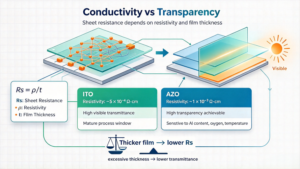
For many TCO systems, electrical conductivity and optical transparency must be balanced rather than optimized independently. Increasing carrier concentration may improve conductivity under certain conditions, but it can also increase optical absorption or affect other film properties. The final performance depends on the material composition, defect structure, film thickness, and deposition conditions.
A stable manufacturing process requires careful control of sputtering conditions and sufficient consistency across the deposited film. The practical objective is to achieve the required electrical conductivity, optical transmittance, thickness uniformity, and substrate compatibility without compromising overall film quality.
Quality Control from Powder to Finished Film
Quality control should distinguish among powder properties, target properties, and deposited-film performance. Each stage requires measurements suited to the question being investigated.
| Product stage | Typical characterization methods | Main purpose |
| TCO powder | ICP or GDMS for relevant impurities; particle size analysis; XRD where appropriate | Verify composition, purity, particle characteristics, and phase composition |
| Ceramic sputtering target | Density measurement, XRD, SEM, dimensional and surface inspection | Evaluate densification, structure, dimensions, and defects |
| Bonded target assembly | Dimensional checks and suitable bonding-integrity inspection | Verify assembly quality and compatibility with the intended system |
| Deposited TCO film | Four-point probe, UV–Vis spectroscopy, thickness measurement, XRD where relevant | Evaluate electrical, optical, dimensional, and structural properties |
GDMS and ICP-based techniques are used for impurity analysis, while X-ray diffraction (XRD) helps identify crystalline phases. Scanning electron microscopy (SEM) can reveal microstructural features such as pores and grain boundaries. Four-point probe measurements and UV–Vis spectroscopy are commonly used to evaluate film electrical and optical properties, respectively.These methods are complementary rather than interchangeable. A high-purity powder does not automatically produce a dense ceramic target, and a dense target does not guarantee a film with a particular resistivity or transmittance.
For industrial coating applications, thickness and uniformity also matter. A film may show acceptable local electrical properties but still fail application requirements if its properties vary significantly across the substrate.
Common TCO Processing Problems
Several recurring problems can affect TCO material consistency and coating performance.
Nonuniform composition: Uneven mixing, agglomeration, or variations in raw material composition may produce local differences in the ceramic body. Reviewing powder preparation and compositional analysis can help identify the cause.
Low target density or residual porosity: Inadequate powder packing or unsuitable sintering conditions may leave pores or density gradients. Their effect on sputtering depends on the size, distribution, and location of the defects.
Target cracking: Forming defects, machining damage, bonding conditions, and operating temperature gradients may contribute to cracking. The cause should be investigated at the relevant manufacturing or operating stage.
Unstable sputtering: Target surface conditions, system configuration, reactive gas control, and process parameters may contribute to discharge instability or changes in deposition behavior. Target density should not be assumed to be the cause without supporting evidence.
High film resistivity: Possible contributors include film composition, oxygen conditions, carrier concentration, microstructure, thickness, and post-treatment. Target properties are one part of the investigation.
Low optical transmittance or poor uniformity: Film thickness, absorption, reflection, surface morphology, deposition geometry, and process stability can all affect the result. Measurements are needed to distinguish among these factors.
A systematic troubleshooting approach starts by identifying the stage at which the variation occurs, then using appropriate measurements to verify the suspected cause.
Selecting TCO Materials for Manufacturing Applications
Material selection should begin with the intended process and the requirements of the final product.
For powder processing, relevant specifications include chemical purity, composition, particle size, and mixing requirements. For ceramic target fabrication, powder characteristics must also support forming and densification. For sputtering, target composition, dimensions, density, backing-plate requirements, and equipment compatibility may need to be confirmed.
The desired film properties should guide these decisions. Electrical resistivity, optical transmittance, film thickness, substrate temperature, and coating uniformity may impose different requirements on the material and process.
ULPMAT supplies selected inorganic materials in powder, granule, and sputtering target forms. Relevant TCO product families include ITO, AZO, ZnO, IZO, and IGZO, subject to the available form and specification of each product.
When selecting a material, buyers should confirm the required composition, purity, particle size or target dimensions, and intended processing method. Custom dimensions and target assembly requirements should be discussed separately where applicable.
Matching the material form and specifications to the intended manufacturing route provides a practical starting point for process development.
Conclusion
he TCO manufacturing process involves more than selecting an oxide composition. Powder characteristics, forming and sintering conditions, target quality, deposition parameters, and post-treatment all contribute to the consistency and performance of the final material or coating.
For material developers and coating manufacturers, understanding these relationships helps distinguish problems originating in the powder or target from those caused by deposition conditions. For buyers, confirming composition, purity, product form, dimensions, and intended processing requirements provides a more reliable basis for material selection.
ULPMAT supplies selected TCO-related inorganic materials for research and industrial material applications. Confirming the required specifications at the beginning of a project helps establish whether a particular powder, granule, or sputtering target is suitable for the intended manufacturing route.
FAQs
The TCO manufacturing process converts selected oxide raw materials into functional transparent conductive thin films through powder preparation, ceramic sputtering target fabrication, thin-film deposition, and performance characterization. Each stage influences the final film’s electrical conductivity, optical transmittance, thickness uniformity, and structural properties.
Common transparent conductive oxide (TCO) materials include indium tin oxide (ITO), aluminum-doped zinc oxide (AZO), indium zinc oxide (IZO), zinc oxide (ZnO), and indium gallium zinc oxide (IGZO). Material selection depends on the required electrical and optical properties, deposition method, substrate compatibility, and cost considerations. The appropriate choice also depends on the intended application and manufacturing requirements.
Powder purity, particle size distribution, morphology, and agglomeration can affect powder mixing, forming behavior, and sintering. These characteristics influence the density, porosity, microstructure, and compositional uniformity of the finished ceramic target. Consistent powder properties help manufacturers control target quality and reduce variation during subsequent deposition, although the final film properties also depend on sputtering conditions and substrate characteristics.
Ceramic TCO sputtering targets are typically manufactured through raw-material batching, powder mixing, forming or compaction, sintering, machining, and quality inspection. The specific process depends on the material composition, target geometry, and required specifications. Key quality-control parameters include density, phase composition, dimensions, surface condition, and mechanical integrity.
Key parameters in TCO thin-film deposition include sputtering power, working pressure, oxygen partial pressure, substrate temperature, deposition time, and target composition. Their effects vary with the material and deposition system. For example, oxygen conditions can influence defect chemistry and carrier concentration, while substrate temperature can affect film growth and crystallinity. Process windows established for one TCO material should not be transferred directly to another without validation.
Sputtering target density, porosity, phase distribution, compositional uniformity, and surface condition can affect erosion behavior, deposition stability, and film-to-film consistency. However, target quality alone does not determine the final film properties. Sputtering power, gas pressure, oxygen partial pressure, substrate temperature, film thickness, and post-deposition treatment can also influence electrical conductivity, optical transmittance, and structural characteristics.
TCO thin films are commonly evaluated through electrical, optical, structural, and thickness measurements. Sheet resistance is measured to assess electrical performance, while resistivity can be determined when film thickness is known. UV–Vis spectroscopy is used to measure optical transmittance, X-ray diffraction (XRD) helps identify crystalline phases and preferred orientation, and thickness measurements assess coating uniformity. The appropriate combination of tests depends on the material and application requirements.
Manufacturers can improve TCO production consistency by controlling raw-material purity and particle size, maintaining reproducible powder processing, verifying target composition and density, and monitoring deposition parameters. Film thickness, sheet resistance or resistivity, and optical transmittance should be measured using consistent procedures and compared across production batches. Recording process conditions alongside film-characterization results helps identify sources of variation and establish a repeatable process window for each TCO material and deposition system.
References
- 1. Patel, J., Sharme, R. K., Quijada, M. A., and Rana, M. M. “A Review of Transparent Conducting Films (TCFs): Prospective ITO and AZO Deposition Methods and Applications.” Nanomaterials, 14(24), Article 2013, 2024.
- 2. Stadler, A. “Transparent Conducting Oxides—An Up-to-Date Overview.” Materials, 5(4), 2012, pp. 661–683.
- 3. Linss, V. “Challenges in the Industrial Deposition of Transparent Conductive Oxide Materials by Reactive Magnetron Sputtering from Rotatable Targets.” Thin Solid Films, 634, 2017, pp. 149–154.
- 4. Ellmer, K., and Welzel, T. “Reactive Magnetron Sputtering of Transparent Conductive Oxide Thin Films: Role of Energetic Particle (Ion) Bombardment.” Journal of Materials Research, 27(5), 2012, pp. 765–779.
Related TCO Material Guides
Transparent Conductive Oxide (TCO) Materials: Applications, Materials and Selection Guide
Indium Tin Oxide Materials: Complete Guide from Powder to Sputtering Target
AZO Materials: Why Composition Alone Does Not Determine Thin-Film Performance
Understanding Zinc Oxide Materials: From ZnO Powder and Granules to Sputtering Target Production
What Is an Indium Zinc Oxide Rotatable Target? Applications, Advantages, and Sputtering Performance