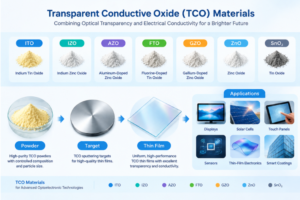

ITO Vs AZO is a practical comparison for engineers selecting a transparent conductive oxide (TCO) when a thin film must combine electrical conductivity with optical transparency. Indium tin oxide (ITO) and aluminum-doped zinc oxide (AZO) can both be deposited as transparent conductive films, including by sputtering, but they are not interchangeable in every application.
ITO generally offers lower electrical resistivity and a more established industrial processing window, while AZO provides an indium-free alternative based primarily on zinc oxide and aluminum. The practical choice depends on the required sheet resistance, optical transmittance, film thickness, substrate conditions, and deposition process.
For engineers selecting a TCO material or sputtering target, the key question is not simply whether ITO or AZO is “better.” It is which material can provide the required film performance under the intended process conditions.
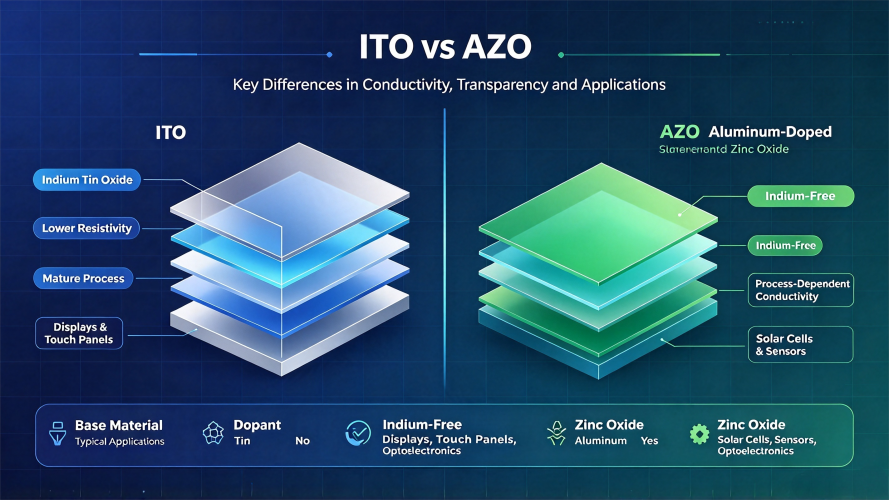
ITO vs AZO: Key Differences at a Glance
ITO is primarily based on indium oxide (In₂O₃) doped with tin, while AZO is based on zinc oxide (ZnO) doped with aluminum. Both are n-type transparent conductive oxides, but their carrier generation, defect chemistry, and processing behavior are different.
| Selection factor | ITO | AZO |
| Base material | Indium oxide | Zinc oxide |
| Typical dopant | Sn | Al |
| Indium dependence | Yes | No |
| Electrical performance | Generally lower resistivity | Good conductivity, but strongly process-dependent |
| Visible-light transparency | High | High |
| Process maturity | Highly established | Increasingly developed |
| Common deposition | Sputtering and other thin-film processes | Sputtering and other thin-film processes |
| Typical applications | Displays, touch panels, transparent electrodes, optoelectronics | Solar cells, transparent electrodes, sensors, optoelectronics |
| Main selection consideration | Electrical performance and established process | Indium-free chemistry and application requirements |
This table is a general comparison rather than a set of fixed material specifications. Actual film performance can vary with dopant concentration, target density, film thickness, substrate temperature, oxygen partial pressure, sputtering power, and other deposition parameters.
What Are ITO and AZO?
ITO
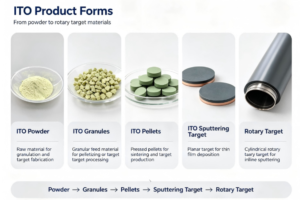
Indium tin oxide (ITO) is a widely used transparent conductive oxide based on indium oxide doped with tin oxide. A commonly used composition is approximately 90 wt% In₂O₃ and 10 wt% SnO₂, although commercial compositions can vary depending on the target specification and application.ITO combines relatively low electrical resistivity with high visible-light transparency. This combination has made it a standard material for transparent electrodes in displays, touch panels, photovoltaic devices, and other optoelectronic components.Its major advantage is not only its intrinsic electrical and optical performance but also the maturity of its industrial deposition and patterning processes.
AZO
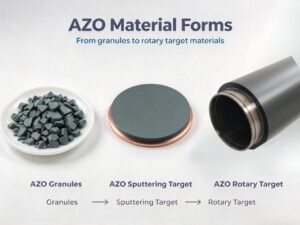
Aluminum-doped zinc oxide (AZO) is a transparent conductive oxide based primarily on ZnO with Al introduced as a dopant. Unlike ITO, AZO does not depend on indium.The electrical properties of AZO are strongly influenced by aluminum concentration, carrier concentration, carrier mobility, oxygen vacancies, crystallinity, film thickness, and deposition conditions. As a result, two AZO materials with similar nominal compositions can produce noticeably different thin-film properties.AZO is therefore best considered as an alternative TCO system with its own processing window rather than simply a lower-cost substitute for ITO.
ITO vs AZO: Electrical Conductivity and Optical Transparency
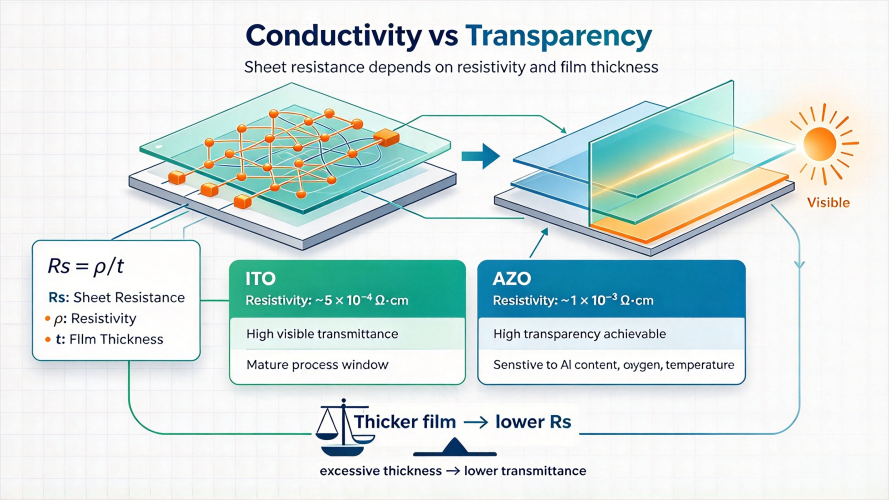
Electrical conductivity is one of the main differences between ITO and AZO. ITO generally achieves lower resistivity than AZO in many sputtered-film systems, which is one reason it remains widely used for displays, touch panels, and transparent electrodes.As a practical reference, sputtered ITO films can reach resistivity values around 5 × 10⁻⁴ Ω·cm, while AZO films can be around 1 × 10⁻³ Ω·cm under suitable deposition conditions. Both materials can provide high visible-light transmittance, but the final balance between conductivity and transparency depends strongly on film thickness and the deposition process.For practical applications, sheet resistance is often more useful than resistivity alone:
Rs = ρ / t
where Rs is sheet resistance, ρ is resistivity, and t is film thickness.
This is important when comparing ITO and AZO because film thickness affects both electrical and optical performance. A thicker film can reduce sheet resistance, but excessive thickness may reduce visible-light transmission. The target is therefore to achieve the required electrical performance while maintaining the optical transmission and thickness required by the application.
AZO can be particularly sensitive to processing conditions. Aluminum concentration, oxygen conditions, substrate temperature, film thickness, and crystal quality can all influence its conductivity. ITO is also process-dependent, but its long industrial history means that established ITO processes can often provide a more predictable performance window.
For material selection, the key question is not simply which material has lower resistivity. It is whether ITO or AZO can achieve the required sheet resistance and optical transmittance at the intended film thickness and deposition conditions.
ITO vs AZO for Sputtering and Film Deposition
Both ITO and AZO are widely used as sputtering materials, but the target itself is only one part of the deposition system.
For sputtered films, performance can depend on:
- target composition and dopant concentration
- target purity
- relative density and porosity
- grain structure and secondary phases
- sputtering power
- working pressure
- oxygen partial pressure
- substrate temperature
- target-to-substrate distance
- deposition rate
- final film thickness
This is particularly important when comparing AZO materials. Aluminum concentration alone does not determine the final film properties.
For example, increasing the Al content can change the formation of secondary phases and affect densification and electrical behavior. A target with the same nominal Al concentration as another supplier’s target does not necessarily guarantee the same sputtered-film performance.
Target density and microstructure can also affect sputtering stability. Higher-density targets generally contain less open porosity and may provide more consistent erosion behavior, while differences in grain structure or secondary phases can influence the deposition process and resulting film.
Sputtering conditions also need to be optimized for the specific material system. Oxygen partial pressure, substrate temperature, sputtering power, and film thickness can significantly change carrier concentration, mobility, crystallinity, and optical properties.
For this reason, an ITO or AZO target should be evaluated as part of a material–target–process system, rather than as a chemical formula alone.
How to Compare ITO and AZO Sputtering Targets
When selecting a sputtering target, comparing only the nominal dopant concentration is insufficient.
| Factor | What to Check |
| Purity | Chemical purity and impurity control |
| Composition | Sn or Al concentration |
| Density | Relative density and porosity |
| Microstructure | Grain structure and secondary phases |
| Dimensions | Target size, thickness, and tolerance |
| Bonding | Backing plate and bonding configuration |
| Film data | Representative resistivity and transmittance |
A supplier comparison is more meaningful when it includes both target specifications and representative sputtered-film data, particularly when the application has defined electrical and optical requirements.
This specification-based approach is also relevant when evaluating high-purity inorganic materials and sputtering targets from technical suppliers such as ULPMAT.
Which Applications Use ITO or AZO?
ITO remains particularly important in applications where low electrical resistance, high transparency, and a mature manufacturing process are critical. Typical examples include:
- display electrodes
- touch panels
- transparent electronic components
- photovoltaic devices
- optoelectronic components
AZO is attractive where an indium-free TCO is desirable and the required electrical and optical performance can be achieved within the available process window. Common areas of interest include:
- thin-film solar cells
- transparent electrodes
- Sensors
- Optoelectronics
- transparent electronic devices
The application itself does not automatically determine the material choice. Substrate compatibility, required sheet resistance, optical transmission, deposition temperature, target geometry, and process stability can all affect the decision.
Can AZO Replace ITO?
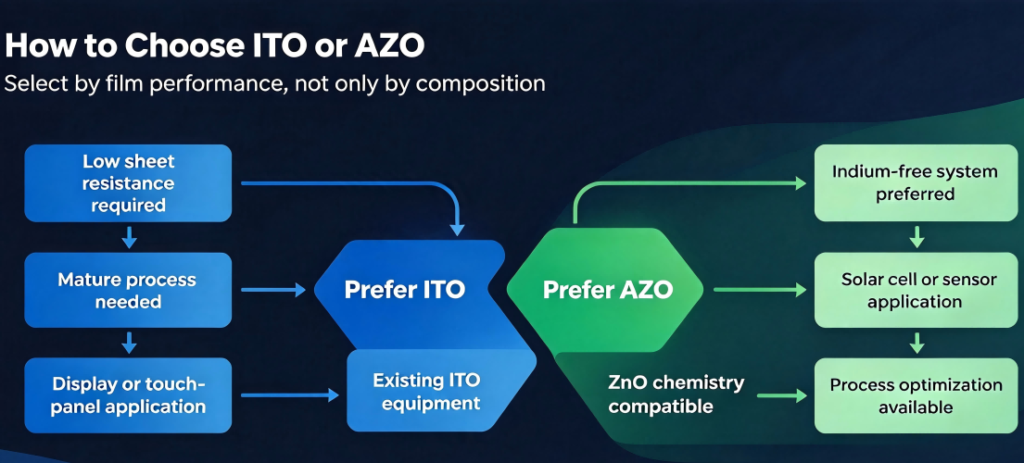
AZO can replace ITO in some applications, but it is not a universal drop-in replacement.
AZO becomes more attractive when avoiding indium is an important material consideration and when the required film performance can be achieved with a ZnO-based system.
ITO may remain the better choice when:
- very low sheet resistance is required
- a mature and well-established process is important
- existing equipment and process recipes are already optimized for ITO
- the application has tight electrical and optical specifications
AZO may be a stronger candidate when:
- an indium-free material is preferred
- ZnO-based chemistry is compatible with the device
- the required conductivity and transparency are achievable
- the deposition process can be optimized for AZO
The correct comparison should therefore be based on film performance under the intended deposition conditions, rather than material composition alone.
How to Choose Between ITO and AZO
The choice between ITO and AZO should be based on the requirements of the finished film, not on the nominal material composition alone. In practice, engineers usually need to balance electrical performance, optical transmission, process stability, material availability, and the amount of process development required.
| Engineering priority | ITO | AZO |
|---|---|---|
|
Low resistivity / sheet resistance |
Generally the stronger starting point when low electrical resistance is critical |
Can provide good conductivity, but performance is more sensitive to composition and deposition conditions |
|
Optical transmission |
High visible-light transmission is well established in optimized films |
High transparency is achievable, but thickness, carrier concentration, and film quality strongly affect the result |
|
Process maturity |
Long-established sputtering processes and broad industrial experience |
Well established for many applications, but the process window may require more application-specific optimization |
|
Indium dependence |
Requires indium-containing material |
Indium-free system based primarily on ZnO and Al |
|
Existing sputtering process |
Advantage when equipment and process parameters are already qualified for ITO |
May require adjustment of power, oxygen conditions, substrate temperature, and other parameters |
|
Tight electrical and optical specifications |
Often preferred when a mature and predictable process is required |
Suitable when the required performance can be demonstrated within the AZO process window |
|
Material supply considerations |
Performance must be balanced against dependence on indium-containing materials |
Attractive when an indium-free material system is preferred |
|
Process development effort |
Lower when an established ITO recipe is already available |
May require additional optimization to balance conductivity, transparency, and deposition stability |
|
Target selection |
Purity, density, composition, dimensions, bonding, and microstructure remain important |
The same factors are important, with additional attention to Al concentration and possible secondary phases |
|
Best fit |
Applications prioritizing mature processing and strong electrical performance |
Applications where an indium-free TCO can meet the required film specifications |
This comparison does not mean that ITO is always the better material or that AZO is only a substitute. The final decision should be based on the performance of the deposited film under the actual process conditions.
For sputtering applications, target specifications are part of that decision. A target with the correct nominal composition may still produce different results if its purity, density, microstructure, dimensions, or bonding configuration differ. Representative film data can therefore be particularly useful when comparing targets from different sources.
In practical development work, the most reliable approach is to define the required sheet resistance, optical transmittance, film thickness, substrate conditions, and deposition window first, and then determine whether ITO or AZO provides the more robust route to those specifications.
Conclusion
ITO and AZO are both important transparent conductive oxide materials, but they offer different combinations of electrical performance, material availability, and process characteristics.ITO generally provides strong electrical performance and a highly established industrial processing history. AZO offers an indium-free alternative with good conductivity and transparency when its deposition conditions and target characteristics are properly controlled.
For material selection, the most reliable approach is to compare target specifications, deposition conditions, and resulting film performance together rather than choosing between ITO and AZO based only on composition or nominal material properties.
FAQs
ITO is based on indium oxide doped with tin, while AZO is based on zinc oxide doped with aluminum. The key material difference is that ITO contains indium, whereas AZO is an indium-free transparent conductive oxide based primarily on ZnO and Al.
ITO generally achieves lower resistivity than AZO in many established thin-film processes, making it a common choice when low electrical resistance is a primary requirement. However, actual conductivity depends on film thickness, dopant concentration, deposition conditions, carrier concentration, and microstructure.
Neither ITO nor AZO is universally more transparent. Both can provide high visible-light transmittance when properly deposited. Actual optical performance depends on film thickness, carrier concentration, crystallinity, surface structure, and deposition conditions.
AZO is an indium-free transparent conductive oxide based primarily on zinc oxide and aluminum. It can provide a useful combination of electrical conductivity and optical transparency while avoiding an indium-containing material system. AZO can therefore be a practical alternative to ITO when its film performance meets the required application specifications.
Yes. AZO is widely used as a sputtering material for transparent conductive films. The resulting film performance depends not only on the nominal Al concentration, but also on target purity, density, microstructure, secondary phases, sputtering power, oxygen conditions, substrate temperature, and film thickness.
Yes. ITO and AZO have different material systems and deposition behavior, so their sputtering parameters generally need to be optimized separately. Oxygen partial pressure, substrate temperature, sputtering power, working pressure, deposition rate, and film thickness can all affect the electrical and optical properties of the deposited film.
Do not compare sputtering targets by dopant concentration alone. Purity, composition, relative density, microstructure, target dimensions, bonding configuration, and representative sputtered-film performance should also be evaluated. For AZO targets, particular attention should be given to Al concentration, densification, and possible secondary phases because these factors can influence sputtering behavior and final film properties.
No. AZO can replace ITO in some applications, but it is not a universal drop-in replacement. The choice depends on the required sheet resistance, optical transmittance, film thickness, substrate, deposition process, process stability, and manufacturing requirements. ITO may remain preferable where very low electrical resistance or an established ITO process is critical, while AZO can be attractive when an indium-free TCO is preferred and the required film performance can be achieved.
References
- 1. Stadler, A. “Transparent Conducting Oxides—An Up-to-Date Overview.” *Materials*, 2012, 5(4), 661–683. DOI: 10.3390/ma5040661.
- 2. Patel, J., Khan Sharme, R., Quijada, M. A., and Rana, M. M. “A Review of Transparent Conducting Films (TCFs): Prospective ITO and AZO Deposition Methods and Applications.” *Nanomaterials*, 2024, 14(24), 2013. DOI: 10.3390/nano14242013.
- 3. “Progress in the Synthesis and Application of Transparent Conducting Film of AZO (ZnO).” *Materials*, 2023, 16(16), 5537.
- 4. “Investigation of Al-doped ZnO (AZO) ceramic targets and thin films.” *Materials Today Communications*, 2025, 49, 114057. DOI: 10.1016/j.mtcomm.2025.114057.
Related Articles
- What Are Transparent Conductive Oxide (TCO) Materials? Applications, Materials and Selection Guide
- Indium Tin Oxide Materials: Complete Guide from Powder to Sputtering Target
- IZTO Sputtering Target: Why It’s Better Than ITO
- IGZO vs ITO Sputtering Target: Key Differences, Applications, and Comparison
- ITO Rotary vs Planar Target: Which Delivers Better Coating Performance?
- How to Choose IGZO Sputtering Target: Key Specifications and Buying Guide
- Understanding Zinc Oxide Materials: From ZnO Powder and Granules to Sputtering Target Production