
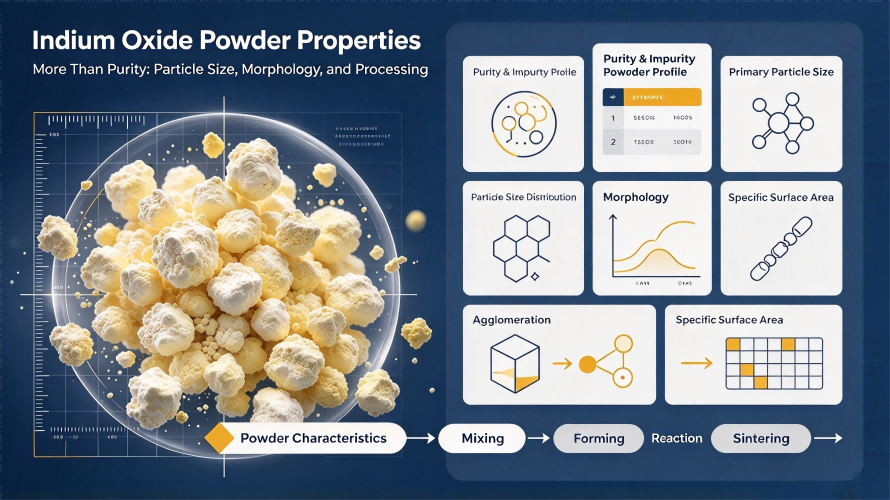
Indium Oxide Powder Properties depend on more than chemical composition. For In₂O₃ powder, purity, particle size, morphology, agglomeration, surface area, and crystal characteristics can all affect how the material behaves during mixing, forming, reaction, and sintering. This is why two indium oxide powders with the same chemical formula and nominal purity may not perform identically in practical processing. For material selection, the important question is not simply whether the powder is high purity, but whether its physical and chemical characteristics match the intended process.
What Is Indium Oxide Powder?
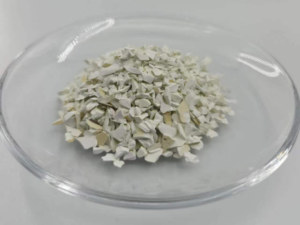
Indium oxide powder is a fine inorganic material with the chemical formula In₂O₃. It is commonly supplied as a yellow to yellowish powder and is used in electronic materials, advanced ceramics, thin-film material development, and other specialized applications.Indium oxide is a cubic-structure n-type semiconductor oxide. Its electrical, optical, and chemical properties make it important in several functional-material systems. However, for powder processing, the chemical formula is only the starting point. The physical characteristics of the powder can strongly influence how it is mixed, dispersed, compacted, reacted, or sintered.
Basic Properties of In₂O₃ Powder
| Property | Typical Information |
| Chemical formula | In₂O₃ |
| CAS number | 1312-43-2 |
| Molecular weight | 277.64 g/mol |
| Crystal structure | Cubic |
| Appearance | Yellow to yellowish powder |
| Physical form | Fine powder |
| Main elements | Indium and oxygen |
| Purity | Application dependent |
In₂O₃ powders are available in a variety of particle size ranges, specific surface areas, and material grades. For instance, distinctions are made between crystalline, fine-powder, and target-grade powders, which differ significantly in terms of particle size distribution and BET specific surface area.
Why Indium Oxide Powder Properties Matter
A common mistake when evaluating inorganic powders is to focus almost entirely on chemical purity. Purity is important, especially when trace elements can affect the final material. However, powder behavior also depends on physical characteristics such as:
- Chemical purity and impurity profile
- Primary particle size
- Particle-size distribution
- Particle morphology
- Agglomeration
- Specific surface area
- Crystal structure and crystallinity
- Batch-to-batch consistency
These properties are interconnected.
For example, reducing particle size generally increases specific surface area, but very fine particles can also have stronger interparticle interactions and a greater tendency to form agglomerates. Research on In₂O₃ powder has specifically identified agglomeration and poor dispersibility as important processing issues, while synthesis and calcination conditions can change particle morphology and size. Therefore, smaller particle size or higher purity does not automatically mean better powder. The useful specification is the one that matches the downstream process.
Purity and Impurity Profile of Indium Oxide Powder
Purity is one of the first specifications considered for high-purity In₂O₃ powder, but the nominal purity value does not provide the complete picture.
Two powders can both be described as 99.99% In₂O₃ while containing different concentrations of individual trace impurities. If a process is sensitive to specific elements, the impurity profile can be more informative than the total purity value alone.
When evaluating high-purity indium oxide powder, it is useful to review:
- Nominal purity
- Individual metallic impurities
- Total impurity concentration
- Analytical method
- Batch consistency
- Certificate of analysis
The objective is therefore not always to select the highest nominal purity. Instead, the purity level and impurity profile should be matched to the requirements of the final material and process.
Particle Size and Morphology of Indium Oxide Powder
Particle size is one of the most important physical characteristics of a powder, but it must be interpreted carefully.
For In₂O₃, primary particle size, agglomerated particle size, and particle-size distribution are not interchangeable measurements.
Primary particles are the individual particles present at the microscopic level. During synthesis, drying, calcination, storage, or handling, these particles can join together and form larger agglomerates.
As a result, a powder can contain very fine primary particles while showing a much larger particle size in a bulk PSD measurement.
This distinction explains why two powders with apparently similar nominal particle sizes can behave differently during dispersion, mixing, compaction, or sintering.
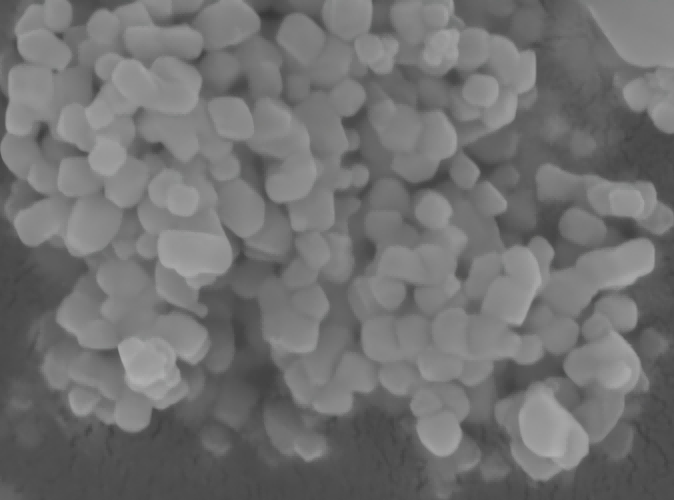
SEM Characterization of Indium Oxide Powder
Scanning electron microscopy (SEM) is useful for examining the morphology and aggregation state of indium oxide powder.
An SEM image can help reveal:
- Particle shape
- Surface morphology
- Particle aggregation
- Relative particle-size features
- Differences between individual particles and agglomerates
Why Particle Size Alone Does Not Define Powder Performance
It is tempting to compare In₂O₃ powders simply by asking which one has the smaller particle size. In practice, this can be misleading.
A finer powder may provide a larger specific surface area and different reaction or sintering behavior. At the same time, fine particles can be more difficult to disperse and may form stronger agglomerates.
Three characteristics should therefore be distinguished:
Primary particle size describes individual particles at the microscopic level.
Agglomerated particle size describes groups of particles that have joined together.
Particle-size distribution describes how particle sizes are statistically distributed throughout the powder.
These parameters answer different questions. A reported “particle size” is therefore meaningful only when the measurement method and definition are also known.
In₂O₃ powders demonstrate this point: different grades deliver distinct D10, D50, D90 and BET values even when the material shares the same In₂O₃ chemical composition.
How Particle Size and Agglomeration Affect Processing
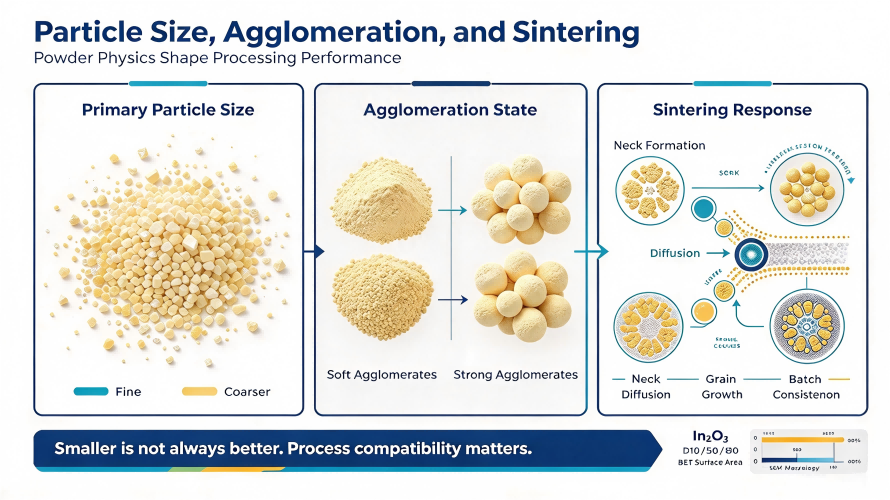
Particle characteristics can influence several stages of powder processing.
Mixing and Dispersion: Particle-size differences can affect how uniformly In₂O₃ powder mixes with other powders, binders, solvents, or additives. Strongly agglomerated fine particles may not disperse in the same way as individually distributed particles of similar primary size.
Packing and Compaction: Particle size distribution and morphology influence how particles arrange themselves during compaction. A controlled distribution can produce different packing behavior from a powder with broad or irregular particle characteristics.
Reaction Behavior: Smaller particles generally provide a larger surface area relative to their mass. This can affect solid-state reactions and other processes where surface interactions are important.
Sintering: Particle size, morphology, and agglomeration can influence particle contact, neck formation, diffusion, grain growth, and densification. The relationship is not simply “smaller is better.” If fine primary particles form strong secondary agglomerates, the effective processing behavior may differ substantially from what the primary particle size alone suggests.
This is one reason powder characterization should combine particle-size data with morphology and surface-area information.
Indium Oxide Powder and Sintering Behavior
Sintering is particularly relevant when In₂O₃ powder is used as a starting material for dense ceramic or oxide materials.
During sintering, particles undergo neck formation, diffusion, grain growth, and densification. The characteristics of the starting powder can influence how these processes develop.
Research has shown that preparation and thermal treatment conditions can change In₂O₃ particle size and morphology. Other studies have also examined the relationship between powder morphology, dispersion, and the properties of materials prepared from In₂O₃ powder.
The practical implication is straightforward: An In₂O₃ powder specification should be evaluated in relation to the final processing route, rather than selected independently of it.
A powder suitable for a ceramic-forming process may not have the same ideal characteristics as a powder intended for another material-preparation method.
How Indium Oxide Powder Is Characterized
No single test provides a complete picture of powder quality. Different analytical techniques answer different questions.
| Characteristic | Common Characterization Method | What It Shows |
| Chemical composition | ICP-OES / ICP-MS | Elemental composition |
| Trace impurities | ICP / GDMS | Individual impurity levels |
| Crystal structure | XRD | Phase and crystallinity |
| Particle morphology | SEM | Shape and aggregation |
| Particle-size distribution | Laser diffraction or other PSD methods | Quantitative particle-size distribution |
| Specific surface area | BET | Surface area available for interaction |
| Thermal behavior | TGA / DSC or application-specific testing | Changes during heating |
For example, SEM can show whether a powder appears strongly agglomerated, while particle-size analysis can quantify the particle-size distribution. XRD can identify the crystalline phase, while elemental analysis can determine trace impurities.
Using several complementary techniques therefore provides a more useful picture of an In₂O₃ powder than relying on one specification alone. Published In₂O₃ studies commonly combine SEM or TEM with XRD and elemental analysis to examine morphology, particle structure, and phase composition.
Applications of Indium Oxide Powder
Electronic and Functional Materials: High-purity In₂O₃ powder can be used as a starting material for electronic and functional oxide systems where controlled composition and material quality are important.
Advanced Ceramics: Indium oxide can be incorporated into ceramic and inorganic material systems. In these applications, powder purity, particle size, morphology, and sintering behavior can all influence processing.
Thin-Film Material Development: In₂O₃ is used in the development of oxide-based thin films and related functional materials. Depending on the preparation route, the characteristics of the starting powder can affect subsequent material processing.
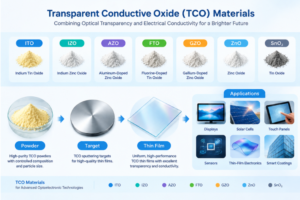
Indium-Based Conductive Materials: Indium oxide is an important component of materials such as indium tin oxide (ITO). In this context, the characteristics of the starting In₂O₃ powder can affect subsequent processing, while the final properties depend on the complete composition and manufacturing route. In₂O₃ powder is also used as a raw material for producing ITO and other indium-based oxide materials.
Gas-Sensing and Surface-Dependent Materials: In₂O₃ has also been studied for gas-sensing applications, where particle size, surface area, morphology, and surface-related characteristics can influence sensing behavior.
How to Select Indium Oxide Powder
When comparing In₂O₃ powders, purity should be evaluated together with the physical characteristics that will affect the actual process.
1. Start With the End Use
Identify whether the powder will be used for:
- Ceramic processing
- Powder mixing
- Thin-film material preparation
- Electronic material development
- Research and development
- Other specialized applications
The end use determines which specifications deserve the most attention.
2. Check Purity and Impurity Profile
Do not stop at a nominal value such as 99.99%. Check whether the critical trace elements are controlled at the required levels and whether the analytical data are appropriate for the application.
3. Define What “Particle Size” Means
Ask whether the reported value represents:
- Primary particle size
- Average particle size
- D10/D50/D90
- Agglomerated particle size
- Another measurement definition
These values should not be treated as interchangeable.
4. Examine Morphology and Agglomeration
SEM images can help determine whether the powder is relatively dispersed, irregular, faceted, needle-like, or strongly agglomerated.
5. Consider Surface Area and Processing Behavior
BET surface area can provide additional information when surface-dependent reactions, dispersion, or sintering are important. A powder that looks attractive from a particle-size specification alone may still behave differently during actual processing.
6. Check Batch Consistency
For repeated production, consistency between lots can be more important than a single excellent test result.
7. Request the Right Technical Data
Depending on the application, useful documentation may include:
- Certificate of Analysis
- Particle-size data
- SEM images
- XRD data
- Trace-element analysis
- Technical Data Sheet
The goal is to evaluate the powder based on measurable characteristics rather than nominal specifications alone.
FAQs
The main properties include chemical purity, individual impurity levels, particle size, particle-size distribution, morphology, agglomeration, crystal structure, crystallinity, and specific surface area. Their relative importance depends on the intended application.
Indium oxide powder is used in electronic and functional materials, advanced ceramics, thin-film material development, indium-based conductive materials, gas-sensing research, and other specialized applications.
Yes. Particle size can affect specific surface area, mixing, packing, reaction behavior, and sintering. However, smaller particles are not automatically better because fine particles can also show stronger agglomeration.
Primary particle size describes individual particles, while agglomerated particle size describes groups of particles that have joined together. A powder can therefore contain very fine primary particles while exhibiting much larger agglomerates in a bulk particle-size measurement.
Common techniques include SEM for morphology, XRD for crystal structure, ICP or GDMS for chemical composition and impurities, particle-size analysis for PSD, and BET for specific surface area.
Not necessarily. Suitability depends on the impurity profile, particle characteristics, processing conditions, and final application. A nominal purity value alone does not fully describe powder performance.
Key specifications include purity, individual impurity levels, particle size, particle-size distribution, morphology, agglomeration, specific surface area, batch consistency, and compatibility with the intended processing method.
Indium oxide powder is primarily In₂O₃, while ITO is an indium-tin oxide material in which tin is incorporated into the indium oxide system. They have different compositions and should be selected according to their respective applications.
Conclusion
The most useful way to evaluate Indium Oxide Powder Properties is to connect the powder specifications with the actual process in which the material will be used.
A practical evaluation can be summarized as:
Purity → Particle Size → Morphology → Agglomeration → Surface Area → Processing → Final Material
A fine powder may provide high surface area but can also show stronger agglomeration. A high-purity powder may satisfy the chemical requirement but still require a different particle-size distribution or morphology for a particular forming or sintering process.
For this reason, the appropriate indium oxide powder is not necessarily the one with the highest purity or smallest nominal particle size. It is the material whose chemical and physical characteristics are compatible with the intended process.
ULPMAT supplies indium oxide in powder and other material forms, with specifications available according to purity, particle size, morphology, and application requirements.