

MoS2 Vs Graphite is a common material selection question for engineers working with solid lubrication, wear-resistant coatings, and advanced material applications. For a broader overview of molybdenum disulfide uses, see our guide to MoS₂ applications.
Both molybdenum disulfide (MoS₂) and graphite are layered solid lubricant materials. Their low-friction behavior comes from their ability to shear between atomic layers. However, similar crystal structures do not mean identical performance. The suitable material depends strongly on the operating environment, including vacuum conditions, humidity, temperature, load, and application requirements.
Understanding MoS2 and Graphite as Solid Lubricant Materials
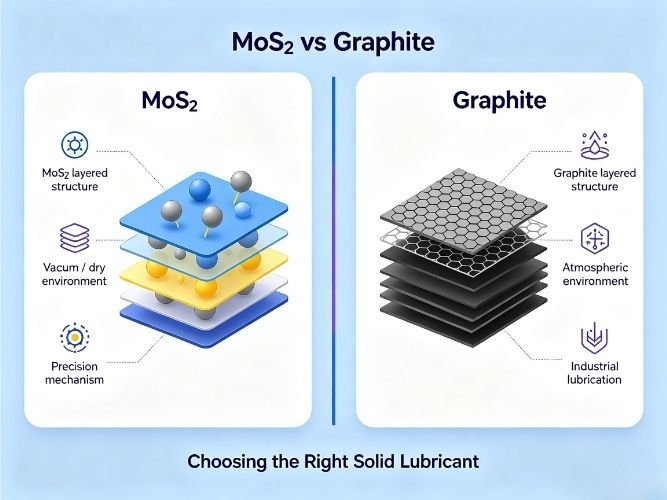
MoS₂ and graphite are two widely used layered solid lubricant materials, but their lubrication mechanisms and suitable environments are different. Both materials rely on weak bonding between atomic layers, allowing the layers to slide under shear forces and reduce friction. However, the difference in their crystal structures determines how they perform under different operating conditions.
Molybdenum disulfide (MoS₂) is a transition metal dichalcogenide (TMD) material with a characteristic S-Mo-S layered structure. Each layer consists of a molybdenum atomic plane sandwiched between two sulfur atomic planes, while the interaction between adjacent layers is relatively weak. This structure enables easy interlayer sliding and provides excellent solid lubrication behavior, especially in dry and vacuum environments where conventional liquid lubricants cannot be used. Due to these properties, MoS₂ is commonly considered for dry lubrication coatings, vacuum mechanical systems, precision components, and advanced material applications.
Graphite, in comparison, is a carbon-based layered material composed of stacked graphene-like structures. Similar to MoS₂, graphite reduces friction through the sliding of adjacent layers. However, its lubrication performance is more strongly influenced by the surrounding environment, particularly humidity. Adsorbed moisture molecules can contribute to easier layer sliding, which is why graphite often performs effectively in normal atmospheric conditions. As a result, graphite remains widely used in general industrial lubrication, conductive lubricant applications, and situations where cost efficiency is an important consideration.
The key difference between MoS₂ and graphite is not simply their ability to reduce friction, but how reliably they maintain lubrication performance under specific environmental conditions.
MoS2 vs Graphite: Key Performance Differences
Although both materials belong to layered solid lubricants, their practical performance differs.
| Property | MoS₂ | Graphite |
| Material type | Transition metal dichalcogenide | Carbon-based layered material |
| Crystal structure | S-Mo-S layered structure | Graphene-like carbon layers |
| Main lubrication advantage | Low shear strength and vacuum compatibility | Good lubrication in suitable atmospheric conditions |
| Vacuum performance | Excellent | Limited |
| Humidity influence | Lower dependence compared with graphite | Strong dependence |
| Electrical property | Semiconductor material | Electrically conductive |
| Typical applications | Vacuum, dry lubrication, precision systems | General industrial lubrication, conductive applications |
| Material cost | Generally higher | Generally lower |
The key difference between MoS₂ and graphite is not simply the friction coefficient. The operating environment determines which material can maintain stable lubrication performance.
How Operating Environment Affects Material Selection
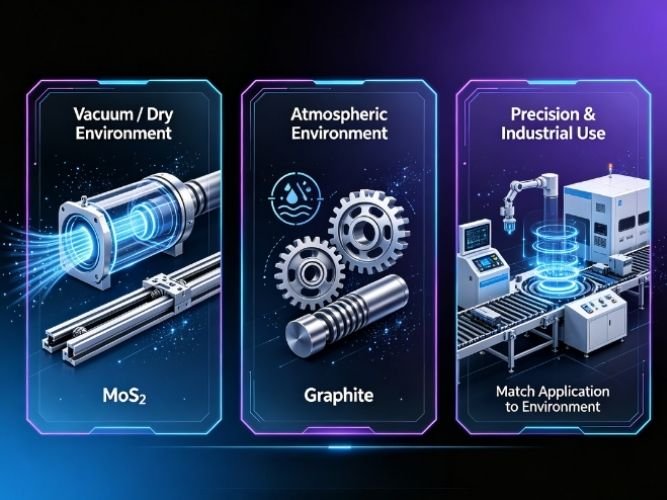
1. Vacuum and Low-Pressure Applications: Why MoS₂ Is Often Selected
For vacuum and low-pressure environments, MoS₂ is usually considered before graphite because the two materials rely on different lubrication mechanisms.Graphite requires certain environmental molecules, especially moisture, to support easy sliding between its layered structures. Research has shown that graphite and MoS₂ have different environmental dependencies, with MoS₂ generally maintaining better lubrication performance in vacuum conditions.When the operating pressure decreases and surface moisture becomes limited, graphite may lose part of its lubricating effectiveness.MoS₂ has a different advantage. Its layered crystal structure allows relatively low friction even under dry and vacuum conditions, making it widely used in applications where liquid lubricants cannot be applied.
Typical examples include:
- Vacuum equipment components
- Aerospace mechanisms
- Precision positioning systems
- Semiconductor manufacturing equipment
For these applications, engineers often prioritize stable dry lubrication performance over general-purpose availability.
2. Humid Atmospheric Conditions: Why Graphite Remains Widely Used
Although MoS₂ performs well in vacuum environments, graphite still remains an important solid lubricant for many conventional applications.In normal atmospheric conditions, graphite can provide effective lubrication because adsorbed moisture helps reduce friction between graphite layers. In addition, graphite offers practical advantages such as electrical conductivity, easy availability, and relatively low cost.
Therefore, graphite is still commonly considered for:
- General mechanical systems
- Electrical contact applications
- Cost-sensitive lubrication solutions
The selection between graphite and MoS₂ should be based on operating conditions, including humidity, pressure, temperature, load, and electrical requirements.
3. High Load and Wear Conditions: Comparing Long-Term Performance
For high-load sliding applications, the choice between MoS₂ and graphite depends strongly on the working environment.MoS₂ is often selected when the application requires:
- Stable dry lubrication under low humidity or vacuum
- Reduced friction during repeated sliding
- Protection against wear in precision mechanisms
Graphite may be more suitable when:
- The system operates in normal atmospheric conditions
- Electrical conductivity is required
- Cost and availability are key considerations
In practical material selection, neither MoS₂ nor graphite is universally better. The appropriate lubricant depends on the combination of operating pressure, environment, contact stress, and equipment requirements.
Choosing Between MoS₂ and Graphite Based on Operating Conditions
The choice between MoS₂ and graphite depends mainly on the operating environment rather than the lubricant material alone. Engineers usually consider factors such as vacuum level, humidity, temperature, mechanical load, and electrical requirements before selecting a solid lubricant.
| Operating Condition | Preferred Consideration | Main Reason |
| High vacuum environment | MoS₂ | Maintains low friction without relying strongly on atmospheric moisture |
| Dry or inert atmosphere | MoS₂ | Provides stable solid lubrication under limited humidity conditions |
| Precision sliding mechanisms | MoS₂ | Suitable for applications requiring consistent friction behavior and low wear |
| Vacuum lubrication systems | MoS₂ | Commonly used where liquid lubricants cannot be applied |
| Normal atmospheric mechanical systems | Graphite | Moisture-assisted layer sliding can provide effective lubrication |
| Electrical contact applications | Graphite | Higher electrical conductivity compared with MoS₂ |
| Cost-sensitive applications | Graphite | Widely available and economical for general lubrication uses |
A Practical Selection Approach
MoS₂ is commonly considered when the application requires:
- Reliable lubrication under vacuum or low-humidity conditions
- Reduced friction in precision moving components
- Dry lubrication where oil-based lubricants are unsuitable
- Stable performance during repeated sliding cycles
Graphite is commonly considered when the application requires:
- Effective lubrication in normal atmospheric environments
- Electrical conductivity or conductive lubricant properties
- A cost-effective solution for general mechanical systems
For advanced engineering applications, the selection of MoS₂ or graphite should be based on the complete operating environment, including pressure, humidity, temperature, contact stress, and functional requirements.
What Material Quality Factors Matter When Selecting MoS₂?

When selecting MoS₂ material, engineers usually evaluate several quality factors rather than focusing only on chemical composition.
MoS₂ Material Selection Process:
Application Requirements → Purity Evaluation → Particle Size & Morphology Assessment → Impurity Control → Quality Documentation Review → Suitable MoS₂ Grade Selection
1. Application Requirements
Define the expected performance requirements, such as lubrication performance, coating compatibility, dispersion behavior, or processing conditions.
2. Purity Evaluation
Evaluate MoS₂ purity and chemical composition, especially for applications where trace contaminants may influence material performance, coating quality, or processing stability.
3. Particle Size and Morphology Assessment
Review particle size distribution and morphology because they can affect powder dispersion, coating uniformity, processing compatibility, and final application performance.
4. Impurity Control
Analyze trace elements and impurity levels to ensure material consistency and meet specific application requirements.
5. Quality Documentation Review
Check available technical information, including purity analysis, impurity data, particle size information, and material specifications.
6. Suitable MoS₂ Grade Selection
Select the appropriate MoS₂ grade based on the application requirements and processing conditions.
Conclusion
MoS₂ and graphite are both widely used layered solid lubricant materials, but their advantages depend on the operating environment and application requirements.MoS₂ is commonly considered for vacuum systems, dry lubrication, precision mechanisms, and applications where stable friction performance is required under low-humidity conditions.Graphite remains a practical choice for conventional lubrication environments, especially when electrical conductivity, availability, and cost considerations are important.
For high-purity MoS₂ applications, ULPMAT supports material selection with controlled specifications and technical documentation to help customers match material characteristics with their specific requirements.
FAQs
MoS₂ (molybdenum disulfide) is mainly used as a solid lubricant, coating material, and advanced functional material. Its layered crystal structure provides low-friction behavior, making it suitable for vacuum lubrication, aerospace components, precision mechanisms, protective coatings, and some thin-film applications.
No. MoS₂ and graphite have different lubrication advantages depending on the operating environment. MoS₂ is commonly selected for vacuum, dry, and low-humidity conditions, while graphite can perform effectively in normal atmospheric environments where moisture supports layer sliding.
The main difference is their environmental dependence. MoS₂ can maintain low-friction performance under vacuum and dry conditions, while graphite lubrication behavior is more influenced by surrounding humidity. The appropriate choice depends on pressure, temperature, load, and application requirements.
MoS₂ is used for vacuum lubrication because its layered structure enables sliding between material layers without relying strongly on atmospheric moisture. This allows stable dry lubrication performance in vacuum equipment, aerospace mechanisms, semiconductor-related systems, and precision motion applications.
Yes, graphite can replace MoS₂ in some applications when operating conditions are suitable. Graphite is often considered for conventional mechanical systems, especially where atmospheric humidity, electrical conductivity, and cost efficiency are important factors.
The selection between MoS₂ powder and graphite powder should consider the operating environment and performance requirements. Important factors include vacuum conditions, humidity, temperature, load, friction requirements, electrical properties, purity requirements, and the intended processing method.
When buying high-purity MoS₂ powder, important factors include purity level, particle size distribution, morphology, trace impurity information, and technical documentation. These parameters can influence dispersion behavior, coating performance, processing compatibility, and application consistency.
MoS₂ is suitable for coating applications because it can provide low-friction surfaces and improved wear resistance through its layered structure. MoS₂ coatings are commonly considered for applications where dry lubrication, reduced friction, or protection against mechanical wear is required.
Content Source: ULPMAT Materials Engineering Team
Scientific References
- 1. Lansdown, A. R. Molybdenum Disulphide Lubrication. Elsevier, 1999.
- 2. Donnet, C., & Erdemir, A. Solid Lubricant Coatings: Recent Developments and Future Trends. Tribology Letters, 2004.
- 3. Bhushan, B. Introduction to Tribology. Wiley.
- 4. Holmberg, K., & Erdemir, A. Influence of Tribology on Global Energy Consumption, Costs and Emissions. Friction, 2017.