

Choosing the right boron carbide particle size is not simply a matter of selecting a finer or coarser powder. For abrasive applications, particle size affects the available grit range and finishing process. For advanced ceramics, particle-size distribution and agglomeration can influence powder mixing, packing, and densification.
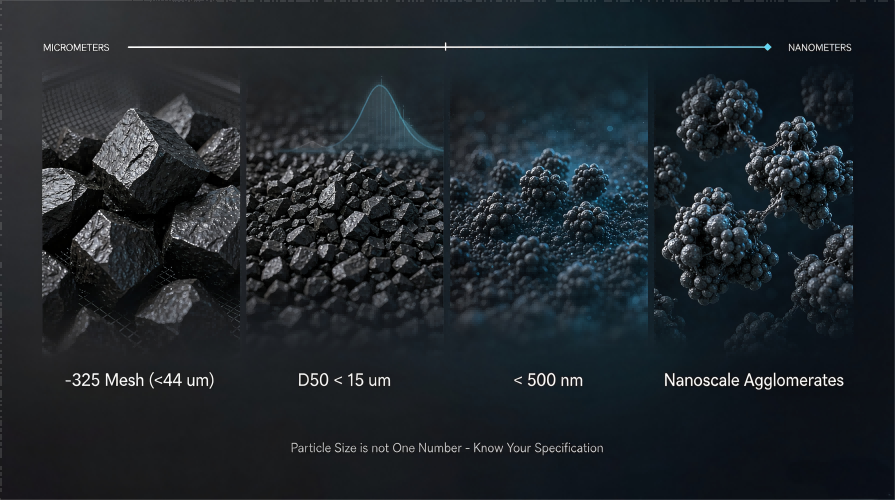
Specifications such as −325 mesh, D50 below 15 μm, and below 500 nm do not describe the same particle-size characteristics. Understanding what each value represents is essential when comparing materials.
This guide explains how to evaluate boron carbide (B₄C) particle size for abrasive and ceramic applications, compare measurement methods, and define material requirements before purchasing.
1. Understanding Boron Carbide Particle Size and Grit
Boron carbide is a hard, wear-resistant ceramic material used in abrasive machining, lapping, polishing, and advanced ceramic applications. Its high hardness makes it suitable for processing hard and brittle materials, including ceramics and sapphire.
However, boron carbide particle size can be described in several different ways.
Mesh Size and Sieve Classification
Mesh designations are commonly used for granular and abrasive materials. They describe a sieve-based classification rather than a single exact particle diameter.
For example, a supplier may list a powder as −325 mesh. Buyers should confirm the applicable sieve standard and the meaning of the minus designation before comparing it with a micron-based specification.
Micron Size and Particle-Size Distribution
Micron specifications express particle size in micrometers (μm). However, a specification such as “less than 15 μm” should not automatically be interpreted as D50 below 15 μm or as a guarantee that every particle is smaller than 15 μm.
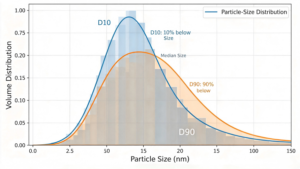
When available, particle-size distribution data provide more information:
D10: 10% of the measured particle population is below this size.
D50: The median particle size; 50% is below this value.
D90: 90% of the measured particle population is below this size.
These parameters help buyers understand the distribution rather than relying on one nominal value.
Primary Particles and Agglomerates
Fine and nanoscale B₄C powders may contain agglomerates. A primary particle observed under a microscope can be much smaller than the particle or agglomerate measured by a particle-size analyzer.
When evaluating a nanoscale specification, buyers should establish whether the stated value refers to primary particle size, dispersed particle size, or another measurement definition.
2. B₄C Particle Size in Abrasive Applications
Boron carbide is used in lapping, polishing, sawing, ultrasonic machining, and other abrasive processes. The appropriate particle-size specification depends on the workpiece material, the required surface finish, and the processing stage.
For precision applications, particle-size distribution and agglomeration can be as important as the nominal size. Oversized particles or agglomerates may affect surface consistency, while the final finish also depends on abrasive concentration, equipment, pressure, speed, and processing time.
Buyers should therefore compare the particle-size specification and measurement method rather than selecting an abrasive based only on its smallest stated particle size.
3. B₄C Particle Size in Ceramic Processing
Boron carbide particle size can affect powder packing and densification during ceramic processing. However, smaller particles do not always produce better results, as agglomeration and processing conditions also play important roles.
In one comparative sintering study, B₄C powder with a nominal particle size of 50 nm achieved a relative density of 93.15% and a Vickers hardness of 29.6 GPa. Under the same conditions (50 MPa, 1900°C, and 10 minutes), powder with a D50 of 0.406 μm achieved 98.29% relative density and 32.84 GPa hardness, while powder with a D50 of 1.47 μm achieved 94.75% relative density and 30.87 GPa hardness.
These results show that nominal particle size alone cannot predict ceramic densification. Particle-size distribution, agglomeration, and sintering conditions should also be considered. The results apply to the specific powders and processing conditions used in the study.
For ceramic applications, buyers should evaluate B₄C purity and relevant impurities alongside particle size. Depending on the formulation, boron and carbon content, oxygen, iron, and silicon may also require attention.
4. Why Nanoscale B₄C Specifications Need Careful Evaluation
A nanoscale specification does not always represent the particle size of the powder as measured in a dispersion. Primary particles may form larger agglomerates, resulting in a measured particle-size distribution in the micrometer range.
For example, one study reported primary B₄C particles of approximately 25 nm, while the measured particle-size distribution showed a D10 of 0.54 μm, a D50 of 2.48 μm, and a D90 of 5.48 μm.
This difference highlights the importance of understanding what a particle-size specification actually represents. When evaluating fine or nanoscale B₄C, buyers should clarify whether the stated size refers to primary particles or agglomerates, and check the measurement method and sample preparation conditions. A nanoscale label alone is not enough to establish the particle-size distribution of the supplied powder.
5. How to Compare Boron Carbide Particle-Size Measurements
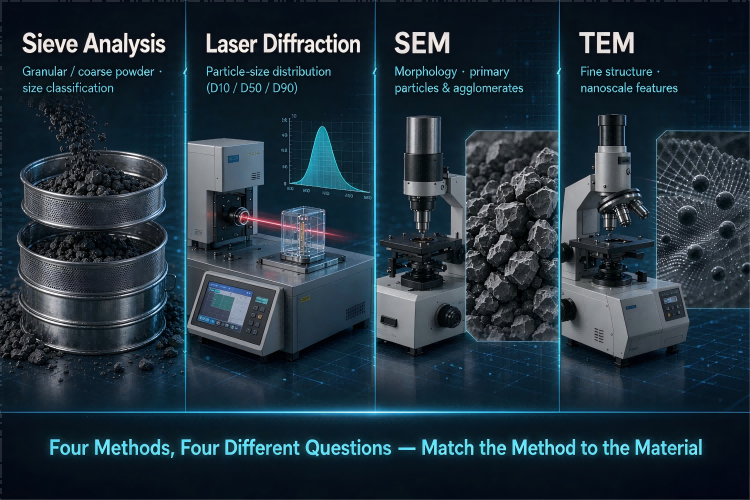
Different measurement techniques describe particle size in different ways. The method should match the material form and the information required.
| Method | What it can help evaluate | Important consideration |
| Sieve analysis | Size classification of suitable granular and coarse powder materials | Sieve standard and retained or passing fractions |
| Laser diffraction | Particle-size distribution across a measured size range | Dispersion medium and sample preparation |
| SEM | Particle morphology and visible primary particles or agglomerates | Images show selected fields, not automatically the full bulk distribution |
| TEM | Fine particle structure and nanoscale features | Sample preparation and field selection |
6. What to Include in a Boron Carbide Purchase Specification
A clear purchasing specification helps reduce misunderstandings between the buyer and supplier. Instead of requesting only “fine B₄C powder,” define the material requirements and the information needed for evaluation.
When preparing a purchase specification, consider the following points:
Material and form: Specify boron carbide (B₄C) and whether the requirement is for powder or granules.
Purity: State the required purity and, where necessary, the chemical-analysis basis.
Particle size: Define the required mesh designation or particle-size value. If particle-size distribution is important, specify whether D10, D50, and D90 values are required.
Measurement method: Identify the preferred or agreed method, such as sieve analysis, laser diffraction, or microscopy.
Morphology and agglomeration: Indicate whether particle shape, morphology, or agglomeration characteristics need to be evaluated.
Documentation: List the required documents, such as a certificate of analysis (COA), safety data sheet (SDS), and other quality records.
Quantity and application: State the order quantity and intended use, such as abrasive lapping, polishing, or ceramic processing.
Not every application requires all these details. Coarse abrasive materials and fine ceramic powders may need different particle-size and characterization requirements.
For a more useful quotation, buyers should distinguish between mandatory specifications and additional information requested for evaluation. This helps suppliers recommend a suitable material and reduces unnecessary back-and-forth during the purchasing process.
7. Available Boron Carbide Specifications at ULPMAT
ULPMAT Boron Carbide Particle Size Specifications
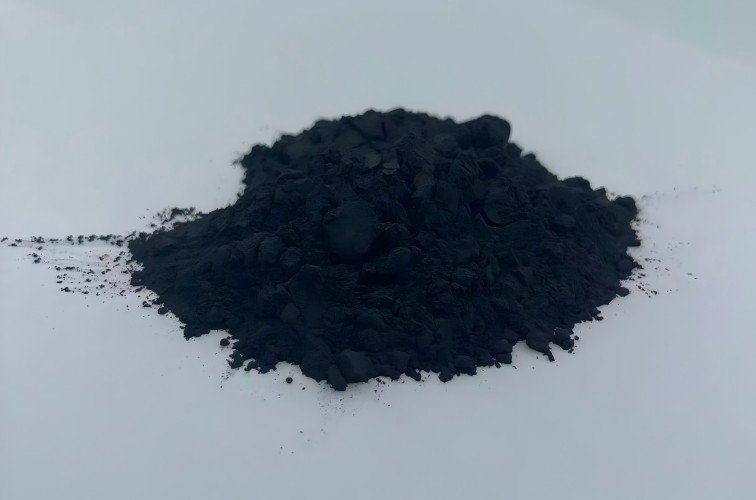
ULPMAT provides boron carbide (B₄C) in several particle-size specifications, covering nanoscale, micron-scale, and mesh-classified materials. The available TDS lists the following options:
| Product No. | Material | Purity | Particle Size |
| 050600PD001 | B₄C | 99% | <500 nm |
| 050600PD002 | B₄C | 99% | D50 <15 μm |
| 050600PD003 | B₄C | 99% | −200 Mesh |
| 050600PD004 | B₄C | 99% | −325 Mesh |
| 050600PDC01 | B₄C | Customized | Customized |
These specifications provide different starting points for application-based material selection. However, they should not be treated as directly interchangeable particle-size measurements.
For example, D50 <15 μm describes a median particle-size requirement, while −200 Mesh and −325 Mesh are sieve-based designations. The <500 nm specification should also be interpreted according to its stated measurement definition.
When comparing these grades, buyers should confirm the required particle-size definition, measurement method, and any additional distribution requirements relevant to their process.
For applications with specific particle-size or material requirements, ULPMAT also lists a customized B₄C option. Buyers can provide their target particle-size range, purity requirements, application, and quantity for specification evaluation.
Explore the available Boron Carbide Powder specifications or contact ULPMAT with your application requirements.
For a quotation, buyers can provide their target particle-size range, purity requirement, material form, quantity, application, and documentation requirements.
FAQs
The appropriate particle size depends on the workpiece material, required surface finish, and polishing process. Different finishing stages may require different abrasive size ranges. The specified abrasive size should not be treated as a direct guarantee of the final surface roughness.
They represent different types of particle-size specifications. Mesh is a sieve-based designation, while micrometers express particle dimensions. The applicable sieve standard and the definition of the micron value should be confirmed before comparing the two specifications.
Not necessarily. A specification of less than 500 nm does not automatically mean that the powder has a D50 of 500 nm. The value may refer to a different particle-size definition. Primary particles can also form agglomerates, resulting in a larger measured particle-size distribution.
No. Particle size can influence densification, but it is not the only determining factor. Agglomeration, purity, powder morphology, additives, pressure, temperature, and holding time can all affect the final ceramic properties. Very fine powders do not necessarily produce better results under every processing condition.
Start with the required purity, particle-size specification, material form, and order quantity. If tighter process control is needed, also clarify whether particle-size distribution data, measurement methods, chemical analysis, and batch-specific quality documentation are available.
Conclusion
Selecting the right boron carbide particle size requires more than comparing mesh, micron, or nanometer values. For abrasive applications, buyers should consider particle-size distribution and the required finishing stage. For ceramic processing, particle size must be evaluated together with agglomeration, purity, morphology, and the intended densification route.
The most useful supplier comparison is based on clearly defined specifications and comparable measurement methods—not simply the smallest particle-size number.
At ULPMAT, buyers can review available boron carbide powder and granule specifications and provide their application, particle-size, purity, and quantity requirements when making an inquiry.
Looking for a Boron Carbide Grade for Your Application?
Share your required particle-size range, purity, material form, application, and quantity with ULPMAT. You can also review our available boron carbide powder and boron carbide granules specifications to identify a suitable starting point for your inquiry.
References
- 1. Liu et al. Influence of Sintering Process Conditions on Microstructural and Mechanical Properties of Boron Carbide Ceramics. Materials, 2021.
- 2. Spark Plasma Sintering of Boron Carbide: From Characterisation to Finite Element Modelling. Journal of the European Ceramic Society, 2024.
- 3. Impact of Dry Chemical-Free Mechanical Pressing on Deagglomeration of Submicron-Sized Boron Carbide Particles. Nanomaterials, 2025.
- 4. NIST. Recommended Practice Guide: Particle Size Characterization. Special Publication 960-1.