

Silicide powders may look similar in a product listing, but differences in composition, phase purity, and particle size can determine whether a material is suitable for your process. Choosing the right grade requires more than comparing chemical formulas or nominal purity values. Engineers also need to consider particle-size specifications, impurity levels, and compatibility with the intended application.
Titanium silicide, tungsten silicide, niobium silicide, nickel silicide, and magnesium silicide have different compositions and material characteristics. Understanding these differences can help researchers and engineers compare available grades and define the specifications they need before ordering.
This guide explains what to check when selecting silicide powders, how to interpret common specifications, and what technical information to request from a supplier.
1. What Makes One Silicide Powder Different from Another?
Silicides are compounds formed between silicon and one or more metallic elements. Their properties depend on the metal, the silicon-to-metal ratio, and the resulting crystal structure.
For example, TiSi₂, WSi₂, NbSi₂, and NiSi₂ are transition-metal disilicides, while Mg₂Si has a different stoichiometric ratio and material behavior. These compounds should not be treated as interchangeable simply because they all contain silicon.
The metal component influences the characteristics engineers need to consider:
Titanium silicide (TiSi₂): Studied for its electrical and materials-related properties, including applications in semiconductor technology.
Tungsten silicide (WSi₂): A refractory metal silicide investigated for high-temperature and electronic-material applications.
Niobium silicide (NbSi₂): Studied in high-temperature materials research, including refractory material systems.
Nickel silicide (NiSi₂): Relevant to research on metal–silicon interfaces and semiconductor-related materials.
Magnesium silicide (Mg₂Si): Investigated in thermoelectric materials research and other functional-material systems.
These are broad areas of research, not a guarantee that every powder grade is qualified for a particular device or process. The appropriate material should be evaluated against the actual application and processing conditions.
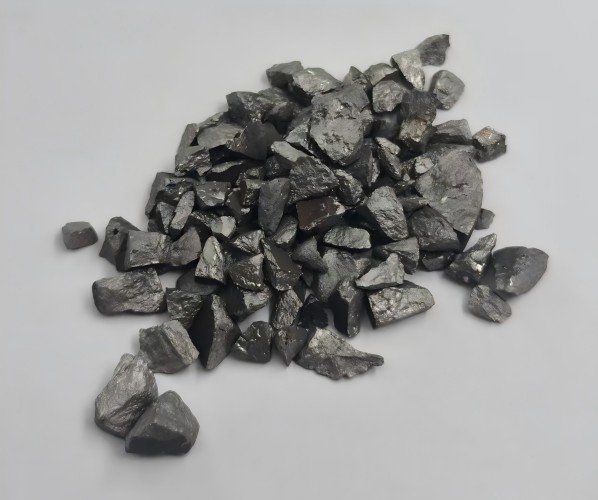
2. Why Do Chemical Composition and Phase Composition Both Matter?
Chemical composition and phase composition describe different aspects of a powder.
Chemical composition indicates which elements are present and their relative amounts. For a disilicide such as WSi₂, the nominal formula represents a tungsten-to-silicon atomic ratio of 1:2.
Phase composition describes the crystalline compounds or phases present in the material. A powder can have an overall elemental composition close to its nominal formula while still containing secondary phases or unreacted constituents.
This distinction matters when a process requires a specific silicide phase rather than simply the presence of the relevant elements.
For material evaluation, engineers may consider complementary analytical methods:
X-ray diffraction (XRD): Used to identify crystalline phases and assess whether the expected phase is present.
X-ray fluorescence (XRF): Can help determine elemental composition for suitable sample types and measurement conditions.
Energy-dispersive X-ray spectroscopy (EDS): Often used with electron microscopy to examine local elemental composition.
Inductively coupled plasma (ICP) methods: May be used for quantitative elemental analysis, depending on sample preparation and the elements being measured.
No single method answers every question. XRD provides phase information, while elemental analysis helps establish chemical composition. If phase purity is important, do not rely on a total-purity percentage alone.
Before ordering, confirm which analytical methods are available and whether the reported results apply to the actual production batch.
3. How Should Engineers Compare Silicide Powder Particle Sizes?
Particle size can influence powder handling, mixing, packing, reaction behavior, and processing consistency. The appropriate size depends on the intended process rather than on a general preference for finer powder.
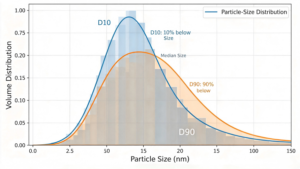
A supplier may describe powder size using mesh, a nominal size range, or a particle-size distribution such as D10, D50, and D90. These descriptions are not equivalent.
Mesh size refers to a sieve classification and indicates whether particles can pass through a specified mesh opening under the relevant test conditions.
D10 is the particle size below which 10% of the measured particle population falls.
D50 is the median particle size.
D90 is the particle size below which 90% of the measured particle population falls.
For example, a specification of -325 mesh should not be interpreted as a D50 value. It describes a sieve-based size classification, not the median of a measured particle-size distribution.
When comparing suppliers, ask whether the stated size is based on sieving, laser diffraction, image analysis, or another method. Also clarify whether the measurement describes primary particles or agglomerates.
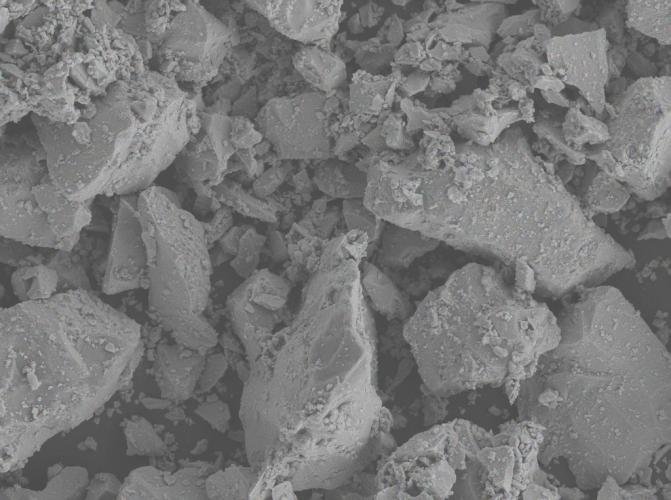
This is particularly important for fine powders. Particles may form clusters during storage or handling, so the apparent particle size can differ depending on the measurement method and sample preparation.
For a more useful comparison, engineers should consider the full size distribution when available, rather than relying only on one nominal size.
4. Is Higher Purity Always the Better Choice?
A higher stated purity can be useful, but it does not automatically make a powder the best choice for every application.
The importance of purity depends on the process, the intended function, and the types of impurities present. Some applications may be particularly sensitive to metallic contaminants or deviations in stoichiometry. Others may place greater emphasis on particle size, phase composition, or processing compatibility.
When reviewing a purity specification, check how the value is defined. For example, determine whether it is based on metallic impurities, total elemental analysis, or another calculation method. Different reporting conventions can make two nominal purity values difficult to compare directly.
Useful information to request includes:
The stated purity and its calculation basis.
The analytical method used.
The impurity elements included in the analysis.
Detection limits or reporting limits, where available.
Whether the data are representative of the supplied batch.
A certificate of analysis (COA) can help connect the specification to a particular batch. For critical work, engineers should also establish acceptance criteria before purchasing rather than assuming that a general purity label is sufficient.
5. Which Silicide Powder Should You Consider for Your Application?
The starting point is to identify the material system and the function the silicide is expected to perform. The following overview can help narrow the initial selection, but it does not replace application-specific validation.
| Silicide | Formula | Research and engineering areas to investigate |
| Titanium silicide | TiSi₂ | Semiconductor-related materials and electrical contacts |
| Tungsten silicide | WSi₂ | Refractory materials and electronic-material research |
| Niobium silicide | NbSi₂ | High-temperature and refractory material systems |
| Nickel silicide | NiSi₂ | Metal–silicon interfaces and semiconductor-related research |
| Magnesium silicide | Mg₂Si | Thermoelectric and functional-material research |
The same selection criteria should not be applied mechanically to every compound. For example, Mg₂Si has a different stoichiometry from the transition-metal disilicides listed above. Its application requirements and material evaluation should therefore be considered separately.
For high-temperature research, engineers may begin by comparing refractory silicides such as WSi₂ and NbSi₂. For semiconductor-related studies, TiSi₂ and NiSi₂ may be relevant depending on the intended material structure and process. Mg₂Si should be assessed in the context of its own functional-material requirements.
The final choice should be based on the required composition, phase, particle size, purity, and compatibility with the planned processing route.
6. What Information Should You Request Before Ordering Silicide Powders?
A clear technical specification helps reduce misunderstandings between the engineering team and the supplier. Before requesting a quotation, define the requirements that are important to the application.
Material identity and composition
Confirm the chemical formula and required stoichiometry.
Clarify whether a specific crystalline phase is required.
Define acceptable composition tolerances, where applicable.
Particle characteristics
Specify the required mesh size or particle-size distribution.
State whether D10, D50, and D90 data are needed.
Clarify whether morphology or agglomeration is important.
Purity and quality documentation
Define the required purity and reporting basis.
Ask which impurity elements are measured.
Request available COA, SDS, or technical documentation.
Confirm whether batch identification and traceability are available.
Processing requirements
Explain the intended application or processing route.
Identify any restrictions on powder handling, packaging, or storage.
Confirm whether the supplied form is suitable for the intended equipment and process.
Not every application needs every data point. The objective is to identify the characteristics that can affect the result and agree on how they will be evaluated before the material is supplied.
7. Explore Silicide Powder Options at ULPMAT
ULPMAT lists several silicide powder materials for research and engineering requirements, including titanium silicide, tungsten silicide, niobium silicide, nickel silicide, and magnesium silicide.
Available product specifications should be checked against the requirements of the intended application. Listed options include:
Titanium silicide powder (TiSi₂): 99.5%, -325 mesh.
Tungsten silicide powder (WSi₂): 99%, -200 mesh; 99.5%, -325 mesh.
Niobium silicide powder (NbSi₂): 99% and 99.5%, -325 mesh.
Nickel silicide powder (NiSi₂): 99%, -80 mesh; 99.5%, -325 mesh.
Magnesium silicide powder (Mg₂Si): 99%, -200 mesh.
These are listed product options, not D50 measurements. Please refer to the individual product pages or contact ULPMAT to confirm current availability, detailed specifications, and documentation for a particular batch.
Explore the relevant product pages:
For a specific requirement, provide the chemical formula, target purity, particle-size specification, and intended application when making an inquiry. This makes it easier to assess whether a listed grade is suitable or whether a different specification should be discussed.
FAQs
Silicide powders are powdered compounds containing silicon and a metallic element. Different silicides have different chemical compositions, crystal structures, and material properties.
TiSi₂ is titanium disilicide, while WSi₂ is tungsten disilicide. They contain different metal elements and are investigated for different material and engineering applications. Their suitability depends on the intended process and required properties.
No. Mesh is a sieve-based classification, whereas D50 is the median particle size measured using a particle-size analysis method. They should not be used interchangeably.
Check chemical composition, phase identity, particle-size specification, measurement method, impurity reporting, and batch documentation. The relative importance of each factor depends on the intended application.
Customization requirements should be discussed with the supplier. Provide the required formula, purity, particle-size range, and any phase or documentation requirements so that feasibility can be evaluated.
Conclusion
Selecting silicide powders requires more than comparing chemical formulas or headline purity values. Chemical composition, phase identity, particle-size distribution, impurity reporting, and process compatibility all contribute to a meaningful material specification.
By defining these requirements before ordering, engineers can make more consistent comparisons between grades and suppliers. The most suitable silicide powder is the one that meets the technical requirements of the intended process—not necessarily the one with the highest purity or finest nominal particle size.