Ta2O5 vs Nb2O5 for optical coatings: Which material is better for laser mirrors, antireflection coatings, and optical filters? Compare their deposition processes, thin-film properties, and application requirements to make a more informed material selection.
1. Ta2O5 vs Nb2O5: What Matters in Optical Thin-Film Design?
Ta2O5 and Nb2O5 are both high-index dielectric oxides. They are commonly used as functional layers in multilayer optical coatings, where the refractive-index contrast between adjacent materials helps control reflection and transmission.
However, the performance of a deposited film cannot be determined by its chemical formula alone.
Important factors include:
Refractive index (n) at the operating wavelength.
Extinction coefficient (k) and optical absorption.
Film density and microstructure.
Surface roughness and interface quality.
Oxygen stoichiometry and defect concentration.
Residual stress and coating adhesion.
Deposition conditions and post-deposition treatment.
The refractive index of either oxide can vary with wavelength, deposition method, oxygen content, film density, and microstructure. Therefore, published optical constants should be treated as reference data rather than universal values for every deposition system.
For practical selection, engineers should compare measured thin-film properties under conditions close to their own coating process.
2. How Deposition Processes Affect Ta2O5 and Nb2O5 Films
The optical performance of Ta2O5 and Nb2O5 films depends not only on the oxide composition but also on the deposition conditions. Film density, stoichiometry, surface morphology, and thickness uniformity can vary significantly with the deposition technique. As a result, the same oxide may exhibit different optical properties when deposited using different processes.
Electron-beam evaporation, ion-assisted deposition, and magnetron sputtering are three established approaches for preparing these oxide films. Understanding how each process influences film growth is essential when selecting materials for a specific optical coating design.
2.1 Electron-Beam Evaporation
Electron-beam evaporation is widely used in optical coating production. Under vacuum, an electron beam heats the source material until it evaporates. The vapor then travels toward the substrate, where it condenses to form a thin film.
Ta₂O₅ and Nb₂O₅ granules can both serve as evaporation sources. However, the composition of the deposited film does not always correspond exactly to that of the starting material. During evaporation, oxygen may be released from the oxide, potentially changing the stoichiometry of the growing film. The extent of this effect depends on source temperature, evaporation rate, oxygen partial pressure, and the overall chamber conditions.
Oxygen control is therefore an important part of oxide film deposition. Depending on the coating system, oxygen may be introduced during evaporation to help maintain the desired film composition. Substrate temperature and deposition rate also influence film growth, while thickness uniformity remains essential for achieving the intended optical response.
The characteristics of the evaporation source should not be overlooked. Material purity, granule dimensions, and batch consistency affect source handling and process repeatability. For coating manufacturers operating established evaporation systems, these factors are relevant to maintaining stable production conditions.
2.2 Ion-Assisted Deposition (IAD)
Ion-assisted deposition (IAD) combines thermal evaporation with simultaneous ion bombardment of the growing film. Energetic ions transfer additional energy to the deposited material, influencing how particles arrange themselves on the substrate.
Compared with conventional evaporation, ion assistance can promote denser film structures and modify surface morphology. These changes may affect refractive index, optical absorption, mechanical stress, and long-term coating stability. The extent of the improvement depends on the ion energy, gas composition, substrate temperature, and deposition rate.
For Ta₂O₅ and Nb₂O₅ coatings, oxygen supply is particularly important because film stoichiometry contributes to the resulting optical properties. Ion source voltage and current also require careful adjustment. Insufficient ion assistance may provide limited changes in film structure, whereas excessive bombardment can increase internal stress or introduce defects.
IAD is particularly relevant to multilayer optical coatings, where film density and interface quality can influence the overall performance of the coating stack. Rather than maximizing ion energy, the process should be optimized to balance film densification, optical properties, and mechanical stability.
2.3 Magnetron Sputtering
Magnetron sputtering produces thin films through the bombardment of a solid target by energetic ions in a plasma. The ejected material travels toward the substrate and forms a deposited layer. Both Ta₂O₅ and Nb₂O₅ films can be prepared using sputtering, but the source configuration determines how the oxide is introduced into the process.
There are two approaches worth distinguishing.
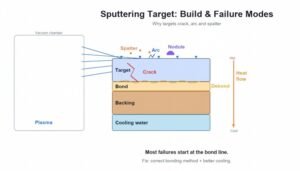
Ceramic-target sputtering uses a Ta₂O₅ or Nb₂O₅ ceramic target directly. In this case, target density, purity, composition uniformity, bonding quality, and dimensions are important considerations. Variations in target properties can affect sputtering behavior and production consistency.
Reactive magnetron sputtering starts with a metallic tantalum or niobium target. Oxygen is introduced into the deposition chamber, where it reacts with the sputtered metal species to form the corresponding oxide film. Oxygen flow, target condition, plasma stability, and deposition rate must be controlled to maintain the required film composition. Changes in oxygen conditions can also influence deposition stability and optical properties.
Although both approaches can produce oxide coatings, they are not equivalent in terms of source material or process control. Ceramic-target sputtering begins with an oxide source, while reactive sputtering forms the oxide during film growth.
Magnetron sputtering is often selected for applications requiring controlled film thickness, repeatable deposition, and uniformity across larger substrates. The final coating quality, however, depends on the target characteristics, equipment configuration, and optimization of the deposition conditions.
2.4 Comparing the Deposition Processes
The choice of deposition method should reflect the required film properties and the capabilities of the coating equipment. The main differences can be summarized as follows:
| Deposition method | Source material | Primary process consideration |
| Electron-beam evaporation | Ta₂O₅ or Nb₂O₅ granules | Evaporation behavior and oxygen control |
| Ion-assisted deposition | Oxide evaporation material with ion assistance | Film density, ion energy, and stress |
| Ceramic-target sputtering | Ta₂O₅ or Nb₂O₅ ceramic target | Target quality and sputtering stability |
| Reactive magnetron sputtering | Metallic Ta or Nb target with oxygen | Oxygen control and reactive process stability |
No single deposition method is universally suitable for every Ta₂O₅ or Nb₂O₅ coating. Electron-beam evaporation may fit established evaporation systems, while IAD provides additional control over film growth. Magnetron sputtering offers an alternative when target-based deposition and process repeatability are priorities.
Ultimately, the selection should be based on the optical constants, absorption, film structure, thickness uniformity, and reliability required by the coating design. A stable process that consistently achieves these requirements is more valuable than a high deposition rate alone.
3. Application-Based Selection: Where Are Ta₂O₅ and Nb₂O₅ Used?
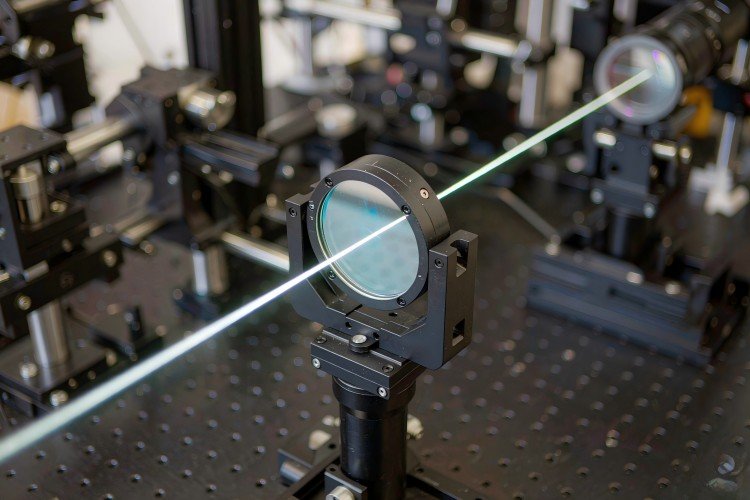
The most practical way to compare these materials is to start with the intended optical component.
3.1 Laser Mirrors and High-Reflectivity Coatings
High-reflectivity mirrors commonly use alternating high-index and low-index dielectric layers. Ta₂O₅ and Nb₂O₅ may both be evaluated as high-index materials in these multilayer structures.
For laser mirrors, the key requirements often include:
Low optical absorption.
High reflectivity at the target wavelength.
Suitable laser-induced damage threshold (LIDT).
Low scattering and surface defects.
Controlled residual stress.
Stable interfaces between coating layers.
Ta₂O₅ is an established material option for dielectric optical coatings, including high-power laser coating systems. Nb₂O₅ is also a candidate for high-index multilayer designs.
Neither material is universally superior in laser-damage resistance. LIDT depends on film composition, deposition defects, interfaces, electric-field distribution, coating architecture, wavelength, pulse duration, and test conditions.
In one set of reported coating comparisons, the Ta₂O₅ single-layer film showed lower optical absorption but also a lower measured LIDT than the Nb₂O₅ single-layer film. The Nb₂O₅ high-reflector coating reached an LIDT of 25.6 J/cm² among the tested samples.
This value applies to the specific coating and test conditions and should not be treated as a universal LIDT value for Nb₂O₅. It illustrates why laser mirror materials must be evaluated using data from the intended deposition process and coating design.
Selection guidance: For high-power laser mirrors, compare both oxides using measured absorption, LIDT, film stress, and defect data under the intended operating conditions. Do not select a material based on refractive index alone.
3.2 Antireflection (AR) Coatings
Antireflection coatings are designed to reduce unwanted reflection over a specified wavelength range and angle of incidence.
They may consist of a single layer or a multilayer stack, depending on the optical design. In multilayer AR systems, high-index and low-index materials are combined to control the reflected and transmitted spectra.
Ta₂O₅ and Nb₂O₅ can both be considered as high-index components, but the final selection depends on:
Target wavelength range.
Required reflectance or transmittance.
Substrate material.
Number of coating layers.
Deposition temperature and process compatibility.
Film absorption and environmental stability.
For visible and near-infrared coatings, the refractive-index dispersion of the deposited film should be measured or reliably characterized at the actual operating wavelengths.
Selection guidance: For AR coatings, compare the optical constants of the deposited films and evaluate the complete multilayer design. The material with the more suitable refractive index and absorption profile for the design may be the better choice.
3.3 Optical Filters and Bandpass Coatings
Optical interference filters use multilayer structures to transmit or reflect selected wavelength ranges.
Examples include bandpass filters, edge filters, dichroic filters, and wavelength-selective coatings.
In these applications, the accuracy and repeatability of each layer are particularly important. Small variations in refractive index or physical thickness can shift the transmission or reflection spectrum.
Nb₂O₅ is used in sputtered optical layers, including antireflection coatings and Bragg mirrors. Ta₂O₅ is also used in dielectric multilayer coating systems.
For filter production, engineers should evaluate:
Refractive-index dispersion.
Film thickness uniformity.
Layer-to-layer repeatability.
Surface and interface roughness.
Residual stress.
Spectral stability after environmental or thermal exposure.
Selection guidance: For optical filters, prioritize process repeatability and accurate optical-constant control. Either Ta₂O₅ or Nb₂O₅ may be suitable depending on the target spectrum and the coating equipment.
3.4 Beam Splitters and Dichroic Coatings
Beam splitters and dichroic coatings divide or redirect light according to wavelength, polarization, or incidence angle.
These components often use multilayer dielectric stacks to achieve specific reflection and transmission characteristics.
The selection of Ta₂O₅ or Nb₂O₅ should be based on the required spectral response, coating design, and deposition process.
Important considerations include:
Reflection and transmission bands.
Angle of incidence.
Polarization dependence.
Spectral edge position.
Film stress and adhesion.
Uniformity across the coated aperture.
Selection guidance: For beam splitters and dichroic coatings, use optical simulation and measured film data to compare candidate materials within the complete multilayer design.
3.5 Optical Waveguides and Integrated Photonics
Tantalum oxide and niobium oxide thin films are also material options for photonic applications.
Ta₂O₅ is of interest in integrated photonics because of its high refractive index and compatibility with thin-film waveguide structures. Potential applications include optical waveguides and resonator-based devices.
Nb₂O₅ thin films can also be used in optical waveguide and other photonic structures.
For these applications, the requirements differ from those of a conventional mirror or filter. Propagation loss, sidewall roughness, film absorption, refractive-index uniformity, and fabrication compatibility become important.
Selection guidance: For integrated photonics, evaluate propagation loss and fabrication compatibility rather than relying only on bulk optical properties or coating data. The selected material must be compatible with the complete deposition and patterning process.
4. Ta₂O₅ or Nb₂O₅? A Practical Selection Guide by Application
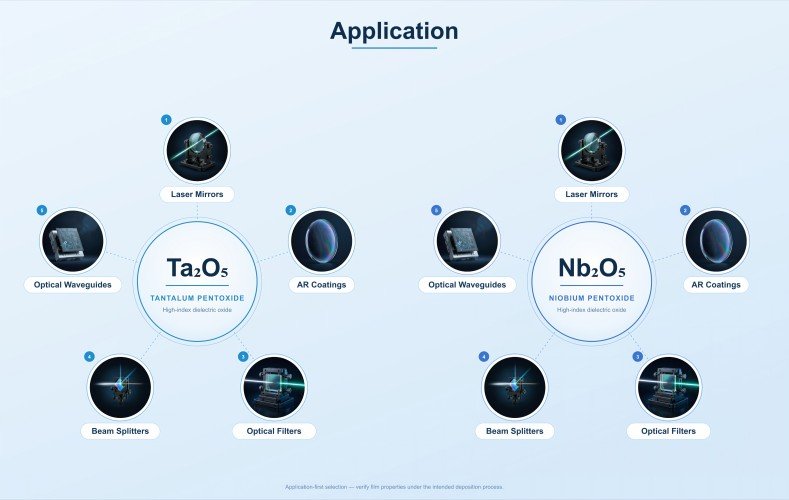
The following table summarizes the main considerations when selecting between the two materials.
| Application | Key performance requirements | Ta₂O₅ considerations | Nb₂O₅ considerations |
| High-power laser mirrors | Low absorption, LIDT, low defects, stress control | Established candidate for dielectric laser coatings; verify process-specific damage data | Also suitable for high-reflector structures; verify LIDT under actual test conditions |
| Antireflection coatings | Refractive-index matching, low reflection, spectral accuracy | Suitable candidate for high-index layers | Suitable candidate for high-index layers |
| Optical interference filters | Accurate refractive index, thickness control, repeatability | Can be used in multilayer dielectric designs | Used in sputtered optical filters and Bragg mirrors |
| Beam splitters | Spectral control, reflectance/transmittance, coating stability | Evaluate within the complete multilayer design | Evaluate within the complete multilayer design |
| Optical waveguides | Low propagation loss, uniformity, patterning compatibility | Material option for integrated photonic structures | Material option for optical waveguide structures |
There is no universal rule that Ta₂O₅ should always be selected for laser coatings or that Nb₂O₅ is always better for filters.
The more reliable approach is to compare the deposited films under the same or closely matched process conditions.
A Simple Decision Framework
If the application is a high-power laser mirror: Start with absorption, LIDT, defect density, and stress data.
If the application is an antireflection coating: Start with the target wavelength, substrate, and required refractive-index profile.
If the application is an optical filter: Focus on refractive-index dispersion, layer thickness, and spectral repeatability.
If the application is a beam splitter: Evaluate the complete multilayer design at the required angle and polarization.
If the application is an optical waveguide: Compare propagation loss, film uniformity, and compatibility with patterning.
This application-first approach helps narrow down the material choice before selecting the deposition source.
5. Selecting Ta₂O₅ and Nb₂O₅ Materials for Different Deposition Processes
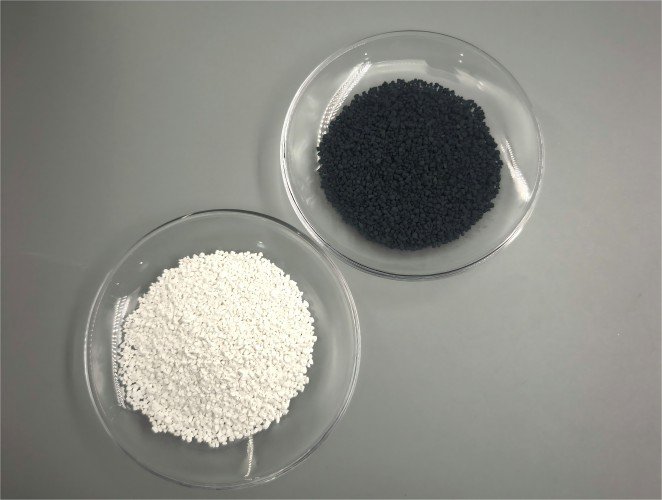
After selecting the coating material and deposition route, the next step is to determine the appropriate source material form. Ta₂O₅ and Nb₂O₅ are available in different forms for material processing and thin-film deposition, including powders, granules, pellets, pieces, and sputtering targets.
The choice depends on the deposition technique, equipment configuration, material handling requirements, and final application. A specification suitable for electron-beam evaporation, for example, may not be appropriate for a sputtering system or another material processing route.
5.1 Available Forms of Ta₂O₅ and Nb₂O₅
For evaporation processes, Ta₂O₅ and Nb₂O₅ may be supplied in granules, pellets, pieces, or other suitable source forms, depending on the evaporation source and loading requirements. Particle size, material purity, and consistency between batches should be considered when specifying the material.
Ta₂O₅ Material Range:
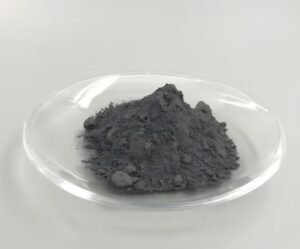
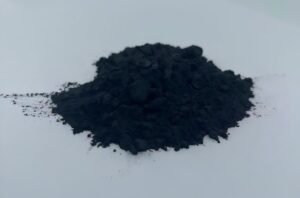
Ta₂O₅ Powder
Ta₂O₅ Granules
Ta₂O₅ Pellets
Nb₂O₅ Material Range:
Nb₂O₅ Powder
Nb₂O₅ Granules
Nb₂O₅ Pellets
For sputtering applications, ceramic targets are used in systems designed for direct oxide-target deposition. Their specifications involve not only chemical composition and purity but also target dimensions, density, microstructure, and bonding requirements.
Related Sputtering Materials:
Ta₂O₅ Sputtering Target
Nb₂O₅ Sputtering Target
Ceramic Sputtering Target
Powder forms may also be relevant to customers working with ceramic processing, target manufacturing, coating preparation, or other material development applications. Particle size distribution, purity, composition, and powder characteristics should be matched to the intended processing route.
5.2 What Matters When Specifying Ta₂O₅ and Nb₂O₅
Regardless of material form, several specifications deserve attention:
Purity and chemical composition: These should meet the requirements of the intended process and final application.
Particle size or dimensions: Powder particle size, granule dimensions, and target geometry should be specified according to the equipment and processing method.
Physical properties: Depending on the product form, density, porosity, morphology, and surface condition may also be relevant.
Batch consistency: Consistent material characteristics help support repeatable processing and quality control.
Quality documentation: Confirm the availability of relevant technical data sheets, certificates of analysis, and other quality documentation when required.
The highest available purity or a standard product specification is not necessarily the best choice for every application. A suitable specification should reflect the actual process conditions and technical requirements.
5.3 Ceramic Targets and Reactive Sputtering: Two Different Material Requirements
For sputtering applications, it is important to distinguish between direct ceramic-target sputtering and reactive sputtering.
Direct ceramic-target sputtering uses Ta₂O₅ or Nb₂O₅ targets as the source materials. Target purity, density, dimensions, composition uniformity, and bonding requirements are important considerations.
Reactive sputtering, by contrast, uses metallic tantalum or niobium targets in an oxygen-containing atmosphere to form the oxide film during deposition. In this case, the metallic target specifications and reactive process conditions must be considered separately.
These routes use different source materials and require different equipment configurations. Selecting the correct material form at the beginning helps avoid mismatches between the supplied material and the intended deposition process.
5.4 Custom Specifications for Different Applications
Standard specifications may be suitable for many applications, but some projects require adjustments to purity, particle size, dimensions, composition, or material form.
When requesting Ta₂O₅ or Nb₂O₅ materials, buyers should provide the intended application, deposition or processing method, required material form, target specifications, and any documentation requirements. This information helps establish a specification that is compatible with the actual equipment and production process.
ULPMAT offers Ta₂O₅ and Nb₂O₅ materials in different product forms and can discuss customized specifications according to application and processing requirements. Explore the relevant material categories and product pages to identify the appropriate form for your project.
6. What Should Buyers Confirm Before Ordering?
Whether purchasing Ta₂O₅ or Nb₂O₅, buyers should provide enough technical information for the supplier to identify a suitable material form and specification.
A practical checklist includes:
Application and process
Intended optical component: mirror, filter, AR coating, beam splitter, or waveguide.
Deposition method: electron-beam evaporation, IAD, ceramic-target sputtering, or reactive sputtering.
Operating wavelength and coating design.
Substrate material and process temperature.
Material specification
Required chemical composition.
Purity level.
Granule size or target dimensions.
Required material form.
Any limits on relevant impurities.
Quality documentation
Certificate of Analysis (COA).
Technical Data Sheet (TDS).
Safety Data Sheet (SDS), where applicable.
Batch identification and traceability.
Available chemical analysis and inspection information.
For sputtering targets, buyers should additionally confirm density, bonding requirements, dimensions, and compatibility with the deposition system.
For evaporation materials, granule size, source compatibility, and batch consistency should receive particular attention.
Providing the application and deposition details at the inquiry stage can help avoid selecting a material specification that is unsuitable for the actual coating process.
Conclusion
Ta₂O₅ and Nb₂O₅ are both useful candidates for high-index dielectric optical films, but material selection should begin with the intended application and deposition process.
For laser mirrors, absorption, laser-damage resistance, and coating defects are key considerations. For antireflection coatings and optical filters, refractive-index dispersion, thickness accuracy, and spectral repeatability become especially important. For waveguides and integrated photonics, propagation loss and fabrication compatibility must also be considered.
The deposition route matters just as much as the nominal material. Electron-beam evaporation, ion-assisted deposition, ceramic-target sputtering, and reactive sputtering can produce films with different structures and optical properties.
At ULPMAT, Ta₂O₅ and Nb₂O₅ evaporation granules are available in different purity grades and particle sizes for thin-film deposition requirements. For material selection, buyers should match the source form, specification, and available quality documentation to their coating process and application.
FAQs
Neither material is universally better. Ta₂O₅ and Nb₂O₅ are both high-refractive-index dielectric oxides used in optical multilayer coatings. The more suitable choice depends on the operating wavelength, refractive index, optical absorption, deposition process, film stability, and coating design. For a reliable comparison, evaluate optical constants measured under comparable deposition and testing conditions.
There is no single refractive-index value that applies to every Ta₂O₅ or Nb₂O₅ film. The measured value depends on wavelength, film density, oxygen stoichiometry, microstructure, and deposition conditions. Both materials can provide high refractive indices for dielectric coating designs. Engineers should compare measured refractive-index data at the intended operating wavelength rather than relying on a general material value.
Ta₂O₅ and Nb₂O₅ are used as high-index layers in dielectric multilayer coatings. Typical applications include laser mirrors, antireflection coatings, optical filters, beam splitters, and dichroic coatings. Their role is to provide the refractive-index contrast required by the coating design. The final optical performance depends on the complete multilayer structure, film thickness, deposition quality, and operating wavelength.
The deposition method influences film density, stoichiometry, surface morphology, refractive index, optical absorption, and residual stress. Electron-beam evaporation requires attention to evaporation behavior and oxygen control. Ion-assisted deposition can promote denser film structures, while magnetron sputtering provides another route for controlling film growth and thickness. The resulting properties depend on the specific equipment and process parameters.
Yes. Both materials can be deposited through direct ceramic-target sputtering or reactive magnetron sputtering. Direct sputtering uses a Ta₂O₅ or Nb₂O₅ ceramic target, whereas reactive sputtering uses a metallic tantalum or niobium target in an oxygen-containing atmosphere. These approaches require different source materials and process controls.
Neither Ta₂O₅ nor Nb₂O₅ should be selected for high-power laser mirrors based on material identity alone. Relevant factors include optical absorption, laser-induced damage threshold (LIDT), coating defects, residual stress, operating wavelength, and laser pulse conditions. The complete multilayer design and testing conditions must be considered. A reported LIDT value should only be compared with another value when the test wavelength, pulse duration, coating structure, and test protocol are sufficiently comparable.
Optical absorption can be influenced by oxygen deficiency, impurities, structural defects, film composition, and deposition conditions. Incomplete oxidation and substoichiometric regions may introduce defects that increase optical losses. Oxygen control, source material purity, and deposition process optimization are therefore important when preparing low-absorption optical coatings.
The required material form depends on the deposition process and equipment. Evaporation systems may use granules, pellets, pieces, or other suitable source forms, while direct oxide-target sputtering requires ceramic targets. Powder forms may be required for ceramic processing or target manufacturing. Purity, particle size, dimensions, composition, physical properties, and quality documentation should be specified according to the intended application. Customized specifications may be considered when standard material forms do not meet the process requirements.
References
- 1. Song, Y., Sakurai, T., Maruta, K., et al. “Optical and Structural Properties of Dense SiO₂, Ta₂O₅ and Nb₂O₅ Thin-Films Deposited by Indirectly Reactive Sputtering Technique.” Vacuum, 2000.
- 2. Chen, X., Bai, R., Huang, M. “Optical Properties of Amorphous Ta₂O₅ Thin Films Deposited by RF Magnetron Sputtering.” Optical Materials, 2019.
- 3. Massoni, N., Nistor, L. E., Licitra, C., et al. “Sputtered Niobium Pentoxide Layers for Optical Applications.” Thin Solid Films, 2024.
- 4. Xu, C., Zhao, Y., Qiang, Y., Zhu, Y., Guo, L., Shao, J. “Comparison of Laser-Induced Damage in Ta₂O₅ and Nb₂O₅ Single-Layer Films and High Reflectors.” Chinese Optics Letters, 2011, 9(1), 013102.
- 5. Wei, et al. “Sensitivity Analysis of Process Parameters on Deposition Quality and Multi-Objective Prediction in Ion-Assisted Electron Beam Evaporation of Ta₂O₅ Films.” Micromachines, 2026, 17(2), 166.