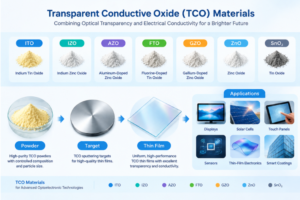


Indium Tin Oxide (ITO) materials are widely used as transparent conductive materials in modern electronic devices, where electrical conductivity and visible light transmission must be achieved at the same time. Transparent electrodes used in displays, touch panels, and photovoltaic devices require materials that can conduct electricity while maintaining optical transparency.This requirement has driven the development of transparent conductive oxide (TCO) materials. Among them, Indium Tin Oxide (ITO) remains one of the most established solutions because it combines high visible light transmission, good electrical conductivity, and mature thin-film processing technology.
ITO materials are commonly supplied in different physical forms depending on the manufacturing process and final application, including:
Selecting the appropriate ITO material form depends not only on purity, but also on processing method, equipment requirements, and the performance requirements of the final product.
What Is Indium Tin Oxide (ITO)?
Indium Tin Oxide (ITO) is a transparent conductive oxide mainly composed of indium oxide (In₂O₃) and tin oxide (SnO₂).Commercial ITO materials are typically based on an In₂O₃-SnO₂ system, with indium oxide accounting for the majority of the composition and tin oxide introduced as a dopant component. A commonly used composition is approximately 90 wt% In₂O₃ and 10 wt% SnO₂, although the exact ratio may vary depending on the target application and deposition requirements.
In the ITO structure, In₂O₃ provides the main oxide semiconductor framework, while SnO₂ doping contributes additional charge carriers and improves electrical conductivity. The balance between composition, carrier concentration, and optical transmission determines the final performance of the material.
ITO is generally classified as an n-type semiconductor oxide. Its electrical and optical behavior is closely associated with factors such as crystal structure, dopant distribution, oxygen vacancy concentration, and thin-film deposition conditions.Through precise control of these factors, ITO can achieve the combination of high visible light transparency and low electrical resistivity required for transparent conductive films in displays, touch panels, photovoltaic devices, and other optoelectronic applications.
Why Is ITO Transparent and Conductive?
The challenge of transparent electrode materials is that electrical conductivity and optical transparency often compete with each other.Metals provide excellent electrical conductivity but block visible light. Insulating materials may transmit light but cannot efficiently transport electrical carriers.
ITO achieves a balance through its semiconductor structure.The transparency of ITO mainly comes from its wide bandgap, which allows most visible light to pass through without strong absorption.
Its conductivity is mainly influenced by:
Tin Doping:During material formation, tin atoms introduce additional charge carriers into the indium oxide lattice. This increases electron concentration and improves electrical conductivity.
Oxygen Vacancy Control:Oxygen vacancies can also contribute free electrons. However, controlling oxygen content is important because excessive defects may influence optical properties and film stability.
In practical thin-film production, ITO performance depends not only on chemical composition but also on sputtering parameters, oxygen conditions, film thickness, and post-treatment processes.
Key Properties of ITO Materials
The performance of ITO materials depends on both intrinsic material characteristics and processing conditions.Typical characteristics include:
| Property | Typical Description |
| Chemical system | In₂O₃-SnO₂ |
| Common composition | 90 wt% In₂O₃ / 10 wt% SnO₂ |
| Material type | n-type semiconductor |
| Crystal structure | Bixbyite structure |
| Bandgap | Approximately 3.5–4.3 eV |
| Visible transparency | Typically above 85–90% for optimized films |
| Electrical resistivity | 10⁻⁴ Ω·cm range for optimized films |
These values represent common ranges reported for ITO films. Actual performance depends on deposition technology, substrate conditions, film thickness, and manufacturing requirements.For industrial applications, material selection should consider the complete process rather than a single specification.
Understanding Different Forms of ITO Materials
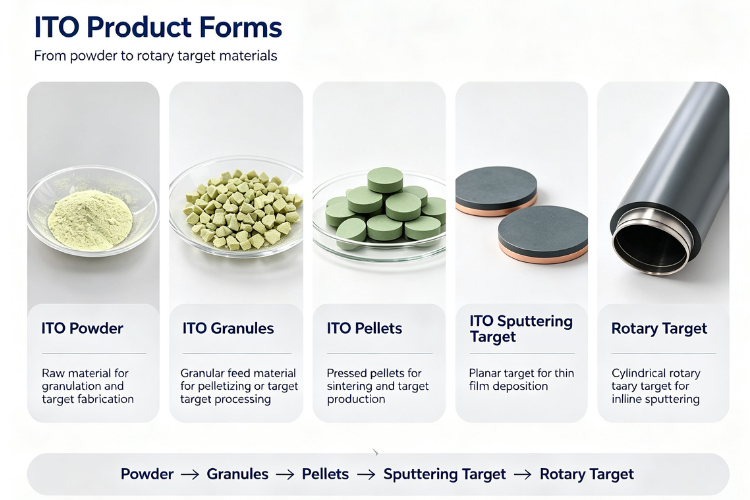
1. ITO Powder
ITO powder is mainly used as a raw material for ceramic processing, especially for manufacturing ITO sputtering targets. Key considerations include chemical purity, composition consistency, particle size distribution, and powder uniformity, which can influence the quality of the final ceramic material.
2. ITO Granules
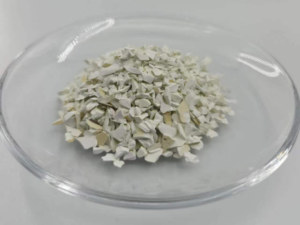
ITO granules provide a larger particle form compared with fine powder, making them easier to handle and suitable for processes requiring controlled material feeding. Selection usually depends on particle size, purity requirements, and compatibility with the specific application.
3. ITO Pellets
ITO pellets are compact forms used when a defined material shape is preferred for certain deposition processes. They are commonly considered for evaporation systems, laboratory coating equipment, and specialized thin-film applications.
ITO sputtering targets are ceramic materials used to produce transparent conductive films through physical vapor deposition, especially magnetron sputtering.Compared with ITO powder, sputtering targets are finished ceramic components that require controlled purity, density, composition uniformity, and mechanical properties to achieve stable deposition performancePlanar ITO targets are commonly used in laboratory systems, research coating equipment, and smaller sputtering systems where flexible operation and easy replacement are important.
ITO rotary targets are designed for large-area coating systems where continuous sputtering operation and high material utilization are required.Compared with planar targets, rotary designs can provide longer operating cycles and are commonly used in industrial coating applications such as large-area glass and display-related production.The selection of a rotary ITO target depends on factors including sputtering equipment configuration, target dimensions, bonding requirements, and production conditions.
How to Select the Right ITO Material?
Choosing the right ITO material depends on how the material will be processed and what performance is required in the final application. Although purity is an important specification, it is not the only factor that determines material suitability.In practical applications, customers also consider material form, particle characteristics, composition consistency, equipment compatibility, and deposition requirements.
Different processes typically require different ITO forms:
| Application Requirement | Recommended ITO Form |
| Ceramic target manufacturing | ITO Powder |
| Controlled material feeding processes | ITO Granules |
| Evaporation or specific deposition systems | ITO Pellets |
| Magnetron sputtering | ITO Sputtering Target |
| Large-area industrial coating | ITO Rotary Target |
For ceramic target manufacturers, ITO powder selection directly influences the subsequent pressing and sintering process, which can affect target density and sputtering performance.For coating companies, finished ITO sputtering targets are usually evaluated based on factors such as target geometry, density, bonding method, and compatibility with the sputtering equipment.Therefore, selecting ITO materials requires considering the entire process chain, from raw material preparation to final thin-film application.
ITO Sputtering and Transparent Conductive Film Production
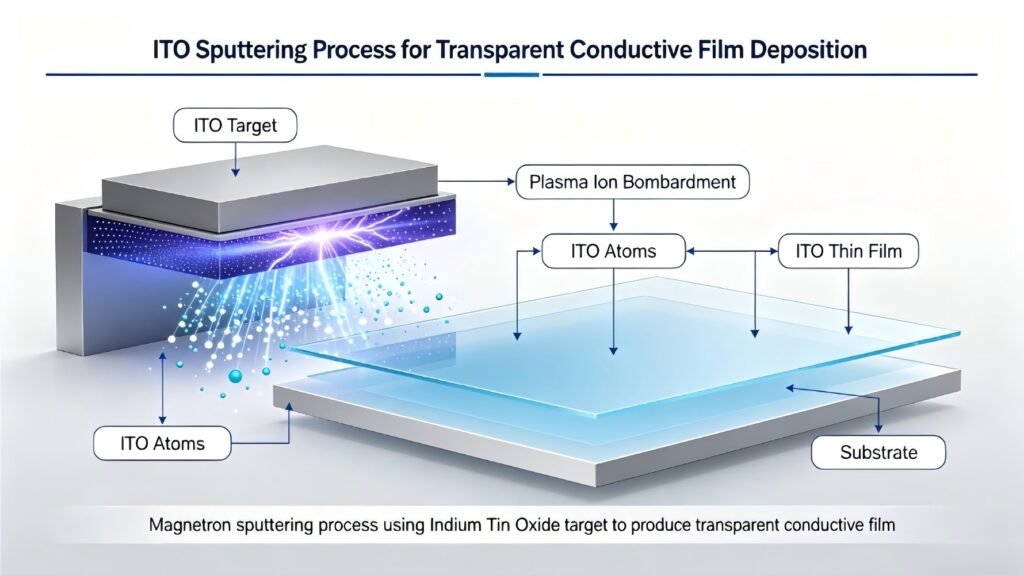
ITO sputtering targets are used to deposit transparent conductive films through physical vapor deposition, especially magnetron sputtering.
The typical production route can be summarized as:
ITO Raw Material→Ceramic Target Manufacturing→ITO Sputtering Target→Magnetron Sputtering→ITO Transparent Conductive Film
During sputtering, plasma ions bombard the ITO target surface and release material atoms, which then deposit onto a substrate to form a thin conductive film.The final film performance depends on both target quality and deposition conditions, including target composition, sputtering parameters, oxygen control, substrate temperature, and film thickness.Therefore, selecting an ITO target requires considering not only material specifications but also the requirements of the sputtering process and final application.
Applications of Indium Tin Oxide (ITO) Materials
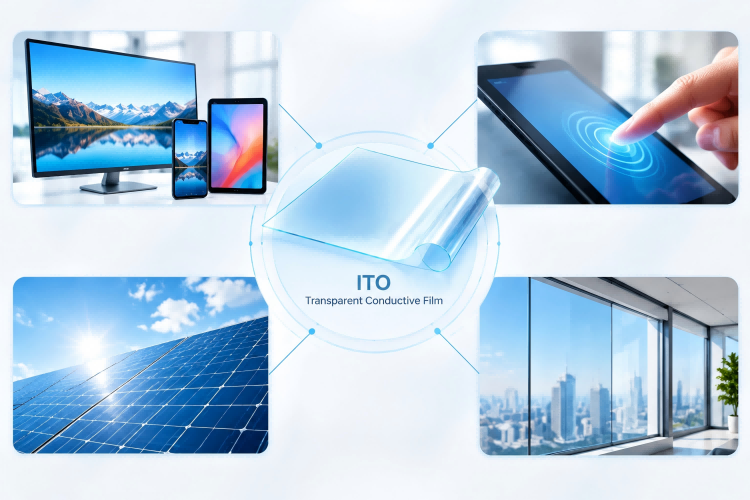
Display Technologies: ITO thin films are widely used as transparent electrodes in LCD displays, OLED displays, and other display panels. The material provides stable electrical conductivity while maintaining high optical transparency and uniform film performance required for advanced display manufacturing.
Touch Panels: ITO is commonly used as a transparent conductive layer in smartphones, tablets, interactive displays, and industrial touch systems. Its combination of electrical conductivity, optical clarity, and mature processing technology makes it suitable for touch sensing applications.
Photovoltaic Devices: ITO functions as a transparent electrode material in thin-film solar cells and other photovoltaic technologies. It allows light transmission into the active layer while providing efficient charge collection and electrical transport.
Optoelectronic Devices: ITO is also applied in transparent heaters, sensors, electro-optical components, and smart window technologies. These applications utilize ITO’s ability to combine transparency, conductivity, and functional thin-film properties.
ITO Compared with Other TCO Materials
Although ITO remains one of the most commercially established transparent conductive oxide (TCO) materials, other TCO materials such as AZO, FTO, and IGZO are also used for specific applications.Material selection depends on factors including electrical performance, optical properties, cost, thermal stability, and device requirements.
| Material | Main Composition | Primary Function | Key Advantages | Typical Applications |
| ITO | In₂O₃-SnO₂ | Transparent conductive electrode | High conductivity, high optical transparency, mature sputtering technology | Displays, touch panels, photovoltaic devices, optoelectronic components |
| AZO | ZnO-Al₂O₃ | Transparent conductive oxide | Indium-free composition, lower material cost potential | Solar cells, transparent electrodes, large-area coatings |
| FTO | SnO₂-F | Transparent conductive oxide | Good thermal stability and chemical durability | Photovoltaic devices, high-temperature applications |
| IGZO | In₂O₃-Ga₂O₃-ZnO | Oxide semiconductor layer | High electron mobility and suitable TFT characteristics | TFT displays and advanced semiconductor devices |
The selection between ITO and other TCO materials depends on the specific requirements of the final device. ITO is mainly used where high conductivity and optical performance are critical, while alternative materials may be considered for applications requiring different cost, stability, or semiconductor characteristics.
FAQs
Indium Tin Oxide (ITO) is a transparent conductive oxide (TCO) material mainly composed of indium oxide (In₂O₃) and tin oxide (SnO₂). It combines high visible light transparency with electrical conductivity, making it widely used for transparent electrodes in displays, touch panels, photovoltaic devices, and other optoelectronic applications.
Commercial ITO materials typically consist of approximately 90 wt% indium oxide (In₂O₃) and 10 wt% tin oxide (SnO₂). The exact composition may vary depending on the required electrical, optical, and deposition performance.
ITO achieves both optical transparency and electrical conductivity because its wide bandgap allows visible light transmission, while tin doping and oxygen vacancy control introduce charge carriers that improve electrical conductivity.
ITO materials are available in several forms, including ITO powder, ITO granules, ITO pellets, and ITO ceramic sputtering targets. Different forms are selected according to the manufacturing process, such as ceramic target production, evaporation, or sputtering deposition.
ITO powder is a raw material used for ceramic processing and target manufacturing. An ITO sputtering target is a finished ceramic component used in sputtering systems to deposit transparent conductive ITO thin films onto substrates.
ITO sputtering targets are mainly used to produce transparent conductive films through magnetron sputtering. These films are commonly applied in display panels, touch screens, photovoltaic devices, and other electronic components.
ITO material selection depends on the application process, deposition equipment, target specifications, composition requirements, purity level, and final thin-film performance requirements.
No. ITO and IGZO are different oxide materials with different functions. ITO is mainly used as a transparent conductive electrode material, while IGZO is an oxide semiconductor commonly used in TFT channel layers.
References
- 1. Ellmer, K. Past Achievements and Future Challenges in the Development of Optically Transparent Electrodes, Nature Photonics, 2012.
- 2. Stadler, A. Transparent Conducting Oxides—An Up-to-Date Overview, Materials, 2012.
- 3. Technical literature related to ITO thin film deposition, transparent conductive oxide materials, and ceramic sputtering target preparation.
Related Articles
- 1.What Are Transparent Conductive Oxide (TCO) Materials? Applications, Materials and Selection Guide
- 2. Understanding Zinc Oxide Materials: From ZnO Powder and Granules to Sputtering Target Production
- 3. How to Choose IGZO Sputtering Target: Key Specifications and Buying Guide
- 4. IGZO vs ITO Sputtering Target: Key Differences, Applications, and Comparison
- 5. IGZO Sputtering Target Quality: How Purity, Composition, and Density Affect Thin Film Performance
- 6. What Is an Indium Zinc Oxide Rotatable Target? Applications, Advantages, and Sputtering Performance
- 7. ITO Rotary vs Planar Target: Which Delivers Better Coating Performance?
- 8. IZTO Sputtering Target: Why It’s Better Than ITO