
MoS2 applications include solid lubrication, tribological coatings, polymer composites, thin films, electronics, sensors, optoelectronics, and catalysis. Its layered crystal structure allows relatively easy shear between adjacent layers, while its thickness-dependent electronic properties make it useful in two-dimensional material research.
For industrial users, however, MoS2 should not be treated as a single specification. Powder used for lubrication, material added to a polymer composite, and few-layer MoS2 used in electronics can require very different material characteristics.
What Makes MoS2 Useful for Different Applications?
Molybdenum disulfide (MoS2) is a layered transition-metal dichalcogenide. Each S–Mo–S layer is strongly bonded within the plane, while adjacent layers interact more weakly.This structure explains much of its practical value. The layers can shear relative to one another, giving MoS2 its well-known solid-lubricating behavior. At the monolayer and few-layer scale, MoS2 also exhibits thickness-dependent electronic properties that have attracted interest for transistors, sensors, and optoelectronic devices.
| Material characteristic | Relevant property | Application |
| Layered structure | Easy interlayer shear | Solid lubrication |
| Lamellar morphology | Low-friction behavior | Tribological coatings |
| Controlled powder characteristics | Dispersion and surface interaction | Lubricants and composites |
| Few-layer structure | Thickness-dependent electronics | 2D devices |
| Phase and defects | Tunable electronic and surface properties | Electronics and catalysis |
The key point is that MoS2 performance depends on more than chemical composition. Purity, morphology, particle size, crystallinity, phase, defects, and operating environment can all affect suitability.
MoS2 Applications in Lubrication, Coatings, and Composites
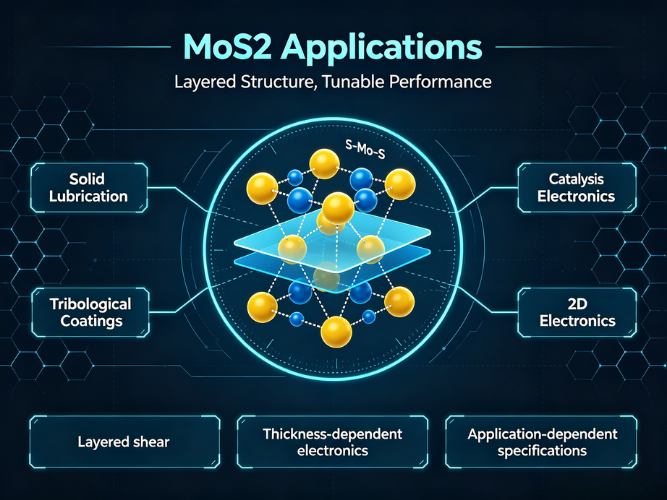
Solid lubrication remains one of the most established uses of MoS2. Its layered crystal structure allows adjacent layers to shear relatively easily, which makes MoS2 useful when conventional oils or greases are difficult to maintain. Typical applications include dry-film lubrication, sliding components, precision mechanisms, vacuum systems, and selected aerospace and space mechanisms.
MoS2 can also be incorporated into tribological coatings and polymer composites. In coating systems, PVD and sputtering are commonly used to deposit MoS2-based films. The final friction, wear resistance, adhesion, and service life depend not only on the starting material but also on deposition pressure, substrate condition, film thickness, microstructure, and operating environment. Doped or composite MoS2 coatings may be considered when greater mechanical or environmental stability is required.
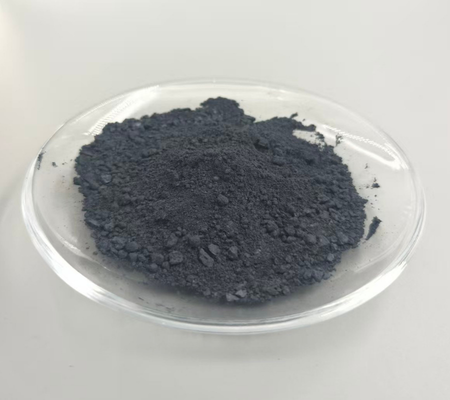
For polymer composites, MoS2 acts as a solid-lubricating filler. Its effectiveness depends strongly on dispersion within the polymer matrix. Particle size, morphology, surface characteristics, loading level, and processing conditions all affect the final tribological behavior. There is therefore no single MoS2 particle size that is optimal for every composite; the appropriate grade depends on the matrix and the required friction, wear, and dispersion characteristics.
MoS2 Applications in Thin Films, Electronics, and Sensors
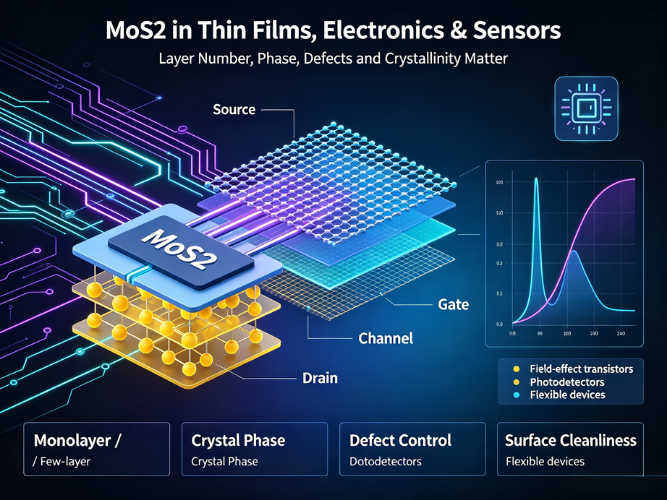
MoS2 is also used as a material for thin-film research and two-dimensional electronic devices. Sputtered MoS2 films can be investigated for tribological surfaces as well as functional, electronic, sensor, and optoelectronic applications. In these systems, the properties of the final film are determined by both the source material and the deposition process. Working pressure, power, substrate temperature and condition, atmosphere, and film thickness can all influence film structure and performance.
For two-dimensional electronics, the material requirements are different from those of conventional bulk MoS2 powder or lubrication grades. Monolayer and few-layer MoS2 have been studied for field-effect transistors, photodetectors, sensors, and flexible electronic devices. Layer number, crystal phase, defect concentration, crystallinity, surface cleanliness, and grain structure can become critical parameters.
This distinction is important when selecting MoS2. High chemical purity is valuable, but it does not by itself define whether a material is suitable for a particular thin-film or electronic application. A MoS2 grade intended for solid lubrication should not automatically be treated as equivalent to a material engineered for two-dimensional device fabrication.
MoS2 Applications in Catalysis and Advanced Materials
MoS2 is also investigated in catalytic systems, particularly for the hydrogen evolution reaction. In this field, surface structure is a major consideration. Catalytic activity can be influenced by the availability of edge sites and defects, crystal phase, surface area, and electrical conductivity.
These requirements are different from those of lubrication applications. A MoS2 material selected for low-friction performance may not have the surface structure or defect characteristics required for efficient catalytic activity.
Taken together, these applications show that MoS2 is not a single-purpose material. Its layered structure supports solid lubrication and tribological applications, while controlled thickness, phase, defects, morphology, and surface characteristics open applications in composites, thin films, electronics, sensors, and catalysis. Material selection should therefore begin with the intended application and then define the appropriate purity, physical form, particle characteristics, structure, and processing requirements.
How to Select MoS2 for Different Applications
The most effective selection process starts with the intended application rather than with a single specification.
| Application | Material form | Main parameters to consider |
| Solid lubrication | Powder / film | Purity, particle size, morphology, environment |
| Polymer composites | Powder | Particle size, dispersion, morphology, loading |
| Tribological coating | Sputtering target / source | Purity, composition, density, microstructure, deposition conditions |
| Thin films | Powder / target | Purity, composition, substrate, deposition parameters |
| 2D electronics | Few-layer / monolayer material | Layer number, phase, defects, crystallinity |
| Catalysis | Nanostructured MoS2 | Edge sites, defects, phase, surface area |
How We Recommend Selecting MoS2
When selecting MoS2 for a specific application, we recommend defining the intended use first and then matching the material specification to the process requirements.
For lubrication and composite applications, particle size, morphology, purity, and dispersion behavior are important. For sputtering and thin-film applications, the physical form, chemical composition, purity, and consistency of the starting material should be considered together with the deposition process. Applications involving electronics or catalysis may require additional control of crystal structure, layer characteristics, defects, or surface properties.
For MoS2 selection, we recommend defining the application and processing method before specifying the material grade. For example, a lubricant additive, polymer filler, sputtering source, and research-grade 2D material can require different combinations of purity, particle characteristics, morphology, and structural control.ULPMAT can provide MoS2 materials according to the requirements of different technical applications, with specifications such as purity and physical form defined for the intended use. We recommend discussing the application, processing method, and required material characteristics before selecting a grade.
For product specifications and available forms, see the ULPMAT Molybdenum Sulfide Powder page.
Conclusion
MoS2 is used in several technical fields, including solid lubrication, tribological coatings, polymer composites, thin films, 2D electronics, sensors, and catalysis. The reason it can serve such different applications is that its performance is strongly related to its layered structure and can be further influenced by particle characteristics, crystal phase, defects, morphology, and surface properties.
The material requirements are therefore application-dependent. Powder used as a lubricant or composite filler may require attention to particle size, morphology, purity, and dispersion, while sputtering and thin-film applications place greater emphasis on composition, film structure, and deposition conditions. Electronics and catalytic applications can require additional control of layer number, crystal phase, defects, or active surface characteristics.
For MoS2 selection, the intended application and processing method should be defined before choosing the material specification. Purity is important, but it should be considered together with physical form, structure, morphology, and application-specific requirements.
FAQs
The main MoS2 applications include solid lubrication, tribological coatings, polymer composites, thin films, 2D electronics, sensors, optoelectronics, and catalysis. The required material characteristics vary according to the application and processing method.
MoS2 has a layered crystal structure with relatively weak interactions between adjacent layers, allowing the layers to shear more easily. This makes MoS2 useful for dry lubrication and selected vacuum, aerospace, and space applications.
Yes. Monolayer and few-layer MoS2 have been studied for field-effect transistors, sensors, photodetectors, flexible electronics, and other two-dimensional devices. Layer number, crystal phase, defects, crystallinity, and surface condition can be important.
Yes. MoS2 can be deposited as a tribological coating using PVD, sputtering, and related thin-film processes. Film thickness, microstructure, adhesion, deposition conditions, and service environment can all affect coating performance.
Yes. Particle size can affect dispersion, surface interaction, processing behavior, and tribological performance in powder-based applications. The appropriate particle size depends on the matrix, formulation, processing method, and intended use.
Yes. MoS2 can be used as a starting material for sputtered and other thin-film systems, including tribological and functional coatings. Final film properties depend on both the starting material and deposition parameters.
Not necessarily. Purity is important, but particle size, morphology, crystal structure, phase, defects, and processing requirements can also determine performance. A grade suitable for lubrication may not be suitable for electronic or catalytic applications.
Selection should begin with the intended application, physical form, and processing method. Purity, particle characteristics, morphology, structure, and operating conditions should then be matched to the specific requirements of the application.
References
- 1. Vazirisereshk et al. “Solid Lubrication with MoS2: A Review.” Lubricants, 2019.
- 2. “Tribological Performance of MoS2 Coatings in Various Environments.” Lubricants, 2016.
- 3. “Evolution Application of Two-Dimensional MoS2-Based Field-Effect Transistors.” Review article.
- 4. “Electrocatalytic Hydrogen Evolution from Molybdenum Disulfide.” Nature Portfolio.