

Ti2AlC vs Ti3AlC2: Which One Is Better?
Technical Review
Reviewed by ULPMAT Materials Team
Technical Expertise:
MAX Phase Materials | Advanced Ceramics | High-Purity Powders
Quick Answer: Ti₂AlC vs Ti₃AlC₂
Ti₂AlC is generally preferred for wear resistance and low-friction applications, while Ti₃AlC₂ is preferred for high-temperature oxidation resistance and Ti₃C₂ MXene production.
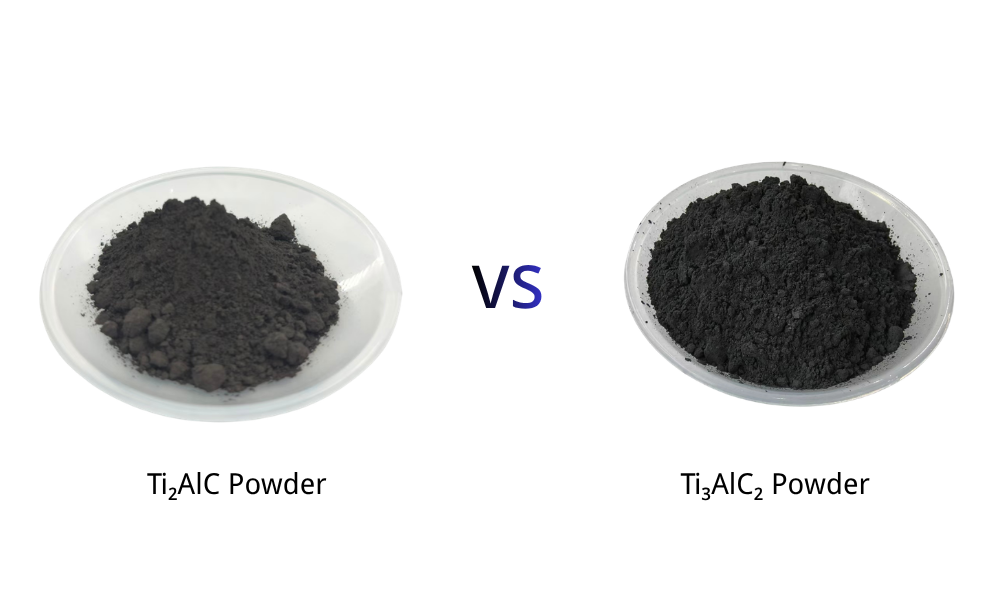
What Are Ti₂AlC and Ti₃AlC₂ MAX Phase Materials?
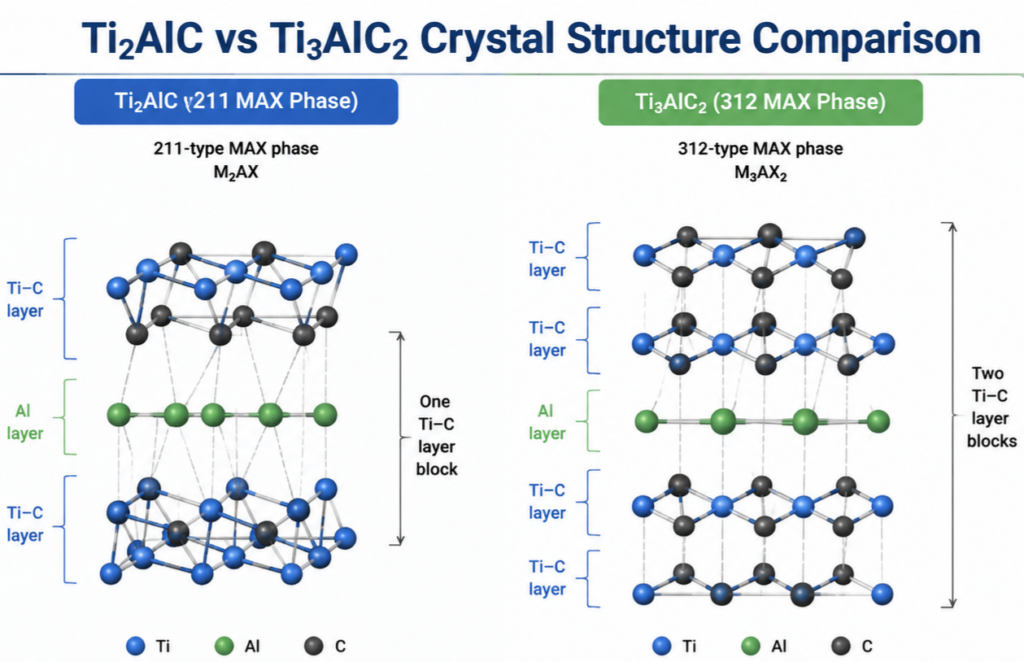
Ti₂AlC is a 211-type MAX phase material composed of titanium, aluminum, and carbon. Ti₃AlC₂ is a 312-type MAX phase material and one of the most important precursors for Ti₃C₂ MXene synthesis. As layered ternary carbides in the MAX phase family, they follow the general formula Mn+1AXn and share a hexagonal structure with strong Ti–C layers and weaker Ti–Al bonds, which gives them a combination of ceramic-like stability and metallic-like conductivity. The main difference is their stacking sequence: Ti₂AlC contains one Ti–C block per unit cell, while Ti₃AlC₂ contains two, resulting in different mechanical, thermal, and oxidation behaviors.
Crystal Structure Differences Between Ti₂AlC and Ti₃AlC₂
Ti₂AlC and Ti₃AlC₂ are both MAX phase materials with the same constituent elements (Ti, Al, and C), but their different atomic stacking sequences result in distinct mechanical and thermal properties. Both crystallize in the hexagonal structure (space group P6₃/mmc), while the number of Ti–C layer blocks differentiates the two phases. Ti₂AlC is a 211-type MAX phase with one Ti–C layer block, whereas Ti₃AlC₂ is a 312-type MAX phase containing two Ti–C layer blocks. The additional Ti–C layer in Ti₃AlC₂ strengthens Ti–C bonding, leading to improved oxidation resistance and high-temperature stability, while Ti₂AlC generally offers better machinability and tribological performance.
| Feature | Ti₂AlC | Ti₃AlC₂ |
| MAX phase type | 211 (M₂AX) | 312 (M₃AX₂) |
| Crystal system | Hexagonal (P6₃/mmc) | Hexagonal (P6₃/mmc) |
| Ti–C layer blocks | One | Two |
| Ti–C bond proportion | Lower | Higher |
| Ti–Al bonding influence | More significant | Less significant |
| Main structural advantage | Better machinability and damage tolerance | Better oxidation resistance and high-temperature stability |
| Typical application focus | Wear-resistant coatings, tribological materials | MXene precursor, high-temperature ceramics, advanced composites |
Ti₂AlC vs Ti₃AlC₂ Properties Comparison
Ti₂AlC and Ti₃AlC₂ Performance Comparison Table
The different atomic structures of Ti₂AlC and Ti₃AlC₂ result in different mechanical, thermal, and functional properties.
The following table summarizes their main characteristics:
| Property | Ti₂AlC | Ti₃AlC₂ |
| MAX phase type | 211 MAX phase | 312 MAX phase |
| Chemical formula | Ti₂AlC | Ti₃AlC₂ |
| Crystal structure | Hexagonal | Hexagonal |
| Main bonding structure | Ti-C layers + Al layers | More Ti-C layers + Al layers |
| Hardness | Higher in many reported thin-film studies | Moderate |
| Friction coefficient | Generally lower | Relatively higher in some tribological studies |
| Oxidation resistance | Good | Excellent |
| High-temperature stability | Good | Better at elevated temperatures |
| Electrical conductivity | Metallic-like | Metallic-like |
| Thermal conductivity | High | High |
| MXene precursor | Not commonly used | Important precursor for Ti₃C₂ MXene |
| Typical applications | Wear-resistant coatings, tribological materials, conductive ceramics | MXene synthesis, high-temperature materials, ceramic composites |
Mechanical Properties and Hardness Comparison
Hardness is one of the key factors when comparing Ti₂AlC and Ti₃AlC₂ for structural and coating applications. Reported values vary with the material form (bulk or thin film), synthesis method, density, and testing technique.
Ti₂AlC generally exhibits higher hardness, especially in thin-film form. Nanoindentation studies have reported hardness values of 10–12 GPa, while bulk Ti₂AlC typically ranges from 4–7 GPa, depending on processing conditions. Its relatively high hardness contributes to good wear resistance, making it suitable for protective coatings and tribological applications.
Ti₃AlC₂ generally shows moderate hardness, with bulk materials commonly reported in the range of 3–6 GPa. Although it is less hard than Ti₂AlC, Ti₃AlC₂ offers better oxidation resistance, excellent thermal stability (up to about 1200 °C), and maintains metallic-like electrical conductivity at elevated temperatures. Therefore, Ti₂AlC is generally preferred for applications requiring higher hardness and wear resistance, whereas Ti₃AlC₂ is better suited for high-temperature environments where thermal stability and oxidation resistance are the primary considerations.
Tribological Properties and Wear Resistance
Ti₂AlC generally exhibits lower friction coefficients and better wear resistance than Ti₃AlC₂, making it a preferred choice for tribological applications. In thin-film studies, Ti₂AlC typically shows friction coefficients of 0.2–0.4 under dry sliding against steel. Its layered crystal structure promotes shear deformation and the formation of protective tribofilms, helping to reduce friction and wear. As a result, Ti₂AlC is widely investigated for wear-resistant coatings, sliding components, and other friction-related applications.
Ti₃AlC₂ also exhibits good tribological performance, although its friction and wear behavior is more dependent on testing conditions, including the counter material, applied load, atmosphere, and temperature. Compared with Ti₂AlC, it is generally selected for applications where oxidation resistance, high-temperature stability (up to about 1200 °C), or Ti₃C₂ MXene production is more important than achieving the lowest possible friction coefficient.
Ti₃AlC₂ as a MXene Precursor
One of the most significant advantages of Ti₃AlC₂ is its role as a precursor for Ti₃C₂ MXene. By selectively removing the aluminum (Al) layers, the layered Ti₃AlC₂ structure can be converted into two-dimensional Ti₃C₂ MXene, which has attracted extensive interest for energy storage, electromagnetic shielding, sensors, and electronic devices.
This capability distinguishes Ti₃AlC₂ from Ti₂AlC and is one of the main reasons why Ti₃AlC₂ is widely studied in MAX phase research. For a detailed explanation of the conversion process and MXene applications, see our article “What Is Ti3AlC2 MAX Phase and Why Does It Combine Ceramic and Metallic Properties?”
Applications of Ti₂AlC and Ti₃AlC₂
Ti₂AlC is primarily investigated for applications that benefit from its combination of hardness, machinability, wear resistance, and thermal stability. These properties make it suitable for wear-resistant coatings, tribological components, conductive ceramic parts, and structural materials operating under demanding conditions.
Ti₃AlC₂, by contrast, is best known for its excellent oxidation resistance and its role as a precursor for Ti₃C₂ MXene. It is widely studied for MXene-related research, high-temperature ceramic composites, thermal protection materials, and multifunctional composites that take advantage of its layered structure and electrical conductivity.
How to Choose Between Ti₂AlC and Ti₃AlC₂?
Although Ti₂AlC and Ti₃AlC₂ have the same elemental composition, their different crystal structures provide different advantages. The choice mainly depends on whether the application requires higher wear resistance or better oxidation resistance and high-temperature performance.
Ti₂AlC is generally preferred for wear-resistant and low-friction applications. Its higher hardness, good machinability, and layered structure make it suitable for protective coatings, sliding components, tribological studies, and conductive ceramic applications.
Ti₃AlC₂ is more suitable for high-temperature applications and MXene-related research. Its excellent oxidation resistance and ability to produce Ti₃C₂ MXene make it attractive for advanced ceramics, composites, and functional materials.
Ti₂AlC vs Ti₃AlC₂ Selection Guide
| Application Requirement | Recommended Material | Reason |
| Wear-resistant coatings | Ti₂AlC | Higher hardness and better tribological performance |
| Low-friction applications | Ti₂AlC | Layered structure and sliding behavior |
| Ti₃C₂ MXene synthesis | Ti₃AlC₂ | Al layers can be selectively removed |
| High-temperature oxidation resistance | Ti₃AlC₂ | Better oxidation stability |
| Conductive ceramic applications | Both | Metallic-like electrical conductivity |
| MAX phase research | Both | Different structural advantages |
FAQs
Q1: What is the difference between Ti₂AlC and Ti₃AlC₂?
A1: Ti₂AlC and Ti₃AlC₂ are both titanium aluminum carbide MAX phase materials, but they have different crystal structures. Ti₂AlC is a 211-type MAX phase with one Ti–C layer block, while Ti₃AlC₂ is a 312-type MAX phase with two Ti–C layer blocks. This structural difference results in different mechanical properties, oxidation resistance, and application advantages.
Q2: Which is harder, Ti₂AlC or Ti₃AlC₂?
A2: Ti₂AlC generally shows higher hardness, especially in thin-film form, with reported hardness values of approximately 10–12 GPa. Bulk Ti₃AlC₂ typically shows moderate hardness around 3–6 GPa but provides better oxidation resistance and high-temperature stability. Ti₂AlC is generally preferred for wear-resistant applications.
Q3: Is Ti₃AlC₂ a MAX phase material?
A3: Yes. Ti₃AlC₂ is a 312-type MAX phase composed of titanium, aluminum, and carbon. Its layered hexagonal structure provides a combination of ceramic-like properties, such as oxidation resistance and thermal stability, with metallic-like electrical conductivity.
Q4: Can Ti₃AlC₂ be used to produce Ti₃C₂ MXene?
A4: Yes. Ti₃AlC₂ is one of the most widely used precursors for Ti₃C₂ MXene synthesis. During selective etching, aluminum layers are removed from Ti₃AlC₂, producing two-dimensional Ti₃C₂ MXene materials.
Q5: What are the main applications of Ti₂AlC?
A5: Ti₂AlC is mainly investigated for wear-resistant coatings, tribological components, conductive ceramics, and structural applications requiring good hardness, machinability, and thermal stability.
Q6: What are the main applications of Ti₃AlC₂?
A6: Ti₃AlC₂ is widely studied for Ti₃C₂ MXene production, high-temperature ceramic composites, advanced materials research, and functional composites.
Q7: Which one should I choose, Ti₂AlC or Ti₃AlC₂?
A7: Ti₂AlC is generally preferred for wear resistance, low-friction applications, and protective coatings. Ti₃AlC₂ is more suitable for high-temperature applications, oxidation-resistant materials, and MXene-related research.