

Strontium Carbonate (SrCO3) is an important inorganic compound widely used as a raw material in ferrite materials, electronic ceramics, and specialty glass applications. Due to its stable chemical properties, excellent thermal behavior, and compatibility with high-temperature ceramic processing, this compound has become one of the most important strontium sources in industrial material manufacturing.
Among various applications, the production of strontium ferrite is the most significant use of Strontium Carbonate. It provides the strontium component required for forming magnetic ceramic structures and plays an important role in determining the performance, consistency, and processing efficiency of ferrite materials.
What Is Strontium Carbonate (SrCO₃)?
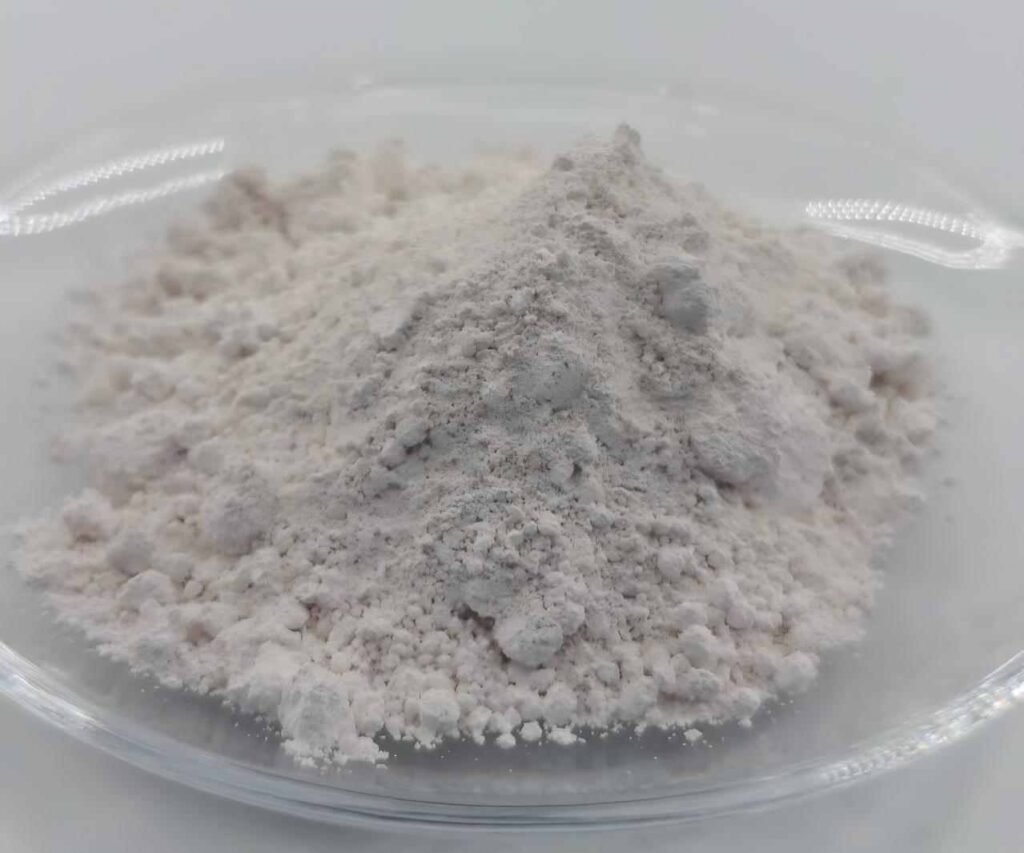
This inorganic carbonate compound has the chemical formula SrCO3 and CAS number 1633-05-2. It is typically a white powder, renowned for its chemical stability and reliable performance in high-temperature reactions.Unlike some highly reactive strontium compounds, strontium carbonate exhibits good storage stability and convenient handling characteristics, making it suitable for large-scale industrial applications.
Key properties of strontium carbonate include:
- Chemically stable composition
- Good thermal decomposition properties
- Compatibility with ceramic processing techniques
- Controllable particle size
- Suitable for high-temperature synthesis
Due to these properties, it is often chosen as a precursor material rather than directly used as a final functional material.
Why Is Strontium Carbonate Used in Ferrite Materials?
Ferrite materials are ceramic compounds containing iron oxide combined with other metal elements. They are widely used for permanent magnets because of their magnetic properties, chemical stability, and relatively low production cost.
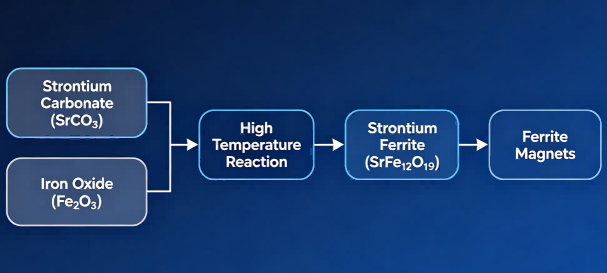
It is mainly used as a strontium source during the production of strontium ferrite magnets.During the high-temperature reaction process, Strontium Carbonate reacts with iron oxide to form strontium ferrite:
SrCO₃ + Fe₂O₃ → SrFe₁₂O₁₉ + CO₂
The formed strontium ferrite (SrFe₁₂O₁₉) belongs to the hexagonal ferrite family and is widely used in permanent magnet applications.
The advantages of using Strontium Carbonate include:
1. Stable Strontium Source
Strontium Carbonate provides a consistent amount of strontium during the ceramic reaction process. This helps manufacturers maintain stable composition control and achieve predictable material performance.
2. Suitable Reaction Behavior
During heating, SrCO₃ gradually decomposes and reacts with iron oxide. This controlled reaction behavior supports uniform ferrite formation and efficient ceramic processing.
3. Industrial Processing Compatibility
The powder material can be easily mixed with other ceramic raw materials, making it suitable for large-scale ferrite manufacturing processes.
Applications
Ferrite Magnets
One of the most important applications of Strontium Carbonate is the production of strontium ferrite magnets. During the high-temperature manufacturing process, this compound provides the strontium source required to react with iron oxide and form strontium ferrite, a widely used magnetic ceramic material.
Strontium ferrite magnets are valued for their excellent corrosion resistance, stable magnetic performance, cost-effective production, and long service life. These characteristics make them suitable for a wide range of applications, including electric motors, loudspeakers, magnetic separators, automotive components, and household electronic products.
The quality and consistency of the raw material can influence the reaction process, crystal structure formation, and final magnetic performance of ferrite materials. Therefore, reliable material selection is important for manufacturers producing permanent magnets.
Electronic Ceramic Materials
Beyond ferrite magnet production, strontium-based compounds are also used in electronic ceramic formulations. These materials can provide specific electrical, thermal, and structural properties required for functional ceramic components.As a stable source of strontium, SrCO₃ can participate in high-temperature ceramic reactions to form functional phases with controlled composition. This makes it suitable for applications involving electronic ceramic components, dielectric ceramic systems, and advanced ceramic materials.
With the continuous development of electronic devices and functional materials, stable ceramic raw materials remain essential for achieving consistent manufacturing performance.
Specialty Glass Applications
Strontium compounds are also used in specialty glass manufacturing. During high-temperature processing, Strontium Carbonate can decompose and provide strontium oxide, which helps modify the composition and properties of glass formulations.In these applications, strontium-containing materials can contribute to improvements in optical performance, chemical stability, and specific physical characteristics required by advanced glass products. As a result, this material continues to be an important raw material for specialty glass industries.
What Factors Affect the Performance of Strontium Carbonate Powder?
The performance of Strontium Carbonate Powder in industrial applications depends on several important material characteristics. Factors such as purity, particle size distribution, and chemical consistency can influence the reaction process, processing efficiency, and final properties of ceramic and ferrite materials.
Purity:The purity level of Strontium Carbonate Powder plays an important role in industrial manufacturing. High purity materials help minimize unwanted impurities that may interfere with ceramic reactions, magnetic performance, or the consistency of final products.
Particle Size Distribution:Particle size distribution can affect powder mixing, reaction efficiency, and sintering behavior during high-temperature processing. A suitable particle size range helps improve material uniformity and supports stable production processes.
Chemical Consistency:Consistent chemical composition is essential for manufacturers producing ferrite materials and ceramic products on a large scale. Reliable raw material quality helps maintain stable processing conditions and achieve consistent product performance.
Conclusion
High-purity strontium carbonate with stable chemical composition and reliable quality is key to achieving stable production performance. Reliable strontium carbonate suppliers can provide suitable material specifications, including controllable purity and particle size characteristics, to meet the needs of diverse industrial applications. With the continued growth in demand for permanent magnets, electronic components, and advanced ceramic materials, strontium carbonate remains a crucial raw material supporting modern materials technology. A reliable supply of high-quality strontium carbonate powder will continue to play a vital role in improving material performance and production consistency.