

Key Considerations for Aqueous Battery Cathode Materials
Material Overview
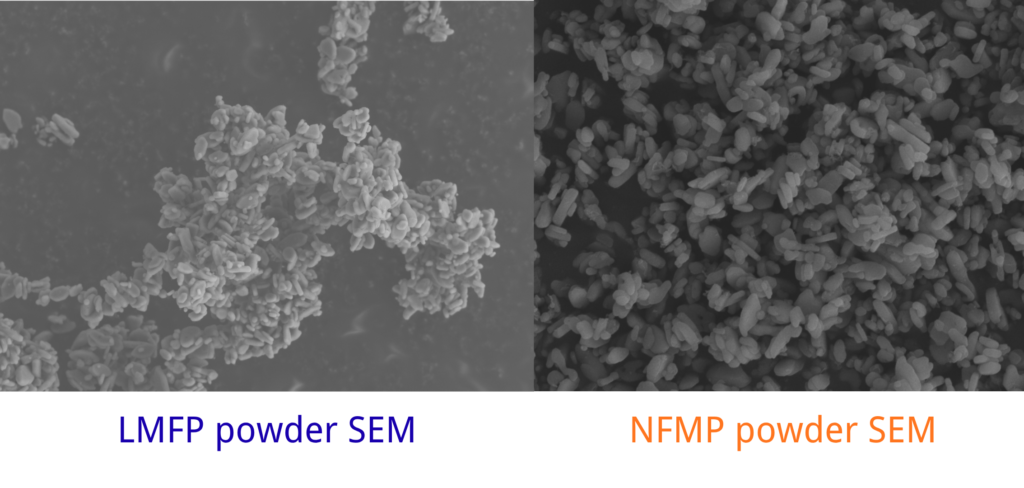
Lithium Manganese Iron Phosphate -LMFP (LiMnₓFe₁₋ₓPO₄)
LMFP is a lithium-based olivine-structured cathode material derived from LFP, where manganese is partially substituted to increase operating voltage.
When evaluating cathode materials for aqueous battery systems, the decision is rarely about a single parameter. Whether you are a battery researcher, procurement manager, or system integrator, your concerns are typically practical and multi-dimensional:
- Can this material maintain stable cycling performance in water-based electrolytes?
- Is the material suitable for scale-up production and long-term supply?
- How does the cost-performance ratio compare between lithium-based and sodium-based systems?
- Which material is better suited for grid-scale storage versus laboratory research?
Two materials frequently appear in these discussions:
- Lithium Manganese Iron Phosphate (LiMnₓFe₁₋ₓPO₄)
- Sodium Iron Manganese Phosphate (NaFeMnPO₄)
Both belong to the phosphate family and share structural similarities, but they differ significantly in system compatibility, cost structure, and application strategy.
Below, we provide a practical analysis based on real-world application considerations.
Key characteristics:
- Olivine structure (stable framework)
- Higher voltage than LFP (due to Mn redox contribution)
- Moderate electronic conductivity (often requires carbon coating)
Common use:
- Widely applied in conventional lithium-ion batteries.
- Suitable for hybrid aqueous lithium battery systems.
- Valuable for developing safer cathode materials in energy storage research.
Sodium Iron Manganese Phosphate-NaFeMnPO4 NFMP
NFMP is a sodium-based phosphate cathode material, also with olivine-type structure, designed for sodium-ion systems.
Key characteristics:
- Larger ionic radius (Na⁺ vs Li⁺)
- Lower cost raw materials
- Compatible with aqueous sodium electrolytes
Common use:
- Widely applied in advanced sodium-ion batteries.
- Well-suited for modern aqueous energy storage systems.
- Ideal for large-scale grid-scale energy storage applications.
Core Performance Comparison
| Parameter | LMFP | NFMP |
|---|---|---|
|
Crystal structure |
Olivine |
Olivine |
|
Charge carrier |
Li⁺ |
Na⁺ |
|
Working voltage (non-aqueous reference) |
~3.5–4.1 V vs Li/Li⁺ |
~3.0–3.5 V vs Na/Na⁺ |
|
Theoretical capacity |
~170 mAh/g (similar to LFP range) |
~150–165 mAh/g (reported range) |
|
Electronic conductivity |
Low |
Low |
|
Ionic diffusion |
Moderate |
Moderate–fast |
|
Cost |
Higher (Li) |
Lower (Na) |
|
Resource availability |
Limited |
Abundant |
Important note for aqueous systems:
Due to water decomposition (~1.23 V window), practical cell voltage is much lower, and material performance depends heavily on electrolyte engineering.
Performance in Aqueous Battery Systems
LMFP in Aqueous Systems
Strengths:
- Structural stability under repeated cycling
- Well-studied lithium diffusion pathways
- Compatible with modified aqueous electrolytes (e.g., high-concentration salts)
Limitations
- Lithium cost and supply constraints
- Reduced effective voltage in aqueous systems
- Requires surface modification for stability
NFMP in Aqueous Systems
Strengths:
- Lower material cost (sodium abundance)
- Better suitability for large-scale systems
- Compatible with sodium-based aqueous electrolytes
Limitations:
- Larger Na⁺ radius → slower kinetics in some structures
- Lower energy density compared to lithium systems
- Less mature industrial ecosystem
What do customers primarily value when making a purchase?
From a buyer’s perspective, material selection is rarely about a single parameter.
1. Cost vs Performance
- LMFP → higher cost, better maturity
- NFMP → lower cost, scalable
If your priority is budget control, sodium wins.
Application Scenario
| Scenario | Recommended Material |
|---|---|
|
Prototype battery design |
LMFP |
|
Grid energy storage |
NFMP |
|
Low-cost systems |
NFMP |
|
Laboratory research |
LMFP |
Supply Chain Stability
- Lithium → price fluctuations
- Sodium → widely available
Long-term projects tend to favor sodium systems.
Energy Density vs Safety Trade-Off
A key reality in aqueous batteries:
- Energy density is lower than non-aqueous systems
- Safety is significantly higher
Comparison Insight:
- LMFP → slightly higher energy potential
- NFMP → better system-level cost efficiency
Practical Selection Guide
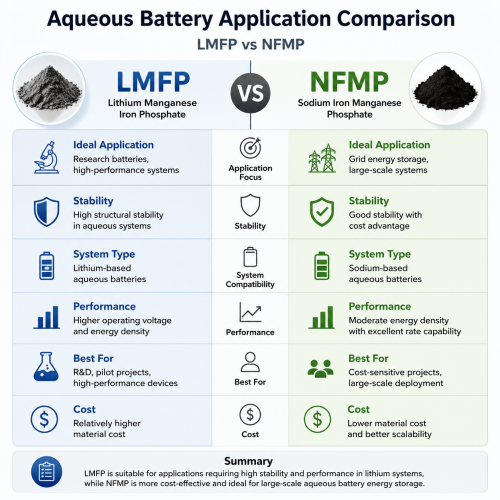
Choose LMFP if:
- You are working on lithium-based systems
- You need better electrochemical consistency
- You are in R&D or academic research
Choose NFMP if:
- You are designing large-scale storage systems
- Cost is a major constraint
- You prefer sodium-ion ecosystem development
Conclusion
LMFP and NFMP are both promising cathode materials for aqueous battery systems, but they are designed for different priorities.
- LMFP offers better maturity and electrochemical stability, making it suitable for research and lithium-based systems.
- NFMP provides cost advantages and scalability, making it more attractive for large-scale energy storage applications.
The final choice depends on your application goals, cost constraints, and system design strategy.