

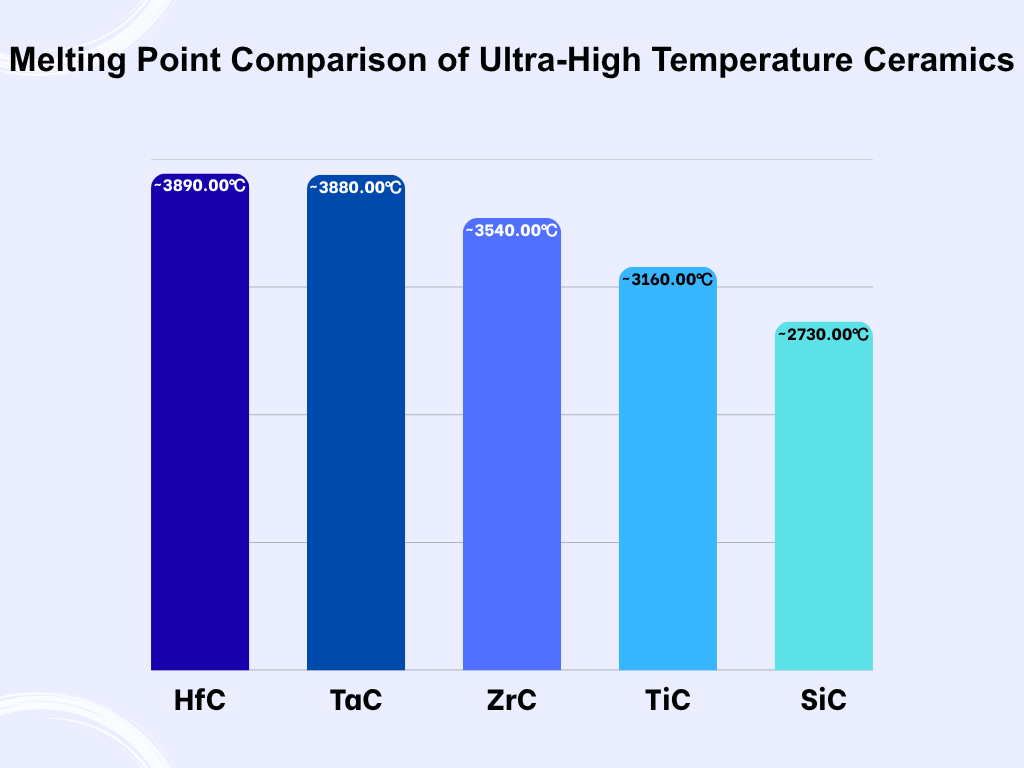
Hafnium carbide (HfC) is widely recognized as one of the most promising ultra-high temperature ceramic (UHTC) materials due to its exceptional thermal stability, high hardness, and resistance to extreme environments.The hafnium carbide melting point is approximately 3890°C, making HfC one of the ceramic materials with the highest melting temperatures currently known. This outstanding thermal performance allows hafnium carbide ceramics to maintain structural stability under conditions where conventional materials fail.
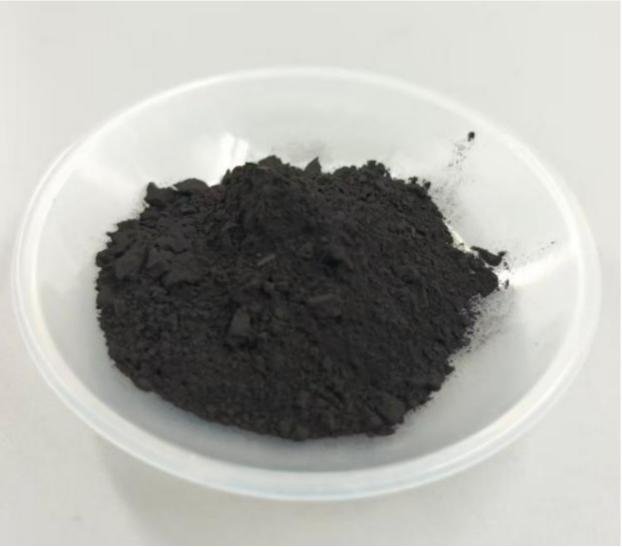
Because of these unique properties, hafnium carbide is attracting increasing attention for applications including aerospace thermal protection systems, hypersonic vehicles, high-temperature coatings, and advanced ceramic composites.For advanced manufacturing and research applications, high-purity hafnium carbide powder is commonly used as a starting material for producing HfC-based ceramic components.
What Is the Hafnium Carbide Melting Point?
Hafnium carbide belongs to the ultra-high temperature ceramic (UHTC) family. Compared with other UHTC materials, HfC exhibits one of the highest melting points, together with tantalum carbide (TaC), while each material offers different advantages depending on the application requirements.
| Property | Hafnium Carbide | Tantalum Carbide | Zirconium Carbide | Hafnium Diboride | Zirconium Diboride |
| Chemical Formula | HfC | TaC | ZrC | HfB2 | ZrB2 |
| Melting Point | ~3890°C | ~3880°C | ~3540°C | ~3250°C | ~3245°C |
| Crystal Structure | Cubic (NaCl-type) | Cubic (NaCl-type) | Cubic (NaCl-type) | Hexagonal | Hexagonal |
| Density | ~12.7 g/cm³ | ~14.5 g/cm³ | ~6.6 g/cm³ | ~10.5 g/cm³ | ~6.1 g/cm³ |
| Hardness | ~20–30 GPa | ~20–30 GPa | ~15–25 GPa | ~20–25 GPa | ~20–25 GPa |
| Thermal Conductivity | ~20–30 W/(m·K) | ~20–30 W/(m·K) | ~20–25 W/(m·K) | ~60–100 W/(m·K) | ~50–100 W/(m·K) |
| Main Advantages | Highest melting temperature, excellent thermal stability | High hardness, wear resistance, extreme temperature capability | Lightweight UHTC option, good thermal stability | High thermal conductivity, oxidation resistance | Good thermal shock resistance |
Among these materials, hafnium carbide and tantalum carbide show the highest melting temperatures, both approaching 3900°C. This exceptional thermal stability makes them suitable for extreme environments where conventional ceramic materials cannot maintain performance.
Why Does Hafnium Carbide Have Such a High Melting Point?
The exceptional hafnium carbide melting point is mainly attributed to its strong atomic bonding, stable crystal structure, and unique thermophysical properties. The strong bonding between hafnium and carbon atoms requires significant energy to break, allowing HfC to maintain excellent mechanical strength and structural stability even at temperatures approaching 3900°C. This strong Hf–C bonding network also contributes to its high hardness, resistance to thermal deformation, and outstanding performance in extreme environments.
Hafnium carbide adopts a stable face-centered cubic (NaCl-type) crystal structure, which provides excellent lattice stability under high-temperature conditions. This highly ordered structure helps HfC maintain its dimensional stability, mechanical integrity, and resistance to creep deformation during prolonged thermal exposure. The combination of strong chemical bonding and a stable crystal lattice is one of the key reasons why HfC performs exceptionally well among ultra-high temperature ceramic materials.
In addition to its extremely high melting point, hafnium carbide demonstrates excellent thermal stability and resistance to harsh operating conditions. HfC can withstand high heat flux, thermal shock, and rapid temperature changes, making it suitable for demanding applications such as aerospace thermal protection systems, hypersonic vehicles, and advanced ceramic composites. When combined with appropriate protective systems, hafnium carbide can provide reliable performance in extreme high-temperature environments.
Common Processing Methods for Hafnium Carbide
The properties of hafnium carbide ceramics depend not only on the properties of hafnium carbide (HfC) itself, but also on the manufacturing process used to prepare the powder and compact it into dense components. Processing methods significantly affect purity, particle size distribution, microstructure, density, and final mechanical properties.
Carbothermic Reduction Method
The carbothermic reduction method is one of the most commonly used methods for industrial-scale production of hafnium carbide powder. In this process, hafnium oxide reacts with a carbon source at high temperature to produce hafnium carbide (HfC).
Processing Technology:
Hafnium Oxide (HfO₂) + Carbon Source → Hafnium Carbide Powder → Powder Processing → High-Purity Hafnium Carbide Powder
Advantages include:
- Suitable for large-scale production
- Good control over chemical composition
- Relatively low production cost
- High production efficiency
Reactive Hot Pressing Method
The reactive hot pressing method combines chemical synthesis and densification in a single process by simultaneously applying heat and pressure.
Compared to traditional sintering methods, this method offers the following advantages:
- Higher density,
- Lower porosity
- Superior mechanical properties
- Better grain growth control
Reactive hot pressing is commonly used to produce high-performance hafnium carbide components suitable for demanding aerospace and thermal protection applications.
Spark Plasma Sintering (SPS)
Spark plasma sintering (SPS) has become one of the most important technologies for manufacturing high-density, ultra-high-temperature ceramic materials.
This process utilizes pulsed current and pressure to achieve rapid densification.
Key advantages include:
- Rapid heating rate
- Shorter processing time
- Lower sintering temperature
- Fine grain microstructure
- High relative density.
Because SPS minimizes grain coarsening, it is widely used in research and advanced ceramic manufacturing.
Advanced Ceramic Processing Technologies
Recent advances in ceramic engineering have expanded the manufacturing possibilities for hafnium carbide components.
Emerging technologies include:
- Pressureless sintering
- Hot isostatic pressing (HIP)
- Additive manufacturing
- Ceramic matrix composite processing
These advanced manufacturing methods enable more complex geometries and improve the material properties of next-generation aerospace and energy systems.
Applications Enabled by Hafnium Carbide's Extreme Thermal Performance
The exceptional hafnium carbide melting point and outstanding thermal stability make HfC suitable for a variety of extreme-temperature applications.
Aerospace and Thermal Protection Systems:Hafnium carbide is used in thermal protection systems for aerospace applications, including heat shields, leading edges, and nose tips exposed to extreme temperatures.
Hypersonic Vehicles:Its excellent thermal stability and mechanical strength make HfC a promising material for hypersonic vehicles operating under severe aerodynamic heating.
High-Temperature Ceramics and Coatings:HfC is widely used in advanced ceramic components and protective coatings to improve wear resistance and high-temperature performance.
Ultra-High Temperature Ceramic Composites:Hafnium carbide is often combined with materials such as TaC, ZrC, HfB₂, ZrB₂, and SiC to develop ultra-high temperature ceramic composites with enhanced overall performance.
FAQs
Hafnium carbide (HfC) is among the ceramic materials with the highest known melting temperatures, reaching approximately 3890°C. Tantalum carbide (TaC) has a similarly high melting point, and the reported values may vary slightly depending on material purity, stoichiometry, and testing methods. Both HfC and TaC are widely recognized as ultra-high temperature ceramics (UHTCs) for extreme-temperature applications.
Hafnium carbide powder is mainly used to manufacture ultra-high temperature ceramics, aerospace thermal protection components, ceramic matrix composites, high-temperature coatings, and refractory materials. High-purity HfC powder is also widely used in research laboratories and advanced ceramic manufacturing where excellent thermal stability and mechanical performance are required.
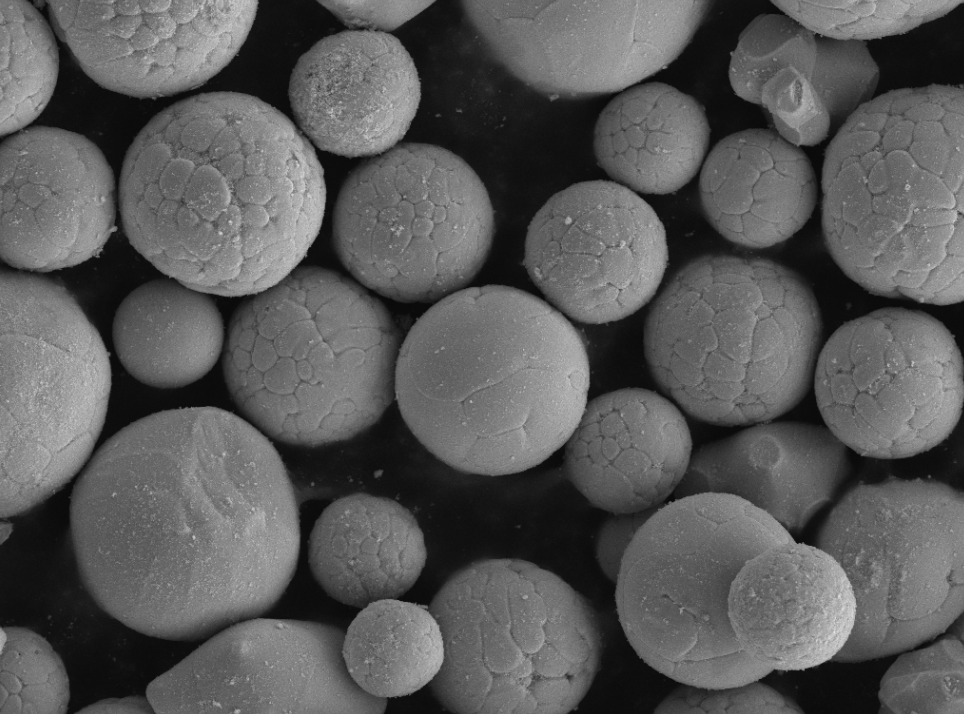
When selecting hafnium carbide powder, important factors include chemical purity, particle size distribution, powder morphology, oxygen content, and phase composition. Technical documentation such as XRD analysis, SEM images, Certificate of Analysis (COA), and Safety Data Sheet (SDS) should also be reviewed to ensure the powder meets the requirements of the intended application.
Hafnium carbide is widely used in industries that require materials capable of withstanding extreme temperatures. Typical applications include aerospace, defense, advanced ceramics, high-temperature coatings, energy technologies, materials science research, and university laboratories developing next-generation ultra-high temperature ceramic materials.