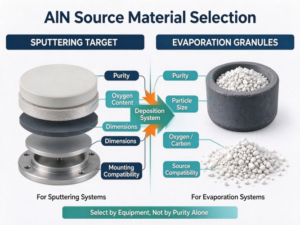
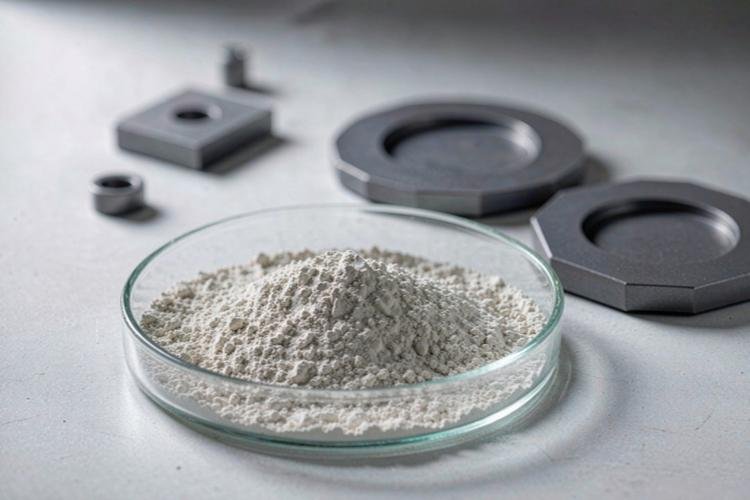
Aluminum nitride (AlN) powder is an important raw material for high-thermal-conductivity ceramics, electronic substrates, and advanced thermal management components. However, selecting the right aluminum nitride powder requires more than checking its nominal purity. Oxygen content, particle size distribution, morphology, surface condition, and sintering behavior all influence powder processing and the thermal conductivity of the final ceramic.
For ceramic manufacturers, engineers, and material buyers, understanding these factors helps avoid powder selection problems that may affect densification, microstructure, and final component performance. This guide explains the key properties to evaluate when purchasing AlN powder and how they relate to ceramic processing.
For buyers comparing different AlN material forms, ULPMAT also provides aluminum nitride powder, aluminum nitride nanopowder, and other aluminum nitride materials for different processing requirements.
Why Aluminum Nitride Powder Quality Matters
Aluminum nitride is valued for its high theoretical thermal conductivity, electrical insulation, and thermal stability. The theoretical thermal conductivity of AlN single crystals is approximately 320 W/(m·K). However, the actual thermal conductivity of a sintered AlN ceramic is usually lower because of oxygen impurities, porosity, grain boundaries, secondary phases, and other microstructural factors.
The starting powder plays an important role in determining these characteristics.
For example, oxygen introduced through powder synthesis, surface oxidation, or moisture exposure can affect the chemical composition and microstructure during sintering. Particle size and distribution influence powder packing and sintering activity, while agglomeration may create local density variations during forming.
Therefore, aluminum nitride powder should be evaluated through its complete chemical and physical specifications rather than nominal purity alone.
1. Oxygen Content: A Critical Factor in AlN Ceramic Thermal Conductivity
Oxygen is one of the most important impurities to consider when selecting aluminum nitride powder for high-thermal-conductivity ceramics.
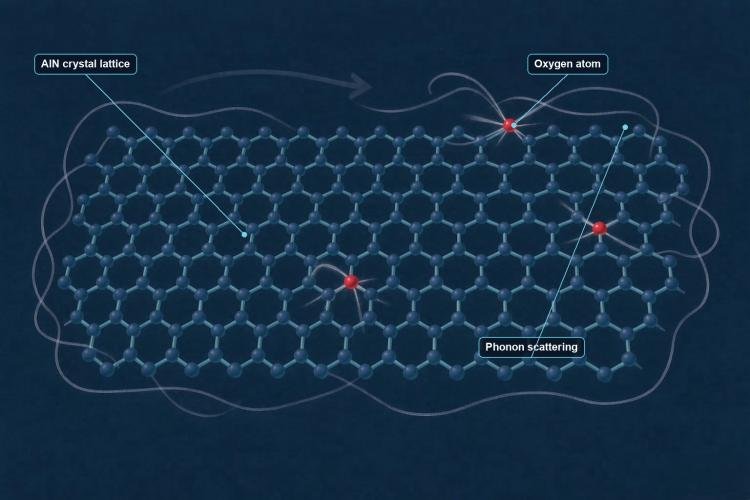
Oxygen can enter the AlN system during powder synthesis, surface oxidation, storage, and exposure to moisture. During ceramic processing, oxygen may enter the AlN lattice or form oxygen-containing secondary phases.
How does oxygen affect thermal conductivity?
When oxygen substitutes for nitrogen in the AlN lattice, it can contribute to aluminum vacancies and lattice defects. These defects increase phonon scattering and reduce the ability of the ceramic to conduct heat.
Oxygen-containing phases at grain boundaries can also influence thermal transport. Their effects depend on phase composition, distribution, and the overall ceramic microstructure.
The influence of oxygen content can be significant. In one reported comparison, reducing the oxygen content of the starting AlN powder from 2.2 wt% to 1.0 wt% increased the thermal conductivity of the resulting ceramics from 106 W/(m·K) to 170 W/(m·K) under the same sintering process.
AlN ceramics with thermal conductivity as high as 220 W/(m·K) and flexural strength of 340 MPa have also been achieved through coordinated control of powder oxygen content, debinding atmosphere, and sintering conditions.
These results demonstrate why oxygen control matters. However, lower powder oxygen content does not automatically guarantee higher ceramic thermal conductivity. Densification, grain development, secondary phases, and sintering conditions must also be considered.
What should buyers check?
When comparing aluminum nitride powder, consider:
-
- Total oxygen content
-
- Surface oxidation condition
-
- Carbon content and other relevant impurities
-
- Powder storage and packaging conditions
-
- Consistency between production batches
For high-thermal-conductivity ceramic applications, oxygen content should be evaluated alongside the intended forming and sintering process.
2. Particle Size: Micron vs. Nano Aluminum Nitride Powder
Particle size affects powder packing, specific surface area, sintering activity, and processing behavior. Both micron-sized and nanoscale AlN powders have useful applications, but they are not interchangeable.
Micron-sized AlN powder
Micron-sized aluminum nitride powder is commonly considered for conventional ceramic processing, including powder mixing, forming, and sintering.
Depending on particle size distribution and morphology, micron-sized powder may offer:
-
- More manageable powder handling
-
- Lower specific surface area than many nanopowders
-
- Suitability for conventional ceramic forming processes
-
- Potentially less severe agglomeration than very fine powders
The appropriate particle size depends on the forming method, required density, and sintering conditions.
Nano aluminum nitride powder
Nanoscale AlN powder has a much higher specific surface area than conventional micron-sized powder. This can increase surface reactivity and sintering activity.
Potential advantages include:
-
- High specific surface area
-
- Increased sintering activity
-
- Potential for fine microstructure control
-
- Suitability for selected advanced ceramic and composite research
However, smaller particles also introduce challenges. Nano AlN powder can be more susceptible to agglomeration, moisture exposure, and surface oxidation. These factors may complicate dispersion, handling, and storage.
Nano-sized powder is not automatically better for every application. Its suitability depends on the required processing route and final component properties.
For applications requiring nanoscale particles, see our aluminum nitride nanopowder specifications for available particle size options.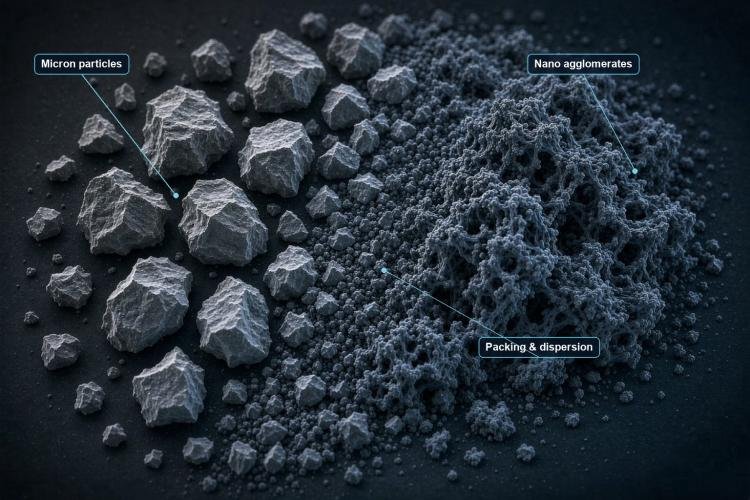
3. Particle Size Distribution: Why D50 Is Not Enough
D50 is a useful parameter for describing the median particle size of aluminum nitride powder. However, it does not provide a complete picture of the particle size distribution.
Two AlN powders can have the same D50 but different distributions, which may result in different packing and processing behavior.
When evaluating particle size distribution, buyers should consider:
-
- D10: The particle size below which 10% of the measured particles fall.
-
- D50: The median particle size.
-
- D90: The particle size below which 90% of the measured particles fall.
A narrow particle size distribution may be useful when consistent processing behavior is required. In some ceramic systems, a broader or deliberately designed distribution may improve particle packing.
The best distribution depends on the forming and sintering process. Buyers should avoid selecting powder based on D50 alone when particle packing and final density are critical.
When comparing commercial AlN powders, buyers can review the available aluminum nitride powder grades and particle size specifications before confirming the required material.
4. Powder Morphology and Agglomeration
Particle morphology influences how aluminum nitride powder flows, disperses, packs, and interacts during processing.
Different production routes can result in different particle shapes and surface characteristics. Depending on the application, powder may contain irregular particles, aggregated particles, or more uniform particle structures.
Agglomeration is particularly important when working with fine AlN powder.
Strong agglomerates may not break apart easily during mixing. They can create local variations in powder packing and contribute to defects or non-uniform microstructures after forming and sintering.
When evaluating powder morphology, consider:
-
- Particle shape and surface structure
-
- Degree of agglomeration
-
- Dispersion behavior
-
- Consistency between batches
SEM images can help assess particle morphology and identify visible agglomeration. BET measurements provide additional information about the specific surface area of the powder.
5. Moisture Sensitivity and Aluminum Nitride Powder Storage
Aluminum nitride powder can react with moisture in humid environments. Surface hydrolysis may produce aluminum oxyhydroxide and aluminum hydroxide phases, while releasing ammonia during the reaction.
Exposure to wet air at 30°C and 70% relative humidity can cause changes in AlN powder surface phases and morphology. This highlights the importance of controlling moisture exposure during storage and handling.
Moisture exposure can change the surface chemistry of AlN powder and increase oxygen-containing compounds. This may affect subsequent processing and the quality of the final ceramic.
For material buyers, practical storage considerations include:
-
- Keep powder in tightly sealed packaging.
-
- Minimize exposure to humid air during handling.
-
- Avoid unnecessary opening and repeated resealing.
-
- Follow the supplier’s recommended storage conditions.
-
- Check packaging integrity before use.
For moisture-sensitive applications, packaging and storage conditions should be included in the material specification and purchasing discussion.
6. How Powder Characteristics Affect AlN Ceramic Sintering
AlN powder characteristics influence sintering, but final ceramic thermal conductivity also depends on processing conditions.
Important factors include:
-
- Sintering temperature
-
- Holding time
-
- Sintering atmosphere
-
- Green-body density
-
- Sintering additives
-
- Oxygen content and distribution
Yttrium oxide (Y₂O₃), for example, is commonly used as a sintering additive in AlN ceramics. Under suitable processing conditions, it can react with oxygen-containing phases and promote the formation of secondary phases that help reduce lattice oxygen.
However, the amount of additive and the resulting secondary-phase distribution must be carefully controlled. Excessive or unsuitable grain-boundary phases can affect final thermal properties.
Particle size also matters. Fine AlN powder can provide higher sintering activity and promote grain development. However, its increased surface area may also be associated with higher oxygen content.
Smaller AlN particles can improve sintering activity and promote grain growth, but increased oxygen content may also encourage secondary-phase formation and affect final thermal conductivity.
This means that selecting the finest available powder is not necessarily the best approach. The powder must match the intended forming and sintering process.
7. Aluminum Nitride Powder Selection Checklist
Before purchasing aluminum nitride powder, ceramic manufacturers and engineers should review the following specifications.
| Parameter | What to evaluate | Why it matters |
| Purity | Nominal AlN purity and impurity profile | Helps assess chemical quality |
| Oxygen content | Total oxygen and, where relevant, surface oxygen | Influences lattice defects and secondary phases |
| Particle size | Mesh size or D50 | Affects processing and sintering activity |
| Particle size distribution | D10, D50, D90 | Helps evaluate distribution consistency |
| Morphology | Particle shape and agglomeration | Influences packing and dispersion |
| Specific surface area | BET value | Provides information about powder surface characteristics |
| Moisture condition | Storage and packaging | Helps protect powder quality |
| Batch consistency | COA and agreed inspection items | Supports production repeatability |
The most suitable aluminum nitride powder is the one that meets the requirements of the complete manufacturing process, not simply the one with the highest purity or smallest particle size.
8. Applications of Aluminum Nitride Powder
Aluminum nitride powder is used in several areas where thermal management, electrical insulation, and ceramic performance are important.
AlN ceramic substrates: Used in electronic packaging and power electronics where heat dissipation and electrical insulation are required.
For substrate manufacturing, ULPMAT offers aluminum nitride substrates in different dimensions and thicknesses for electronic packaging and thermal management applications.
High-thermal-conductivity ceramic components: Used in thermal management systems and electronic devices that require efficient heat transfer.
Thermal interface material research: AlN particles can be used as thermally conductive fillers in selected polymer composite systems.
Advanced ceramic research: Fine and nanoscale AlN powders are investigated for specialized ceramic processing and composite applications.
The required powder specifications vary according to the final product, forming method, and processing conditions.
For finished ceramic components, explore our aluminum nitride ceramics for thermal management and electronic applications.
Frequently Asked Questions
Q1: What is the most important specification when buying aluminum nitride powder?
There is no single specification that applies to every application. Purity, oxygen content, particle size distribution, morphology, and moisture condition should be evaluated according to the intended manufacturing process.
Q2: Does lower oxygen content always mean higher AlN ceramic thermal conductivity?
Not necessarily. Lower oxygen content can help reduce lattice defects, but final thermal conductivity also depends on densification, grain boundaries, secondary phases, and sintering conditions.
Q3: Is nano aluminum nitride powder better than micron-sized powder?
Not in every application. Nano AlN powder offers high surface area and increased sintering activity, but it can also be more difficult to disperse and more sensitive to surface oxidation and moisture. The choice depends on the required process and final properties.
Q4: Is D50 enough to specify aluminum nitride powder?
No. D50 describes the median particle size but does not show the full particle size distribution. D10 and D90 provide additional information and help buyers compare powder consistency.
Q5: How should aluminum nitride powder be stored?
AlN powder should be kept in tightly sealed packaging and protected from humid air. Moisture exposure can cause surface hydrolysis and change the powder’s surface chemistry.
Q6: What documents should buyers request from an AlN powder supplier?
Buyers should request a Certificate of Analysis (COA) and Safety Data Sheet (SDS). Depending on the application, relevant inspection information may include purity, particle size distribution, BET surface area, phase purity, and oxygen or carbon content.
Conclusion
Selecting the right aluminum nitride powder requires a comprehensive evaluation of chemical composition, particle size, morphology, surface condition, and processing requirements.
Oxygen content is important for controlling lattice defects and thermal conductivity, while particle size and distribution influence packing and sintering behavior. Moisture protection and batch consistency are also essential for maintaining reliable powder quality.
Rather than choosing AlN powder based on nominal purity alone, buyers should match the complete powder specification to their forming process and final application.
Looking for aluminum nitride powder for ceramic or thermal management applications? Contact the ULPMAT technical team with your target purity, particle size, oxygen content, and application requirements. You can also explore our refractory materials for additional advanced ceramic materials.
Our team can help review available specifications and discuss suitable material options.
Related ULPMAT Products:
References
-
- “Limiting the lattice oxygen impurities to obtain high thermal conductivity aluminum nitride ceramics.” Ceramics International, 50(18), Part B, 2024, 33488–33495.
- “The quantitative investigation of the lattice oxygen and grain edge oxygen on the thermal conductivity of aluminum nitride ceramics.” Journal of the European Ceramic Society, 43(2), 2023, 313–320.
- “Hydrolysis mechanism of aluminum nitride powder in wet air.” Materials Today Communications, 49, 2025, Article 113873.
- “The influence of sintering parameters and aluminum nitride powder characteristics on the microstructure and thermal conductivity of aluminum nitride ceramics.” Ceramics International, 51(5), 2025, 6300–6308.