AlN thin film deposition is widely used to produce aluminum nitride films for piezoelectric devices, acoustic wave components, MEMS, semiconductor applications, and functional coatings. But achieving a high-quality AlN film involves much more than choosing a deposition method. Crystal orientation, oxygen contamination, substrate conditions, process stability, and source-material specifications all play important roles.
This guide examines the main AlN deposition methods, explains how to evaluate film quality through (002) orientation and rocking curve analysis, and compares AlN sputtering targets with evaporation granules to help engineers and material buyers make informed decisions.
But which factors have the greatest impact on AlN film quality, and how can you identify the right source material before deposition begins? The answer starts with understanding the differences between the available deposition methods.
1. Common AlN Thin Film Deposition Methods

Aluminum nitride thin films can be prepared using different physical vapor deposition (PVD) routes. The appropriate method depends on equipment configuration, substrate requirements, film properties, and production objectives.
1.1 Direct RF Sputtering from an AlN Ceramic Target
Direct sputtering uses an aluminum nitride ceramic target as the material source. RF sputtering is commonly considered because AlN is an electrically insulating ceramic.
During deposition, energetic ions bombard the target surface, releasing material that travels through the vacuum chamber and forms a film on the substrate. The resulting film structure depends on multiple factors, including target condition, working pressure, substrate temperature, deposition power, gas environment, and substrate preparation.
This route is relevant when the deposition system is configured for ceramic-target sputtering and the process requires an AlN source material.
When selecting an AlN sputtering target, evaluate purity, dimensions, density, oxygen content, and physical condition against the requirements of the sputtering system.
1.2 Reactive Sputtering from a Metallic Aluminum Target
Reactive sputtering uses a metallic aluminum target together with nitrogen-containing process gas. Aluminum reacts with activated nitrogen species during deposition to form aluminum nitride on the substrate.
This method differs from direct sputtering using a ceramic AlN target. It requires control of reactive gas conditions and target-surface chemistry.
One important issue is target poisoning. As nitrogen reacts with the aluminum target surface, the target can transition from a metallic state toward a compound-covered state. This transition may affect deposition rate, discharge behavior, and process stability.
The reactive gas ratio, power, pressure, and operating conditions therefore need to be developed and controlled for the specific deposition system. Target poisoning should not be treated as an equivalent issue in every direct AlN ceramic-target sputtering process.
For further technical background, see this review of reactive sputtering of AlN (002) thin films for piezoelectric applications.
1.3 Vacuum Evaporation Using AlN Granules
Vacuum evaporation is another possible source-material route when the deposition equipment and process are compatible with the selected material.
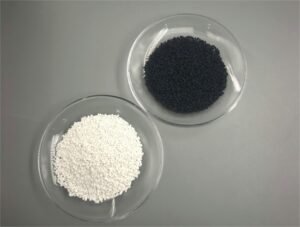
AlN evaporation granules provide a granular source form for suitable evaporation systems. Their selection involves more than nominal purity. Particle size, moisture, oxygen content, carbon content, and material consistency may also need to be considered.
Before choosing this route, verify that the evaporation equipment, heating arrangement, source configuration, and process requirements are suitable for AlN. Do not assume that evaporation granules can be substituted directly for a sputtering target or that the deposited film will automatically have the same composition as the source material.
ULPMAT supplies AlN evaporation granules in different purity and particle-size specifications.
2. Why AlN (002) Orientation Matters
AlN has a hexagonal wurtzite crystal structure. For many piezoelectric and acoustic-device applications, the preferred orientation of the film is an important consideration.
The AlN (002) reflection is commonly examined when evaluating c-axis-oriented films. A strong (002) diffraction peak in an X-ray diffraction (XRD) pattern can indicate preferred orientation, but peak intensity alone does not provide a complete assessment of film quality.
Several factors can influence AlN film orientation:
Substrate material and surface condition: Substrate structure, surface roughness, and preparation can affect nucleation and film growth.
Substrate temperature: Temperature influences adatom mobility and the development of the film structure.
Working pressure: Gas-phase collisions and the energy of arriving species can affect film growth.
Deposition power and rate: These parameters influence the energy and arrival rate of depositing species.
Gas composition: In reactive sputtering, nitrogen availability and process stability are important.
Film thickness and residual stress: Growth conditions and accumulated stress can influence the final film structure.
The optimum conditions are equipment- and application-dependent. A process that produces a suitable AlN (002) orientation on one substrate or deposition system may not produce the same result under different conditions.
Research on c-axis-oriented AlN thin films deposited on different substrates provides further discussion of the relationship between substrate characteristics, deposition conditions, and film orientation.
3. How to Evaluate AlN Film Crystal Quality
XRD is an important tool for characterizing the crystal structure and preferred orientation of deposited AlN films. However, a single diffraction peak should not be used as the only acceptance criterion.
3.1 XRD (002) Peak
A θ–2θ XRD scan can identify the AlN diffraction peaks and help evaluate whether the film exhibits a preferred orientation.
For c-axis-oriented AlN films, the (002) reflection is often an important feature to examine. However, peak intensity can also be influenced by film thickness, measurement configuration, substrate contribution, and other structural factors.
Therefore, comparing XRD results requires consistent measurement conditions. When evaluating samples from different deposition runs, use comparable measurement settings and consider the full diffraction pattern rather than relying only on the height of one peak.
3.2 Rocking Curve and FWHM
The rocking curve of the AlN (002) reflection provides additional information about the distribution of crystal orientation.
Its full width at half maximum (FWHM) is often used as an indicator of the spread in c-axis orientation. A narrower rocking-curve FWHM generally indicates a smaller orientation spread under comparable measurement conditions.
However, rocking-curve results should be interpreted together with other characterization data. They do not independently establish piezoelectric performance, electrical behavior, film stress, or device reliability.
3.3 Additional Film Characterization
Depending on the application, AlN film evaluation may also include:
Film thickness and uniformity measurements
Surface morphology and roughness analysis
Composition and impurity analysis
Residual stress evaluation
Electrical or piezoelectric characterization
The required tests should be defined by the intended device or coating application rather than relying on a single measurement.
4. Oxygen Contamination in AlN Thin Film Deposition
Oxygen is an important impurity to consider when evaluating AlN source materials and deposited films.
Oxygen may be introduced through several routes, including source-material impurities, residual gases, moisture, chamber conditions, substrate surfaces, and process-gas quality.
It is important to distinguish between oxygen content in the source material and oxygen content in the deposited film. A source-material test does not directly establish the oxygen concentration of the final film.
For process evaluation, consider the following factors:
Source material: Review available oxygen-content information and the material specification.
Vacuum environment: Check chamber condition, residual gases, and potential leaks.
Substrate preparation: Control surface contamination and moisture before deposition.
Process gases: Verify gas purity and delivery-system condition.
Film characterization: Use an appropriate analytical method when film oxygen concentration is a critical acceptance parameter.
Oxygen contamination can influence the properties of deposited AlN films. Research on the role of oxygen contaminants in the physical properties of sputtered AlN thin films provides additional technical background.
For applications with strict impurity requirements, define the acceptable oxygen level and the relevant measurement method before ordering source materials.
5. How to Select an AlN Sputtering Target
For direct ceramic-target sputtering, the target is a key consumable. Its specifications should match both the deposition equipment and the film-development requirements.
5.1 Purity and Oxygen Content
Purity is an important initial screening parameter, but it should not be used as the only selection criterion.
A higher nominal purity grade may be appropriate when the application has strict impurity requirements. However, buyers should also consider which impurities are controlled, how purity is measured, and whether oxygen content is specified separately.
For research and production procurement, clarify the required purity grade, impurity limits, and acceptance criteria before comparing quotations.
5.2 Target Dimensions and Equipment Compatibility
Target dimensions must match the sputtering system and mounting configuration.
Important specifications include:
Diameter or length and width
Thickness
Shape and dimensional tolerances
Mounting and installation requirements
Surface condition
Bonding requirements, if applicable to the buyer’s system
A target with the correct nominal purity may still be unsuitable if its dimensions or mounting configuration do not match the equipment.
If a non-standard target size or shape is required, submit a drawing for review through ULPMAT’s customization service.
5.3 Density, Structure, and Material Inspection
Density, phase structure, and surface condition can provide additional information when evaluating ceramic sputtering targets.
Available AlN sputtering target inspection options include:
Purity
Dimensions
Density
Oxygen content
XRD
SEM
Surface condition
Bonding inspection
These are available inspection options. Buyers should confirm the required inspection scope, test methods, and acceptance criteria before placing an order.
For current product specifications, available dimensions, and purity options, please visit ULPMAT’s AlN sputtering target product page directly.
For more information on sputtering target density, bonding conditions, and common material-related issues, read our guide to [sputtering target cracking, arcing, and spattering].
6. How to Select AlN Evaporation Granules
For compatible vacuum evaporation systems, AlN granules should be evaluated according to source compatibility, particle size, purity, and material quality.
6.1 Particle Size and Source Compatibility
Particle size affects how the material can be loaded and handled in an evaporation source. The appropriate size depends on the source design, crucible configuration, heating arrangement, and operating procedure.
Before ordering, confirm the particle-size range accepted by the equipment. Do not assume that a particle size suitable for one evaporation system will be suitable for another.
6.2 Purity, Moisture, and Impurity Control
In addition to nominal purity, buyers may need to consider oxygen content, carbon content, and moisture.
Moisture and surface contamination can be relevant during material handling and vacuum processing. The required limits should be established according to the process and film specifications.
Available AlN evaporation granule inspection options include:
Purity
Particle size
Oxygen content
Carbon content
Moisture
XRD
SEM
For customized particle sizes or other specifications, provide your requirements and a drawing where applicable for review.
For current product specifications, available purity grades, and particle-size options, please visit ULPMAT’s AlN evaporation granules product page directly.

7. Common AlN Thin Film Deposition Problems and What to Check
When an AlN film does not meet its target properties, changing the source material immediately may not solve the problem. A systematic review of the material, equipment, process, and substrate is more useful.
Weak or Inconsistent AlN (002) Peak
A weak or inconsistent (002) peak may be related to substrate condition, deposition conditions, film thickness, or measurement setup.
Before changing the source material, check whether substrate preparation and measurement conditions are consistent. Compare the full XRD pattern and review the deposition history.
Broad Rocking-Curve FWHM
A broad rocking-curve FWHM may indicate a wider distribution of crystal orientations.
Investigate substrate surface condition, nucleation behavior, process stability, and the deposition conditions used during film growth. Compare results from samples prepared under consistent measurement conditions.
High Oxygen Content in the Film
High oxygen content should not automatically be attributed to the AlN source material.
Review source-material specifications, chamber residual gases, moisture, substrate surface condition, possible leaks, and process-gas purity. If oxygen is a critical acceptance parameter, use an appropriate film-analysis method to identify its concentration.
Unstable Reactive Sputtering
For reactive sputtering from metallic aluminum, unstable operation may be associated with nitrogen flow, target-surface condition, power, pressure, and process hysteresis.
Review process records and operating stability before making changes. This issue is specific to reactive sputtering and should not be assumed to apply in the same way to direct ceramic AlN target sputtering.
Poor Film Uniformity
Film non-uniformity may be related to target condition, source-to-substrate geometry, substrate movement, and the spatial distribution of deposition conditions.
Check equipment configuration and process consistency before concluding that the source material is responsible.
A practical investigation sequence is:
Confirm that the deposited film meets the intended thickness and measurement requirements.
Review substrate preparation and deposition-system condition.
Check process stability and operating records.
Review source-material specifications and available quality documentation.
Use film characterization to identify the actual deviation before changing process parameters.
This approach helps distinguish source-material issues from equipment or process-related problems.
8. AlN Sputtering Targets vs. AlN Evaporation Granules
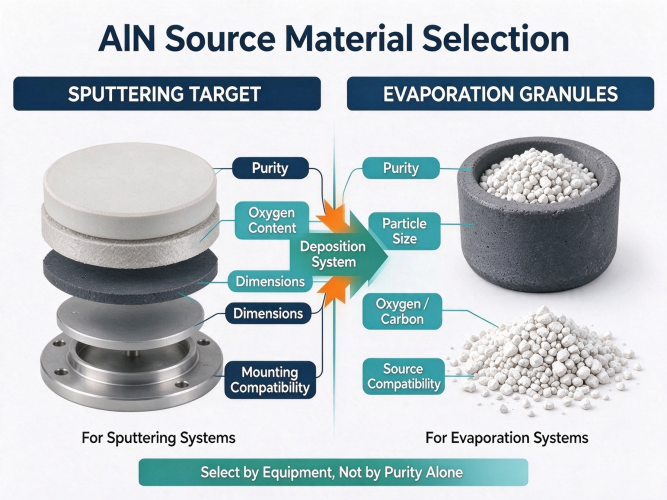
AlN sputtering targets and AlN evaporation granules are different source forms for different deposition configurations. They should not be selected based on nominal purity alone.
An AlN sputtering target is intended for a compatible sputtering system. Its key selection factors include purity, target dimensions, density, oxygen content, surface condition, and mounting compatibility.
AlN evaporation granules are intended for compatible evaporation equipment. Particle size, purity, oxygen content, carbon content, moisture, and source compatibility are important considerations.
The choice should follow the deposition system and film requirements, not a simple comparison of product prices or purity grades.
If the deposition equipment is designed for ceramic-target sputtering, review the available AlN sputtering targets. For compatible evaporation systems, compare the available AlN evaporation granules.
9. What to Include in an AlN Material RFQ
A clear request for quotation helps suppliers evaluate technical requirements and reduces unnecessary clarification.
For an AlN sputtering target, provide:
Required purity grade
Target dimensions and tolerances
Target shape and mounting requirements
Required oxygen-content specification, if applicable
Required inspection items and acceptance criteria
Quantity and delivery requirements
Drawing or equipment interface details, if available
For AlN evaporation granules, provide:
Required purity grade
Particle-size range
Oxygen, carbon, or moisture requirements, if applicable
Required inspection items
Quantity and packaging requirements
Application and evaporation-source information, where relevant
ULPMAT provides COA and SDS documentation for its AlN materials. Available inspection options can be discussed according to the order requirements. Custom specifications can be reviewed based on customer drawings.
To receive a more relevant quotation, specify the material form, purity, dimensions or particle size, quantity, and required documentation. For non-standard specifications, you can also submit a drawing through our customization service.
10. Frequently Asked Questions About AlN Thin Film Deposition
1. What is the most common method for AlN thin film deposition?
Sputtering is an established route for AlN thin film deposition, including direct sputtering from an AlN ceramic target and reactive sputtering from a metallic aluminum target in a nitrogen-containing atmosphere. The suitable method depends on the equipment, substrate, and required film properties.
2. Why is AlN (002) orientation important?
The AlN (002) reflection is commonly used to evaluate preferred c-axis orientation. This orientation is relevant to many piezoelectric and acoustic-device applications. XRD peak intensity and rocking-curve FWHM provide useful structural information, but they do not replace complete film and device characterization.
3. Does higher-purity AlN always produce better films?
No. Higher nominal purity can help meet strict impurity requirements, but film quality also depends on oxygen content, substrate condition, chamber environment, deposition parameters, and process stability. Select the purity grade according to the actual film specification.
4. What should I check before buying an AlN sputtering target?
Check purity, oxygen content, dimensions, density, surface condition, and compatibility with the sputtering system. Also clarify which inspection items, test methods, and acceptance criteria are required for the order.
5. Can AlN evaporation granules be used for sputtering?
No. Evaporation granules and sputtering targets are different material forms intended for different source configurations. Select the material form according to the deposition equipment.
6. What documents are available with ULPMAT AlN materials?
COA and SDS are available for ULPMAT AlN materials. Buyers should confirm the documentation and inspection scope required for their specific order.
7. Select the Right AlN Source Material for Your Deposition Process
Successful AlN thin film deposition depends on the relationship between source-material specifications, equipment configuration, substrate preparation, and process control. Before purchasing, confirm the deposition route, required purity, dimensions or particle size, impurity requirements, and inspection criteria.
ULPMAT offers AlN sputtering targets and AlN evaporation granules in different specifications, with available inspection options and customization review based on customer drawings.
Explore AlN sputtering targets for ceramic-target deposition.
Review AlN evaporation granules for compatible evaporation systems.
For custom dimensions, specifications, or a quotation, contact ULPMAT.
Provide your required material form, specifications, quantity, and application details so the appropriate product options can be reviewed.
References
- 1. “Reactive Sputtering of Aluminum Nitride (002) Thin Films for Piezoelectric Applications: A Review.” Materials, 2018.
- 2. “Substrate Angle-Induced Fully C-Axis Orientation of AlN Films Deposited by Off-Normal DC Sputtering Method.” Journal of Materials Science: Materials in Electronics, 2021.
- 3. Signore, M. A., et al. “Role of Oxygen Contaminant on the Physical Properties of Sputtered AlN Thin Films.” Journal of Alloys and Compounds, 2015, 626, 1267–1272.