
AZO Materials are aluminum-doped zinc oxide materials used as transparent conductive oxides (TCOs). Although aluminum concentration is an important variable, AZO thin-film performance cannot be predicted from nominal composition alone. Experimental studies show that target microstructure, including grain size and densification, can also affect sputtering behavior and the electrical and optical properties of the resulting film.
This leads to a practical question for AZO material selection: Why can AZO targets with similar compositions produce different thin-film performance?
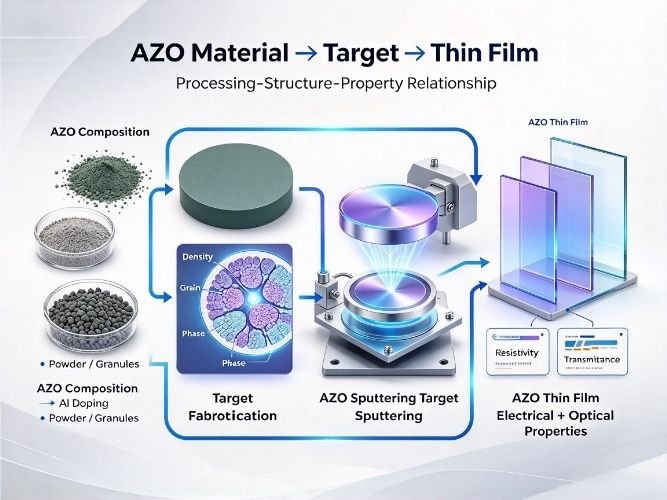
The answer lies in the processing–structure–property relationship. Aluminum doping affects the material structure and phase composition; target fabrication determines density and grain structure; and sputtering conditions then determine how the target is transferred into a thin film. In other words, AZO performance is not controlled by composition alone, but by the interaction between composition, microstructure, and deposition conditions.
AZO Materials: More Than ZnO with Aluminum
AZO, or aluminum-doped zinc oxide, is a ZnO-based transparent conductive oxide in which aluminum is introduced to modify the electrical and optical properties of ZnO. Doped ZnO can combine high visible-light transparency with increased electrical conductivity, which is why AZO has been extensively investigated for transparent conductive film applications. Reviews of AZO research identify aluminum concentration, film structure, and processing conditions as important variables affecting its functional properties.
However, AZO should not be treated simply as a fixed mixture of ZnO and an aluminum-containing dopant.For sputtering applications, several variables can interact throughout the material-processing chain:
| AZO variable | Why it matters |
| Al doping level | Can affect carrier concentration, electrical properties and phase formation |
| Secondary phases | Can influence densification and grain development |
| Target density | Reflects the quality of ceramic densification and microstructure |
| Target grain size | Can influence sputtering behavior and deposited-film properties |
| Powder and granule characteristics | Affect forming and subsequent target fabrication |
| Sputtering conditions | Influence film growth and final electrical and optical properties |
Experimental results confirm the importance of this interaction. A comparison of high-density AZO ceramic targets with varying grain sizes reveals measurable differences in the sputtering rate, surface roughness, and optoelectronic properties of the resulting thin films. AZO should be viewed as a material processing system rather than merely a static chemical composition.
Al Doping: Why More Is Not Always Better
Al doping can improve the electrical conductivity of ZnO by increasing the concentration of electrically active carriers, but more aluminum does not necessarily mean better overall AZO performance. Published experimental results illustrate this clearly. A study comparing AZO ceramic targets with 1, 2, 3 and 4 at% Al found that the 2 at% target reached the highest relative density of 99.40%, while 4 at% Al led to ZnAl₂O₄ formation and reduced densification. Interestingly, the 4 at% target still showed the lowest sheet resistance among the samples studied.
Another study reported 99.78% densification, an average grain size of 3.92 μm and a resistivity of 1.38 mΩ·cm for an AZO target containing 2 wt% Al₂O₃.These results show why AZO materials should not be evaluated by aluminum content alone. For sputtering applications, phase composition, target density, grain structure and electrical properties can also be important selection parameters.
Why AZO Target Microstructure Matters
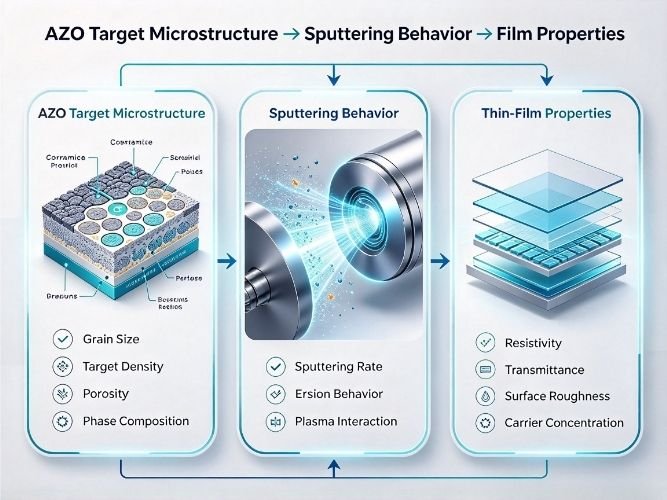
For sputtering applications, an AZO ceramic target is more than a source of chemical composition. Its microstructure can also influence sputtering behavior and the properties of the deposited film.Important target characteristics include grain size, relative density, porosity, phase composition, electrical resistivity and microstructural uniformity. Target fabrication and sintering conditions therefore play an important role in controlling the final target structure.
Published experimental results show this relationship clearly. AZO ceramic targets with relative densities around 99.8% and grain sizes of about 3.9 μm have been reported using optimized sintering processes. Other experiments comparing AZO targets with different grain sizes found measurable differences in sputtering rate, film surface roughness and photoelectric properties.
For example, an AZO target with a grain size of 4.64 μm produced a sputtered film with a resistivity of 3.54 × 10⁻³ Ω·cm, a carrier concentration of 6.95 × 10²⁰ cm⁻³ and an average visible-light transmittance of 91.26% under the reported deposition conditions.These values are experimental results rather than universal specifications. The important point is that changes in AZO target microstructure can affect the resulting thin-film performance even within the same AZO material system.
For this reason, when evaluating AZO sputtering targets, nominal Al content should be considered together with target density, grain structure, phase composition and electrical properties.
From AZO Material to Thin Film
The relationship between AZO material and final thin-film performance can be viewed as a continuous processing chain:
AZO composition → powder processing → granulation/forming → target densification → target microstructure → sputtering → thin-film microstructure → electrical and optical properties
Each stage can influence the next. Powder characteristics affect packing and forming, while fabrication and sintering conditions determine target densification and grain structure. During sputtering, the target microstructure interacts with deposition conditions and contributes to the resulting film properties. Research on AZO targets has linked Al-containing secondary phases with target density and grain development, while sputtering studies have shown that target grain size can affect sputtering rate, surface roughness and film properties.
For practical AZO development, this means that material purity and Al content should be considered together with powder characteristics, target density, grain structure, phase composition and deposition parameters such as sputtering power, pressure, atmosphere and substrate temperature. The optimum combination is application-dependent, so a processing condition that works well in one experimental system should not automatically be treated as a universal AZO sputtering recipe.
AZO Thin-Film Troubleshooting
When an AZO film does not meet its expected electrical or optical performance, changing the aluminum concentration is not necessarily the first variable to investigate. A more systematic approach is to trace the issue through the material-to-film chain, including Al activation and defects, target resistivity and microstructure, target density and phase composition, as well as sputtering power, pressure, atmosphere, substrate temperature and plasma uniformity.
For example, high film resistivity may be related to carrier concentration, defects or deposition conditions, while poor optical transmittance can involve film thickness, surface roughness and defects. Variations between batches may also originate from differences in target density, grain structure, phase composition or material uniformity. From a process-engineering perspective, the more useful question is therefore not simply “Is the Al concentration correct?”, but “Are the material, target and deposition conditions consistent with the required film properties?”
Choosing the Right AZO Material Form
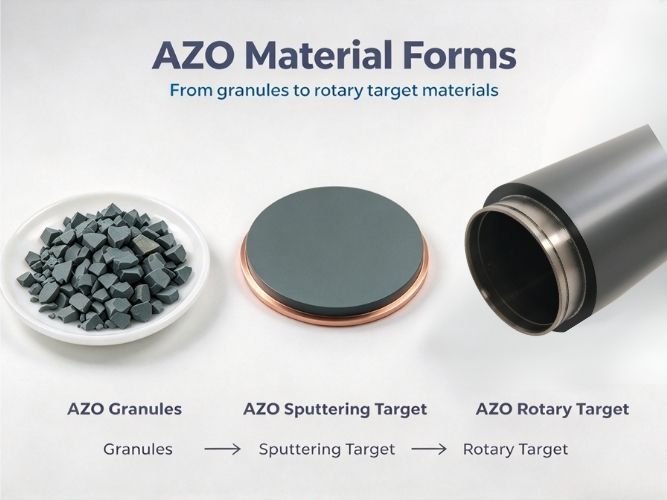
AZO is available in different processing forms, and the appropriate form depends on how the material will be used.
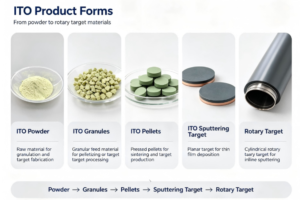
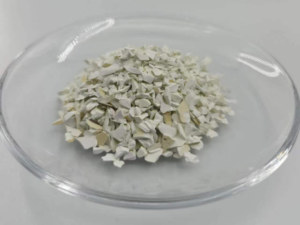
AZO granules are processed ceramic materials with controlled particle characteristics, making them suitable for applications where powder handling, flowability and forming behavior are important. Compared with fine powder, granulated AZO can provide more controlled particle characteristics for downstream ceramic processing.
For target fabrication, granule size, particle-size distribution, composition uniformity and phase characteristics can influence packing and forming behavior. Therefore, AZO granules are not simply a different particle size of the same material; their physical characteristics are part of the processing performance of the feedstock.
AZO sputtering targets are used directly for thin-film deposition. Selection should go beyond nominal Al content and consider target density, grain structure, phase composition, electrical properties, dimensions and consistency.
AZO Rotary Targets
AZO rotary targets are designed for rotary sputtering systems and cylindrical deposition configurations. Their selection depends on both the AZO material properties and the dimensional and operating requirements of the sputtering equipment.
For applications requiring different processing and deposition forms, ULPMAT provides Alumina-doped Zinc Oxide in granules, sputtering targets and rotary targets, allowing the material form to be matched to the intended processing route.
AZO and ITO: Different TCO Material Strategies
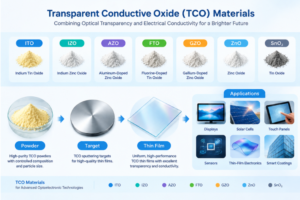
AZO and ITO are both transparent conductive oxide (TCO) systems, but they use different host oxides and dopants. Their practical thin-film performance also depends on target characteristics and deposition conditions, not only on nominal chemical composition.
| Parameter | AZO | ITO |
| Host oxide | ZnO | In₂O₃ |
| Typical dopant | Al | Sn |
| Material system | ZnO:Al | In₂O₃:Sn |
| Key selection factors | Al content, target density, grain structure, phase composition and deposition conditions | Sn content, target density, microstructure, phase composition and deposition conditions |
| Primary trade-offs | Conductivity, transparency and process stability | Conductivity, transparency and process stability |
The comparison is therefore not simply AZO versus ITO by chemical formula. For either TCO system, composition, target microstructure and deposition conditions work together to determine the resulting film properties.
Conclusion
AZO Materials should not be evaluated by aluminum concentration alone. For sputtering applications, the performance of the final film depends on the combined characteristics of the material, ceramic target and deposition process.In practical material selection, factors such as Al content, phase composition, target density, grain structure, electrical properties and sputtering conditions should be considered together rather than evaluated independently.
The key question is therefore not simply “What is the AZO composition?” but “Is the material and target structure suitable for the required thin-film performance and deposition process?”This approach provides a more reliable basis for selecting AZO granules, sputtering targets and rotary targets for different thin-film applications.
FAQs
AZO Materials are aluminum-doped zinc oxide materials used as transparent conductive oxides (TCOs). They are based on ZnO with Al added to modify electrical conductivity and optical properties. AZO can be supplied in forms such as granules, sputtering targets and rotary targets for different processing and deposition applications.
No. Increasing the Al concentration does not necessarily improve all AZO properties. Al doping can increase electrically active carriers, but excessive doping may promote secondary-phase formation and affect target densification, microstructure or other material properties. The suitable Al level depends on the material system and intended deposition process.
AZO target grain size can influence sputtering behavior and the properties of the deposited film. Experimental studies have reported changes in sputtering rate, surface roughness and electrical and optical film properties when AZO target grain size is varied. This is why target microstructure can be an important consideration in addition to nominal composition.
AZO thin-film resistivity can be influenced by Al doping and activation, carrier concentration, defects, crystallinity, target characteristics and sputtering conditions. Substrate temperature, atmosphere, pressure and other deposition parameters can also affect the resulting film. The relative importance of these factors depends on the specific deposition system.
AZO granules are processed ceramic feedstock with controlled particle characteristics and can be used for forming and target fabrication. AZO sputtering targets are densified ceramic materials designed for direct thin-film deposition. The two forms serve different processing stages and should not be evaluated only by their chemical composition.
An AZO rotary target is a cylindrical sputtering target designed for rotary sputtering systems. Its material properties need to be considered together with the target dimensions, bonding configuration and operating requirements of the deposition equipment.
References
- 1. Liang, X. et al. From target to film: The crucial role of AZO target grain size in sputtered thin film properties. Materials Today Communications, 2025. DOI: 10.1016/j.mtcomm.2025.113105.
- 2. Investigation of Al-doped ZnO (AZO) ceramic targets and thin films. Materials Today Communications, 2025. DOI: 10.1016/j.mtcomm.2025.114057.
- 3. Investigating the influence mechanism of aluminum doping amount on the density and grain size of AZO target through phase-field simulation. Journal of the European Ceramic Society, 2025. DOI: 10.1016/j.jeurceramsoc.2024.117013.
- 4. Effects of Al₂O₃ doping on the microstructural evolution and densification process of AZO targets. Ceramics International, 2022. DOI: 10.1016/j.ceramint.2022.02.167.
Related Articles
- 1. What Are Transparent Conductive Oxide (TCO) Materials? Applications, Materials and Selection Guide
- 2. Understanding Zinc Oxide Materials: From ZnO Powder and Granules to Sputtering Target Production
- 3. How to Choose IGZO Sputtering Target: Key Specifications and Buying Guide
- 4. IGZO vs ITO Sputtering Target: Key Differences, Applications, and Comparison
- 5. IGZO Sputtering Target Quality: How Purity, Composition, and Density Affect Thin Film Performance
- 6. What Is an Indium Zinc Oxide Rotatable Target? Applications, Advantages, and Sputtering Performance
- 7. ITO Rotary vs Planar Target: Which Delivers Better Coating Performance?
- 8. IZTO Sputtering Target: Why It’s Better Than ITO
- 9. Indium Tin Oxide Materials: Complete Guide from Powder to Sputtering Target
For AZO materials, target selection and material form should be matched to the requirements of the deposition process and the intended thin-film properties.