

IGZO vs ITO sputtering target is an important comparison when selecting oxide materials for thin-film deposition. Although both materials can be deposited by sputtering and can provide optical transparency, they serve different functions in electronic and optoelectronic devices. IGZO (indium gallium zinc oxide) is primarily used as an oxide semiconductor, while ITO (indium tin oxide) is mainly used as a transparent conductive oxide.
The difference affects how each target is selected for applications such as thin-film transistors, display backplanes, transparent electrodes, semiconductor research, and optoelectronic devices. For buyers and engineers comparing IGZO and ITO targets, the relevant factors include composition, electrical function, optical properties, applications, sputtering requirements, purity, and target specifications.
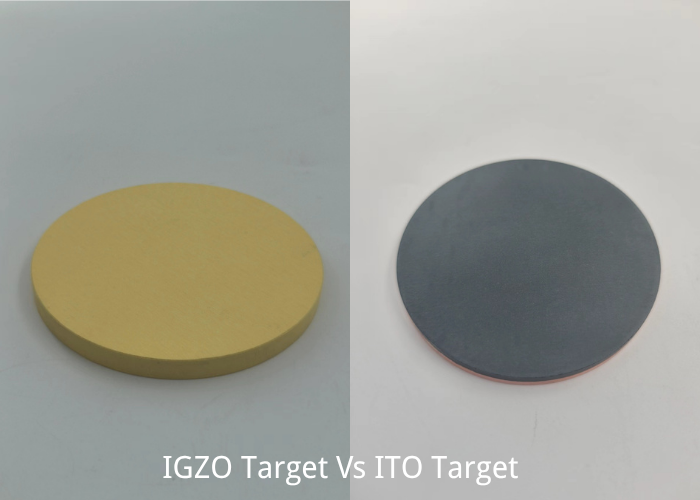
IGZO vs ITO Sputtering Target: What Is the Main Difference?
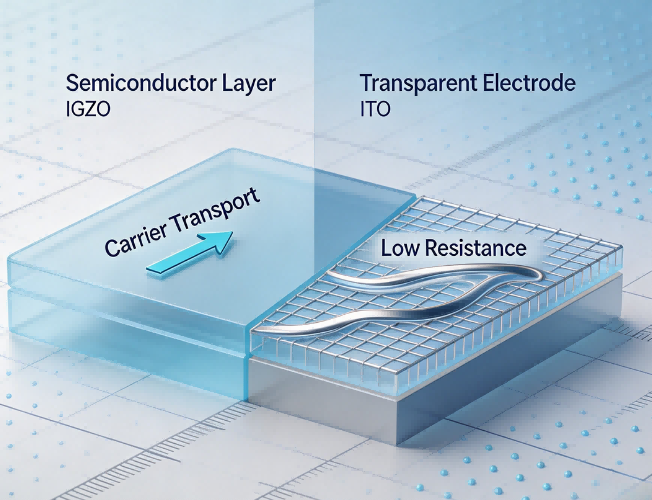
The main difference between IGZO and ITO is their electrical role in the deposited thin film. IGZO is designed for controlled semiconductor behavior, whereas ITO is designed to provide electrical conductivity while maintaining optical transparency.
| Feature | IGZO | ITO |
| Full Name | Indium Gallium Zinc Oxide | Indium Tin Oxide |
| Main Components | In₂O₃, Ga₂O₃, ZnO | In₂O₃, SnO₂ |
| Material Class | Oxide semiconductor | Transparent conductive oxide |
| Primary Function | Semiconductor thin film | Transparent conductive film |
| Typical TFT Role | Active semiconductor layer | Electrode / conductive layer |
| Electrical Priority | Controlled carrier transport | Low electrical resistivity |
| Optical Property | High transparency possible | High transparency |
| Typical Applications | TFTs, display backplanes, oxide semiconductor devices | Transparent electrodes, displays, photovoltaics, optoelectronics |
In simple terms, IGZO is generally selected for semiconductor functionality, while ITO is selected for transparent electrical conduction.
IGZO vs ITO Sputtering Target: Composition, Electrical Properties, and Applications
IGZO and ITO are both oxide materials used in sputtering, but they serve different electrical functions because of their compositions.
IGZO (indium gallium zinc oxide) is composed of In₂O₃, Ga₂O₃, and ZnO. A commonly used composition is In₂O₃:Ga₂O₃:ZnO = 1:1:1 molar ratio. It is primarily used as an oxide semiconductor for TFTs, display backplanes, and other electronic devices. The relative In/Ga/Zn composition can affect the electrical and structural properties of the deposited film.
ITO (indium tin oxide) is primarily composed of In₂O₃ and SnO₂. SnO₂ is introduced to increase carrier concentration and electrical conductivity. ITO is therefore widely used as a transparent conductive oxide (TCO) for transparent electrodes, displays, photovoltaic devices, and optoelectronic components.
| Property | IGZO | ITO |
|---|---|---|
|
Main composition |
In₂O₃ + Ga₂O₃ + ZnO |
In₂O₃ + SnO₂ |
|
Primary function |
Oxide semiconductor |
Transparent conductor |
|
Typical electrical role |
Controlled carrier transport |
Low electrical resistance |
|
Typical applications |
TFTs, display backplanes, semiconductor devices |
Transparent electrodes, displays, photovoltaics |
|
Main selection factor |
Semiconductor performance |
Conductivity and transparency |
For IGZO targets, quality evaluation should consider purity, composition, impurity control, density, and target dimensions, rather than nominal purity alone. For detailed information on target quality and inspection criteria, see IGZO Sputtering Target Quality: How Purity, Composition, and Density Affect Thin Film Performance.
In conventional applications, ITO is generally more conductive than IGZO. However, the appropriate material depends on the required function: ITO is typically selected for low-resistance transparent conduction, while IGZO is selected for controlled semiconductor behavior in TFTs and related devices.
IGZO vs ITO Sputtering Target Sputtering Process
Although IGZO and ITO can both be deposited by sputtering, their process conditions are not interchangeable. Parameters such as sputtering power, working pressure, substrate temperature, and especially oxygen partial pressure influence the properties of the deposited film. For IGZO, oxygen conditions can affect oxygen-vacancy concentration, carrier density, and semiconductor behavior, while for ITO they strongly influence the balance between electrical conductivity and optical transparency. Therefore, changing from one target to the other usually requires process optimization rather than simply applying the same sputtering recipe. The target material and deposition conditions must be considered together to achieve the required film performance.
Which Sputtering Target Should You Choose?
The choice between IGZO and ITO should start with the required function of the deposited film. Choose IGZO when the application requires an oxide semiconductor, such as a TFT active layer, display backplane, or oxide semiconductor research. Choose ITO when the film must provide transparent electrical conduction, particularly for transparent electrodes and low-resistance conductive layers.
When purchasing a target, selection should go beyond nominal purity. Buyers should compare composition, purity, impurity levels, density, target dimensions, geometry, bonding requirements, and sputtering-system compatibility. For IGZO, the specified In₂O₃:Ga₂O₃:ZnO ratio and semiconductor requirements should be confirmed. For ITO, the In₂O₃/SnO₂ composition, conductivity requirements, optical requirements, and target configuration should be checked. A TDS and batch-specific COA can help verify these specifications before purchase.
| Requirement | Recommended Material |
| TFT active semiconductor layer | IGZO |
| Display backplane semiconductor layer | IGZO |
| Controlled semiconductor carrier transport | IGZO |
| Oxide semiconductor R&D | IGZO |
| Transparent conductive electrode | ITO |
| Low-resistance transparent layer | ITO |
| Conductive transparent coating | ITO |
| Transparent optoelectronic electrode | ITO |
The practical rule is simple: choose IGZO for semiconductor functionality and ITO for transparent electrical conduction. The final selection should be confirmed against the device architecture, required film properties, target specifications, and deposition system.

FAQs
No. IGZO (indium gallium zinc oxide) is mainly used as an oxide semiconductor, while ITO (indium tin oxide) is mainly used as a transparent conductive oxide (TCO). Their different compositions and electrical functions make them suitable for different applications.
The main difference is their electrical function. IGZO is primarily used for semiconductor thin films, particularly in TFTs, while ITO is primarily used for transparent conductive films and electrodes.
Generally, yes. ITO is designed to provide high electrical conductivity and optical transparency, whereas IGZO is used for controlled semiconductor behavior. The actual conductivity of either film depends on composition and deposition conditions.
IGZO is not a universal replacement for ITO because they normally perform different functions. IGZO is primarily used for semiconductor layers, while ITO is primarily used for transparent conductive layers. In some device structures, they may be used together rather than as substitutes.
ITO is generally the conventional choice for transparent electrodes because it provides a combination of electrical conductivity and optical transparency. The final choice should depend on the required sheet resistance, optical transmission, device structure, and deposition process.
There is no universal answer. The optical transmission of IGZO and ITO films depends on factors such as composition, thickness, deposition conditions, microstructure, and post-treatment. Transparency should therefore be compared using film-specific measurement data rather than material names alone.
Check the In₂O₃₂O₃ composition ratio, purity, impurity limits, density, target dimensions, geometry, bonding requirements, TDS, and batch-specific COA. Target specifications should also be compatible with the intended sputtering system and film requirements.
Conclusion
IGZO and ITO are both important oxide sputtering materials, but they are normally selected for different functions. IGZO is primarily used for oxide semiconductor applications such as TFT active layers and display backplanes, while ITO is primarily used for transparent conductive electrodes and low-resistance transparent films.The correct choice should therefore be based on the required film function, device architecture, target specifications, and deposition process rather than conductivity or transparency alone.
For detailed information about IGZO target quality and inspection data, see IGZO Sputtering Target Quality: How Purity, Composition, and Density Affect Thin Film Performance.
For available specifications and technical documentation, see the IGZO Sputtering Target product page.
References
- 1. Nomura, K. et al. Room-temperature fabrication of transparent flexible TFTs. Nature.
- 2. Kamiya, T., Nomura, K., Hosono, H. Amorphous In–Ga–Zn–O TFTs. Science and Technology of Advanced Materials.
- 3. Fortunato, E. et al. Transparent Conducting Oxides for Photovoltaics. MRS Bulletin.