

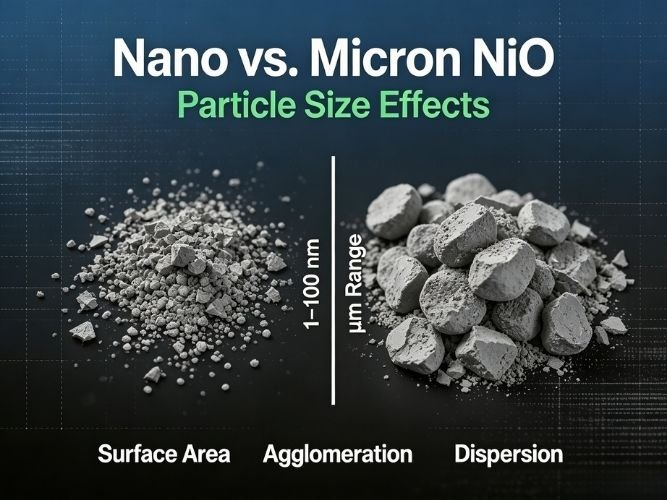
Nickel Oxide Particle Size is a key factor when selecting NiO powder. Nano and micron NiO have the same chemical composition, but different particle sizes can affect surface area, agglomeration, dispersion, and processing behavior. Smaller particles are not always better; the right size depends on the application and processing requirements.
What Is the Difference Between Nano and Micron Nickel Oxide?
These differences become important in applications where surface area, dispersion, and surface reactions affect performance. Therefore, particle size should be evaluated together with purity, morphology, particle-size distribution, crystallinity, BET surface area, and dispersion behavior.
| Factor | Nano Nickel Oxide | Micron-Scale Nickel Oxide |
| Typical scale | Nanometer | Micrometer |
| Surface-to-volume ratio | Higher | Lower |
| Specific surface area | Generally higher | Generally lower |
| Agglomeration tendency | More important | Generally less pronounced |
| Dispersion | Requires greater attention | Often easier to process |
| Surface-related reactions | More strongly affected by surface area | Generally less surface-dominated |
| Powder handling | May require additional process control | Generally more conventional |
| Typical advantage | High surface-area applications | Conventional powder processing |
The practical difference becomes especially important when NiO is used in systems where surface area, adsorption, electrochemical interfaces, or surface reactions influence performance.For this reason, particle size should be evaluated together with purity, morphology, particle-size distribution, crystallinity, specific surface area, and dispersion behavior rather than considered as an isolated specification.
Why Does Nickel Oxide Particle Size Matter?
Particle size affects how nickel oxide powder behaves during processing and how much surface area is available for interaction with the surrounding environment.In general, smaller NiO particles provide a higher surface area per unit mass than larger particles, assuming similar particle shape and density. This can make surface reactions, dispersion, and agglomeration more important when using nano-sized NiO.
For example, using an ideal spherical-particle model and a NiO density of approximately 6.67 g/cm³, the theoretical specific surface area is about 18.0 m²/g for 50 nm NiO and 1.8 m²/g for 500 nm NiO. In other words, under the same ideal conditions, 50 nm NiO has approximately 10 times the theoretical surface area per unit mass of 500 nm NiO.
However, real powders do not behave exactly like ideal spherical particles. Particle shape, surface roughness, porosity, and especially agglomeration can affect the actual accessible surface area.This is particularly important for nano NiO. A powder specified as 50 nm may contain agglomerates that are much larger than the primary particles. Therefore, nominal particle size alone does not fully describe the powder’s practical surface area or dispersion behavior.In simple terms, smaller NiO particles generally provide more surface area, but actual performance also depends on particle morphology and how well the powder is dispersed.
Nano Nickel Oxide Agglomeration: Why Dispersion Matters
Nano NiO has a smaller particle size and higher surface-area-to-mass ratio compared with micron-scale NiO. These characteristics can be beneficial for applications involving electrochemical interfaces, gas sensing, catalysis, and other surface-related processes.However, the main challenge of nano NiO is maintaining good dispersion. Because nanoparticles have high surface energy, individual particles can form agglomerates during storage, mixing, or processing.
Therefore, a NiO powder specified as 50 nm does not always behave as isolated 50 nm particles in an actual formulation. The practical performance depends on particle morphology, BET surface area, agglomeration state, and dispersion behavior.Micron-scale NiO generally has a lower surface-area-to-mass ratio and is less sensitive to nanoparticle aggregation. For applications where extremely high surface area is not required, micron-scale NiO can provide easier handling and more conventional processing behavior.
Particle Size vs. Crystallite Size: What Is the Difference?
Particle size and crystallite size are not the same. Particle size refers to the physical dimensions of the powder particles, while crystallite size refers to the size of a coherent crystalline domain.A single NiO particle may contain one or several crystallites, and several primary particles may also form a larger agglomerate. Therefore, 50 nm NiO does not necessarily have a crystallite size of 50 nm.
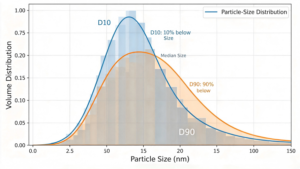
Different characterization methods provide different information. SEM and TEM are commonly used to examine particle morphology and size, while laser diffraction and DLS can measure particle-size distributions under specific conditions. XRD is used to determine crystal structure and can estimate crystallite size. BET measures specific surface area rather than particle size.When comparing NiO powders, always check the measurement method and reported size definition. A particle size measured by SEM should not be directly compared with an XRD crystallite size or a DLS result.
How Does NiO Particle Size Affect Different Applications?
The effect of NiO particle size varies with the application.For electrochemical, gas-sensing, and catalytic applications, surface area and surface accessibility can be important. Nano NiO may be useful in these systems, but its actual performance also depends on morphology, porosity, surface chemistry, and agglomeration.
For ceramic processing, particle size can affect powder packing, sintering, and the final microstructure. Smaller particles may promote sintering, but poor dispersion can lead to uneven packing and affect the final material.
For slurries, coatings, and composites, dispersion is a key consideration. Nano NiO may require more careful mixing because of its tendency to agglomerate, while larger particles can be easier to process in some formulations.The suitable particle size therefore depends on the application, processing method, and required final properties.
How to Choose the Right Nickel Oxide Particle Size?
When selecting NiO powder, particle size should be considered together with the other powder specifications.For surface-sensitive applications, check BET surface area, morphology, and agglomeration in addition to nominal particle size. For slurries and coatings, dispersion and particle-size distribution are particularly important. For ceramic processing, packing, sintering behavior, and final microstructure should also be considered.
Before purchasing, confirm how the particle size was measured and whether the reported value represents primary particles or agglomerates. Useful technical information may include SEM images, particle-size distribution, BET data, COA, TDS, and SDS.The best NiO particle size is therefore determined by the required powder properties and processing conditions, rather than by particle size alone.
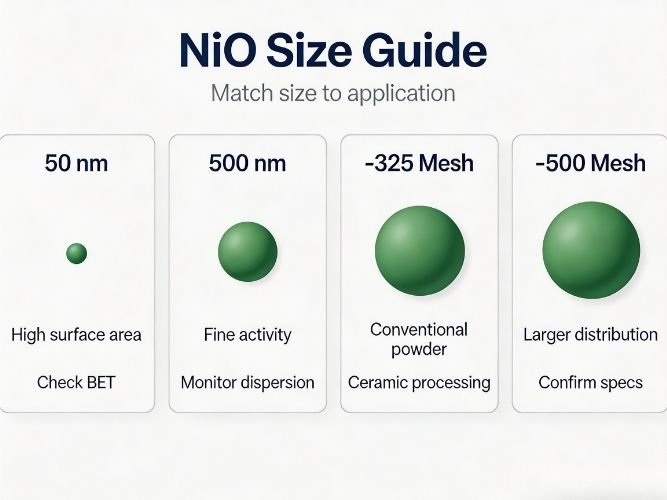
ULPMAT Nickel Oxide Powder: Particle Size Options and Selection Guide
ULPMAT currently offers Nickel Oxide Powder (NiO) with 99.5% purity in four particle-size options: 50 nm, 500 nm, -325 Mesh, and -500 Mesh.
The 50 nm and 500 nm grades provide different fine-particle options, while the mesh grades are specified by mesh size rather than a single particle diameter. For mesh-based powders, the actual particle-size distribution should be confirmed in the product specifications.
When selecting NiO, consider purity, particle-size distribution, morphology, BET surface area, agglomeration, and dispersion in addition to nominal particle size. The appropriate specifications depend on the intended application and processing method.
FAQs
The main difference is particle size. Nano NiO is in the nanometer scale, while micron-scale NiO is in the micrometer scale. The smaller size generally results in a higher surface-to-volume ratio and makes surface area, agglomeration, and dispersion more important.
Not necessarily. Nano NiO can provide a higher theoretical surface-area-to-mass ratio, while micron-scale NiO can be more practical for some conventional powder-processing applications. The appropriate choice depends on the application and processing requirements.
For ideal spherical particles with the same density, yes. Specific surface area increases as particle diameter decreases. However, actual BET surface area can differ because of agglomeration, morphology, surface roughness, and porosity.
Neither is universally better. A 50 nm powder has a higher theoretical surface-area-to-mass ratio, while 500 nm NiO may be easier to handle or disperse in some formulations. The choice depends on the intended use.
Nanoparticles have high surface energy because of their large surface-to-volume ratio. Interparticle interactions can therefore cause primary nanoparticles to form larger aggregates or agglomerates.
No. Particle size describes the physical particle, while crystallite size describes a coherently diffracting crystalline domain. One physical particle can contain multiple crystallites.
SEM and TEM can provide direct information about particle morphology and dimensions at the observed scale. Laser diffraction and DLS can provide particle-size information under specific measurement conditions. XRD can be used to estimate crystallite size rather than directly measuring the external particle diameter.
BET analysis provides an experimental measurement of specific surface area under defined adsorption conditions. It can help identify differences between powders with similar nominal particle sizes but different levels of aggregation, roughness, or porosity.
ULPMAT currently lists NiO powder with 50 nm, 500 nm, -325 Mesh, and -500 Mesh particle-size specifications and a listed purity of 99.5%.
Conclusion
Nickel Oxide Particle Size affects surface area, agglomeration, dispersion, and processing behavior. Smaller particles generally provide a higher surface-area-to-mass ratio, but actual performance also depends on morphology and dispersion.For ideal spherical particles, 50 nm NiO has a theoretical surface area of about 18.0 m²/g, compared with 1.8 m²/g for 500 nm NiO. Actual BET values may differ because of agglomeration, particle shape, and porosity.ULPMAT offers 99.5% NiO powder in 50 nm, 500 nm, -325 Mesh, and -500 Mesh grades for different research and processing requirements. Choose the particle size based on the application and processing conditions.
References
- 1. Varma et al. Chemical Engineering & Technology, 2022. DOI: 10.1002/ceat.202100442.
- 2. Nano-Structures & Nano-Objects, 2017. DOI: 10.1016/j.nanoso.2017.07.003.
- 3. Materials Science in Semiconductor Processing, 2019. DOI: 10.1016/j.mssp.2019.02.024.
- 4. Bonomo et al. Frontiers in Chemistry, 2018. DOI: 10.3389/fchem.2018.00601.