

High purity calcium silicate powder (CaSiO3) is an important inorganic material used in advanced ceramics, thermal insulation systems, specialty fillers, and high-performance industrial products. Known for its excellent thermal stability, low density, chemical resistance, and white appearance, calcium silicate has become a valuable material in industries that require reliable performance under demanding conditions.
Unlike natural mineral-derived materials, high purity calcium silicate powder is produced using carefully controlled synthesis processes to achieve a consistent chemical composition and reduced impurity levels. These characteristics make it suitable for applications where material quality, reproducibility, and process stability are critical.
As modern industries continue to seek lightweight, thermally stable, and environmentally friendly materials, high purity calcium silicate remains an attractive solution for both traditional and advanced manufacturing sectors.
What Is High Purity Calcium Silicate Powder?
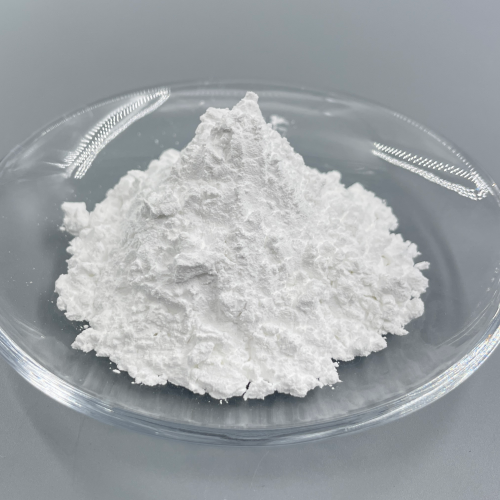
High-purity calcium silicate powder is a synthetic calcium silicate material with the chemical formula CaSiO3. It is typically white and has a purity exceeding 99.5%. It is mainly composed of calcium oxide (CaO) and silicon dioxide (SiO2), bonded together in a stable crystal structure. Compared to natural calcium silicate minerals, high-purity calcium silicate powder is manufactured using carefully selected raw materials and strictly controlled synthesis processes, minimizing the content of metals, alkalis, and other trace impurities.
Typical Physical Properties
High-Purity Calcium Silicate Powder Parameters:
| Property | Typical Value |
| Chemical Formula | CaSiO3 |
| Molecular Weight | 116.16 g/mol |
| CAS No. | 1344-95-2 |
| Appearance | White Powder |
| Crystal Structure | Wollastonite-type |
| Density | 2.8–2.9 g/cm³ |
| Mohs Hardness | 4.5–5.0 |
| Melting Point | ~1540°C |
| Refractive Index | 1.61–1.64 |
| Solubility in Water | Practically Insoluble |
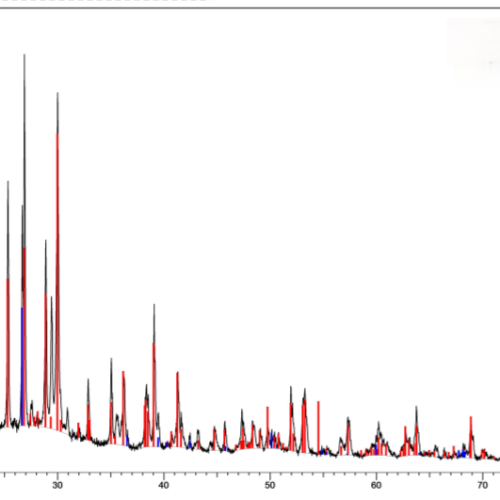
Key Characteristics of High Purity Calcium Silicate Powder
High purity calcium silicate powder is valued for its combination of thermal stability, low density, chemical durability, and process compatibility. These characteristics have made it an important material in advanced ceramics, thermal insulation systems, and specialty industrial formulations.
One of its most notable properties is thermal stability. Calcium silicate maintains structural stability at elevated temperatures and is widely used in insulation materials designed for continuous service temperatures ranging from approximately 650°C to 1000°C, depending on the product formulation and application environment. This makes it suitable for thermal management systems, industrial furnaces, and high-temperature processing equipment.
Another important characteristic is its relatively low density, typically around 2.8–2.9 g/cm³. Compared with many traditional ceramic materials, this lower density can help reduce component weight while maintaining adequate structural performance. As a result, calcium silicate is often selected for applications where both thermal efficiency and weight reduction are important considerations.
High purity calcium silicate also exhibits good chemical stability under normal operating conditions. The material is practically insoluble in water and remains stable when exposed to air, allowing it to maintain consistent performance during storage and processing. Its stable chemical composition contributes to reliable behavior in ceramic formulations and industrial manufacturing processes.
The naturally white appearance of high purity calcium silicate powder is another significant advantage. By controlling trace impurities such as iron and manganese, manufacturers can achieve a cleaner and brighter powder appearance. This characteristic is particularly important for specialty fillers, coatings, and ceramic products where color consistency and product aesthetics are critical.
In addition, high purity calcium silicate powder offers excellent compatibility with a variety of manufacturing methods, including ceramic processing, powder blending, compounding, and composite fabrication. Its consistent composition and controlled particle characteristics help support reproducible processing results and improved product quality.
How Is High Purity Calcium Silicate Powder Produced?
High purity calcium silicate powder is commonly produced through synthetic processes using high-purity calcium compounds and silicon dioxide as starting materials. The most widely used manufacturing route involves a solid-state reaction between calcium carbonate (CaCO₃) and silica (SiO₂) at elevated temperatures.
The simplified reaction can be expressed as:
CaCO₃ + SiO₂ → CaSiO₃ + CO₂
The production process generally includes the following steps:
- Selection of high-purity raw materials.
- Precise weighing and homogeneous mixing.
- High-temperature calcination to form calcium silicate.
- Controlled cooling and phase stabilization.
- Fine milling and particle size classification.
- Quality control testing for purity, particle size, and phase composition.
For applications requiring tighter impurity control and more uniform particle morphology, hydrothermal synthesis or precipitation-assisted methods may also be employed. These advanced production routes can improve particle uniformity and reduce contamination from natural mineral sources.
As a result, synthetic high purity calcium silicate powder offers better consistency, higher whiteness, and more predictable performance compared with conventional mineral-derived materials.
Industrial Applications of High Purity Calcium Silicate Powder
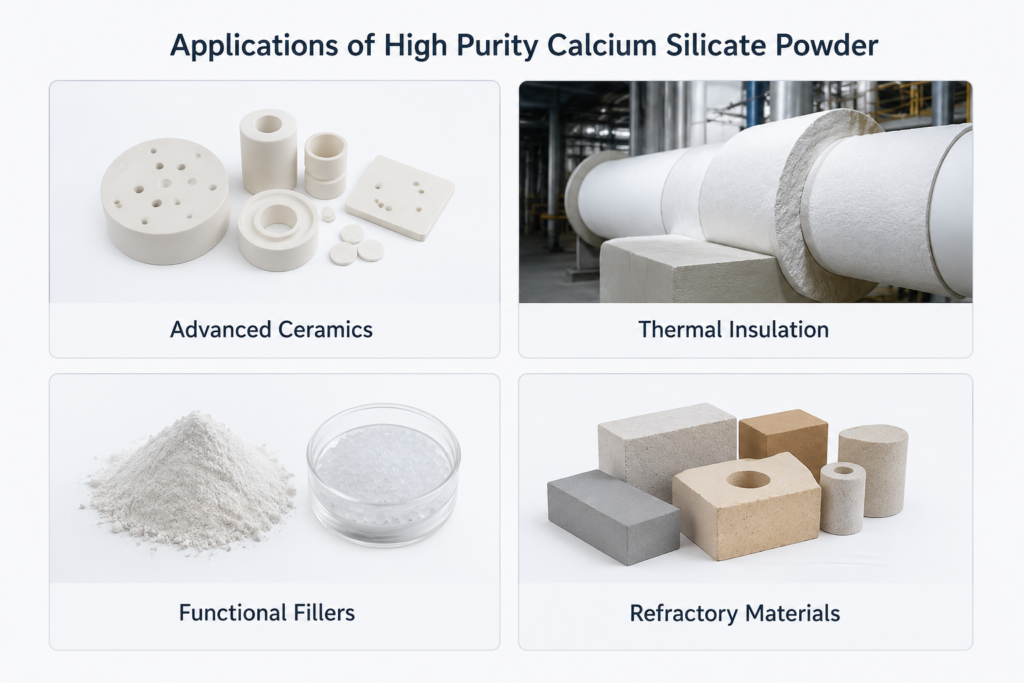
Advanced Ceramics:High purity calcium silicate powder is used in advanced ceramic formulations to improve composition consistency and support stable microstructure development during ceramic processing.
Thermal Insulation Materials:With its low thermal conductivity and excellent thermal stability, calcium silicate is widely used in industrial insulation materials for high-temperature equipment and thermal management systems.
Functional Fillers:As a functional filler, calcium silicate powder can improve dimensional stability, mechanical performance, and thermal resistance in polymers, coatings, and composite materials.
Refractory Materials:High purity calcium silicate is used in selected refractory formulations where consistent composition and reliable performance under elevated temperatures are required.
Why Purity and Impurity Control Matter?
For high-performance applications, purity is an important indicator of material quality.Trace impurities such as iron, aluminum, magnesium, sodium, and potassium can influence material appearance, thermal behavior, and processing performance.
Common effects of excessive impurities include:
| Impurity | Possible Effect |
| Iron (Fe) | Reduced whiteness and color consistency |
| Aluminum (Al) | Changes in crystal structure |
| Magnesium (Mg) | Secondary phase formation |
| Sodium (Na) | Reduced thermal stability |
| Potassium (K) | Altered high-temperature behavior |
By minimizing these contaminants, high purity calcium silicate powder provides better reproducibility, more stable processing characteristics, and improved product consistency.This is particularly important for advanced ceramics, specialty fillers, and engineered industrial materials where quality control requirements are strict.
Advantages of High Purity Calcium Silicate Powder
Compared with conventional industrial-grade materials, high purity calcium silicate offers several important advantages:
- High chemical purity
- Excellent thermal stability
- White appearance
- Low density
- Good chemical resistance
- Consistent particle characteristics
- Improved process reproducibility
- Broad industrial applicability
These benefits have contributed to the growing adoption of high purity calcium silicate in advanced manufacturing and materials engineering.
Conclusion
High purity calcium silicate powder is a valuable material for applications requiring consistent composition, thermal stability, and reliable performance. Its combination of low impurity content, stable crystal structure, and excellent processing compatibility makes it suitable for advanced ceramics, thermal insulation materials, functional fillers, and refractory applications.
At ULPMAT, high purity calcium silicate powder is manufactured using carefully selected raw materials and controlled production processes to ensure consistent quality and reproducible performance. By focusing on purity control, particle consistency, and material reliability, ULPMAT supports customers in developing high-performance products for demanding industrial and research applications.