

What’s the Difference Between Beta and Alpha Silicon Carbide Powder?
Silicon carbide (SiC) powder is widely used in advanced ceramics and abrasive industries due to its high hardness, thermal stability, and chemical resistance. In industrial practice, it is mainly classified into beta silicon carbide (β-SiC) and alpha silicon carbide (α-SiC), which differ in crystal structure and processing behavior.
Although both phases share the same chemical composition, they show clear differences during powder synthesis and ceramic processing. β-SiC is generally associated with finer particle size and higher sintering activity, making it suitable for advanced ceramic and semiconductor-related applications. In contrast, α-SiC is more commonly used in abrasive and refractory applications where high-temperature stability and wear resistance are more critical.
The selection between the two is therefore mainly determined by processing requirements and final application conditions rather than chemistry alone.
Why Beta Silicon Carbide Powder Is Preferred for Advanced Ceramics?
Higher Sintering Activity
β-SiC powder generally shows higher sintering activity due to its formation at lower temperatures and finer particle size distribution, typically in the submicron range. Compared with α-SiC, β-SiC exhibits higher surface area and surface energy, which improves densification during ceramic processing.
In pressureless sintered SiC systems, β-SiC is commonly used to achieve densification at relatively lower temperatures (typically 1900–2100°C depending on additives), while reducing residual porosity to below 2–5% in optimized systems. These characteristics make it suitable for high-reliability ceramic components used in semiconductor and thermal management applications.
Better Powder Control for Precision Ceramics
Advanced ceramic applications require tight control of powder characteristics, including particle size distribution below 1 μm, impurity levels typically below 0.5 wt%, and stable sintering behavior. β-SiC powders are more suitable for achieving these targets due to their high reactivity and uniform morphology.
They are widely applied in semiconductor ceramic components, plasma-resistant parts, wafer processing tools, and ceramic additive manufacturing systems where dimensional stability and purity are critical performance requirements.
β→α Phase Transformation Behavior
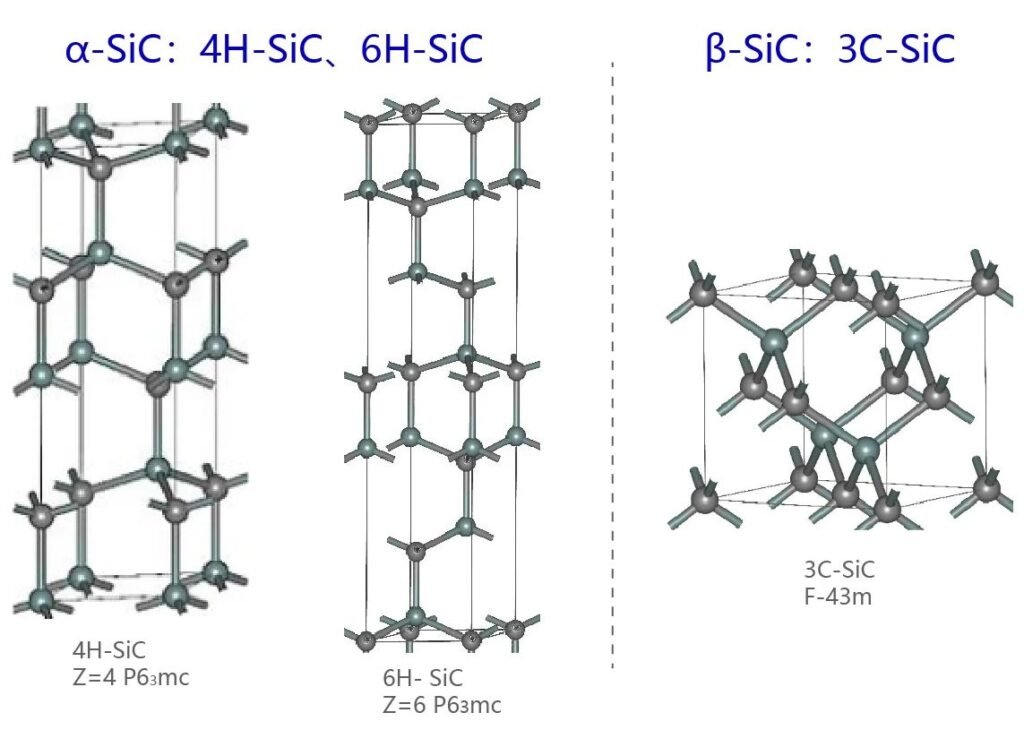
During high-temperature sintering above approximately 2000°C, β-SiC can transform into thermodynamically stable α-SiC polytypes (4H/6H structures). This phase transformation influences grain growth, mechanical strength, and thermal conductivity of the final ceramic.
Controlled β→α transformation is often used to improve fracture toughness, which can increase from ~3 MPa·m¹ᐟ² to 4–5 MPa·m¹ᐟ² in optimized microstructures, depending on processing conditions and additives.
Why Alpha Silicon Carbide Dominates Abrasive and Refractory Industries?
- Superior High-Temperature Stability
α-SiC is the thermodynamically stable phase of silicon carbide, typically formed at temperatures above ~2000°C via high-temperature processes such as the Acheson method. It exists mainly as 4H and 6H polytypes, offering strong structural stability under extreme conditions.
Compared with β-SiC, α-SiC maintains hardness in the range of ~25–28 GPa and shows good oxidation resistance up to ~1600–1700°C in air, making it suitable for long-term high-temperature applications.
- Why Abrasive Applications Prefer α-SiC
α-SiC is widely used in abrasive systems due to its high hardness and stable crystal structure. It performs well in grinding wheels, lapping media, blasting materials, and polishing applications, where resistance to mechanical wear is critical. Commercial abrasive SiC typically exhibits Mohs hardness around ~9–9.5 and is mainly produced via the Acheson process.
- Better Suitability for Refractory Applications
In refractory environments, materials are exposed to thermal cycling, oxidation, and mechanical stress. α-SiC maintains stability up to ~1500–1600°C in continuous service, making it suitable for kiln furniture, furnace linings, and crucibles used in high-temperature industrial systems.
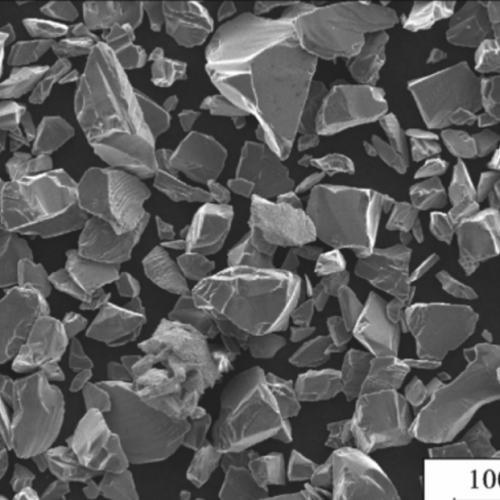
SiC Powder Production Routes and Crystal Phase Formation
The industrial performance of silicon carbide powder is closely related to its synthesis route, as different production methods directly influence particle size, purity, and crystal phase formation.
β-SiC Production
β-SiC is typically synthesized at relatively lower temperatures using controlled chemical processes designed to produce fine and reactive powders. Common production routes include carbothermal reduction, plasma-assisted synthesis, and gas-phase deposition reactions.
In carbothermal reduction, silica (SiO₂) reacts with carbon sources at elevated temperatures under controlled conditions to form fine SiC particles. Plasma synthesis and gas-phase routes further enhance reaction kinetics, allowing the formation of ultrafine powders with narrow particle size distribution and high surface area.
These methods generally operate in the range of ~1400–1800°C and are preferred when high purity, submicron particle size, and good sintering activity are required, especially for advanced ceramic and semiconductor-related applications.
α-SiC Production
α-SiC is primarily produced through the Acheson process, which is a high-temperature solid-state reaction method. In this process, silica sand and petroleum coke are reacted in a resistance furnace at temperatures typically above ~2000°C.
The extreme thermal environment promotes complete crystallization and the formation of thermodynamically stable α-SiC polytypes. Compared with β-SiC routes, the Acheson process generally produces coarser particles with higher crystallinity and superior thermal stability, making it suitable for abrasive and refractory applications.
Which Silicon Carbide Powder Is Better?
Neither β-SiC nor α-SiC is universally superior.The correct choice depends on application requirements.
| Application | Preferred Phase |
| Advanced ceramics | Beta Silicon Carbide |
| Semiconductor ceramics | Beta Silicon Carbide |
| Ceramic 3D printing | Beta Silicon Carbide |
| Abrasives | Alpha Silicon Carbide |
| Refractory materials | Alpha Silicon Carbide |
| High-temperature wear systems | Alpha Silicon Carbide |
Understanding the relationship between crystal structure, powder processing, and final application is essential for selecting the correct silicon carbide material.
Conclusion
Although beta silicon carbide and alpha silicon carbide share the same chemical composition, their industrial roles are fundamentally different.
β-SiC dominates advanced ceramic processing because of its fine particle morphology and superior sintering behavior.
α-SiC remains the preferred material for abrasive and refractory applications because of its outstanding thermal stability and wear resistance.
As advanced ceramics, semiconductor systems, and thermal management technologies continue evolving, understanding the engineering differences between β-SiC and α-SiC powders will become increasingly important for modern material selection.