
What Is an FTO Thin Film?
A fluorine-doped tin oxide (FTO) thin film is a transparent conductive oxide (TCO) coating based on tin dioxide (SnO₂), with fluorine incorporated to modify its electrical properties. FTO combines visible-light transmission with electrical conductivity, making it useful in photovoltaic devices, conductive glass, and other optoelectronic applications.
Although FTO and undoped SnO₂ share the same basic tin oxide structure, they are not equivalent materials. Fluorine can occupy oxygen-related sites in the SnO₂ lattice and contribute additional electrons, potentially improving conductivity. The actual result depends on dopant incorporation, defects, crystallinity, film thickness, and deposition conditions. Consequently, fluorine content alone cannot predict the final film performance.
FTO can be produced through several methods, including chemical vapor deposition, spray pyrolysis, and sputtering. In sputtering, the target composition and deposition conditions must be considered together. For example, a fluorine-containing oxide target can supply material for film growth, while reactive sputtering approaches may use different target and gas combinations.
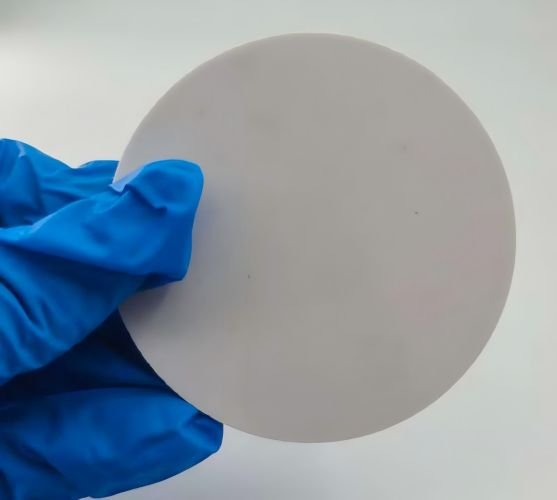
FTO vs SnO₂: What Is the Difference?
The principal difference is the intentional incorporation of fluorine into the tin oxide material.
| Property | SnO₂ | FTO |
| Composition | Tin dioxide | Fluorine-doped tin dioxide |
| Electrical behavior | Depends on intrinsic defects and processing | Fluorine doping can increase electron concentration |
| Optical behavior | Can transmit visible light | Can retain high visible transmission while providing conductivity |
| Performance controls | Defects, crystallinity, thickness, and process | Dopant incorporation, defects, crystallinity, thickness, and process |
| Typical role | Semiconductor, gas-sensing material, functional oxide, or device layer | Transparent conductive coating or electrode |
Undoped SnO₂ is a wide-band-gap semiconductor with useful chemical and thermal stability. However, its electrical conductivity may be insufficient for some transparent-electrode applications without appropriate defect engineering or doping. FTO is one approach to modifying these electrical properties while retaining the optical characteristics needed for transparent coatings.
This distinction also matters when choosing a sputtering target. An SnO₂ target and an FTO target should not be treated as interchangeable simply because both are tin-oxide-based ceramics. The intended film composition and deposition route must match the application requirements.
For related material options, see ULPMAT’s Tin(IV) Oxide Sputtering Target and FTO Sputtering Target pages.
What Determines FTO Thin-Film Performance?
1. Fluorine incorporation and electrical conductivity
Fluorine doping can increase the free-electron concentration in SnO₂, potentially improving electrical conductivity. However, the relationship between fluorine content and film performance is not necessarily linear. Dopant distribution, crystal defects, carrier mobility, and deposition conditions can all influence the final electrical properties.
For this reason, FTO thin-film performance should be evaluated through measured electrical and optical properties rather than nominal composition alone. Sheet resistance, film thickness, and visible-light transmittance should be considered together when comparing deposition results.
2. Experimental Results for FTO Thin Films
Electrical and optical measurements provide useful indicators of FTO thin-film performance. The following experimental results illustrate the relationship between conductivity, carrier transport, and visible-light transmission.
| Measured parameter | Reported result |
| Average visible transmittance | 83% |
| Optical band gap | 3.80 eV |
| Electrical resistivity | 6.71 × 10⁻³ Ω·cm |
| Carrier concentration | 1.46 × 10²⁰ cm⁻³ |
| Carrier mobility | 15 cm²/(V·s) |
These results provide a reference for evaluating FTO thin-film properties. Actual values may vary with film thickness, deposition conditions, substrate characteristics, and post-deposition treatment.
When comparing FTO films, electrical resistivity, sheet resistance, and optical transmittance should be evaluated together under consistent measurement and processing conditions. A film with lower resistivity does not necessarily provide the best overall performance if its optical transmission or surface quality is unsuitable for the intended application.
3. Film Thickness and Sheet Resistance
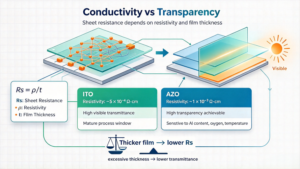
Film thickness is an important factor in determining the electrical behavior of transparent conductive coatings. For a uniform film, sheet resistance can be approximated by:
[R_s=\frac{\rho}{t}]
where (R_s) is sheet resistance, (\rho) is electrical resistivity, and (t) is film thickness.
At a given resistivity, increasing film thickness generally decreases sheet resistance. However, a thicker film may also affect optical transmission, material consumption, and deposition time. The optimal thickness therefore depends on the requirements of the application rather than electrical conductivity alone.
It is also important to distinguish between resistivity and sheet resistance. Resistivity describes a material property, whereas sheet resistance is commonly used to characterize the electrical performance of thin films and is expressed in Ω/sq.
4. Crystallinity, Defects, and Surface Morphology
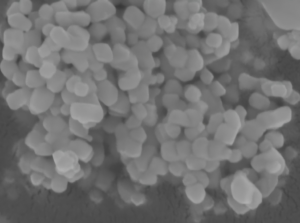
The microstructure of an FTO film influences carrier transport and optical behavior. Crystallinity, grain boundaries, defects, and surface roughness can affect carrier mobility, scattering, and the uniformity of the deposited coating.
Deposition temperature and subsequent thermal treatment may alter grain development and defect populations. Depending on the process, these changes can improve some properties while having limited or adverse effects on others.
For applications involving additional functional layers, such as photovoltaic devices, surface morphology may also influence interfacial contact and device performance. Therefore, electrical and optical measurements may need to be supplemented by structural or surface characterization.
FTO Thin-Film Deposition Methods
FTO thin films can be prepared using several deposition techniques. Each method offers different advantages in terms of process control, substrate compatibility, equipment requirements, and production scale.
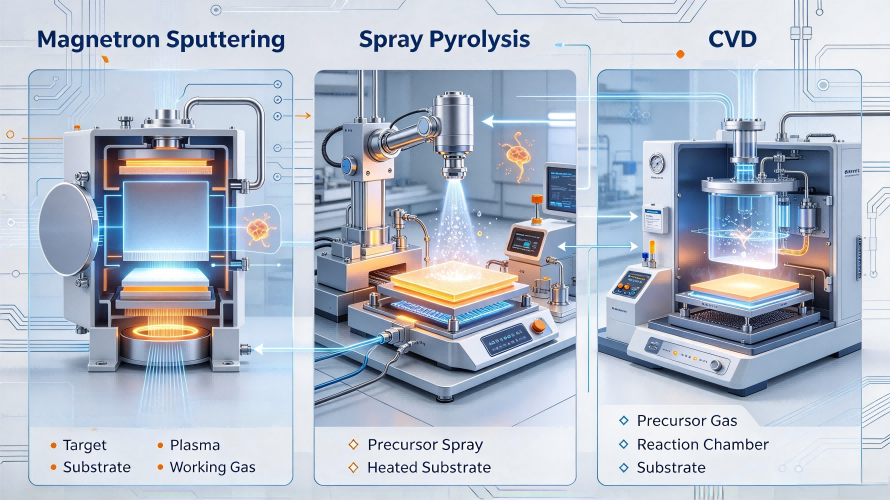
Sputtering: Magnetron sputtering is a physical vapor deposition technique used to form thin films from a solid target. The deposition process allows control over film thickness, deposition rate, and process atmosphere. Reactive sputtering may also be used with suitable target materials and fluorine-containing process chemistry.
The resulting film properties depend on target composition, sputtering power, working pressure, gas flow, substrate temperature, and other process parameters. Sputtering is particularly relevant when controlled thin-film deposition and compatibility with vacuum coating equipment are required.
Spray Pyrolysis: Spray pyrolysis involves spraying a precursor solution onto a heated substrate, where thermal decomposition and chemical reactions produce the oxide coating. Fluorine-containing precursors can be incorporated into the solution to form FTO films.
The method can be suitable for coating relatively large surfaces, including conductive glass. Film quality depends on precursor chemistry, substrate temperature, spray conditions, and the uniformity of the deposited material.
Chemical Vapor Deposition: Chemical vapor deposition (CVD) forms a coating through chemical reactions involving gaseous precursors at or near the substrate surface. Suitable precursor systems can be used to deposit fluorine-doped tin oxide coatings.
CVD is used in processes where coating uniformity, substrate coverage, and production requirements justify the associated equipment and process controls. The achievable film properties depend on precursor selection, reaction conditions, substrate temperature, and deposition rate.
Comparing Deposition Methods
| Factor | Sputtering | Spray pyrolysis | CVD |
| Deposition mechanism | Physical vapor deposition | Precursor spraying and thermal reaction | Gas-phase chemical reaction |
| Process environment | Vacuum | Heated substrate and controlled spraying | Controlled reaction environment |
| Key process variables | Power, pressure, gas flow, substrate temperature | Solution composition, spray rate, substrate temperature | Precursor chemistry, temperature, gas flow |
| Typical consideration | Film control and equipment compatibility | Coating area and precursor control | Coverage, uniformity, and process chemistry |
The most appropriate deposition method depends on the substrate, required film properties, production scale, and available equipment. Results obtained with different methods should not be compared without considering their respective processing conditions.
Applications of FTO Thin Films
FTO is used in applications where electrical conductivity and optical transparency are both required.
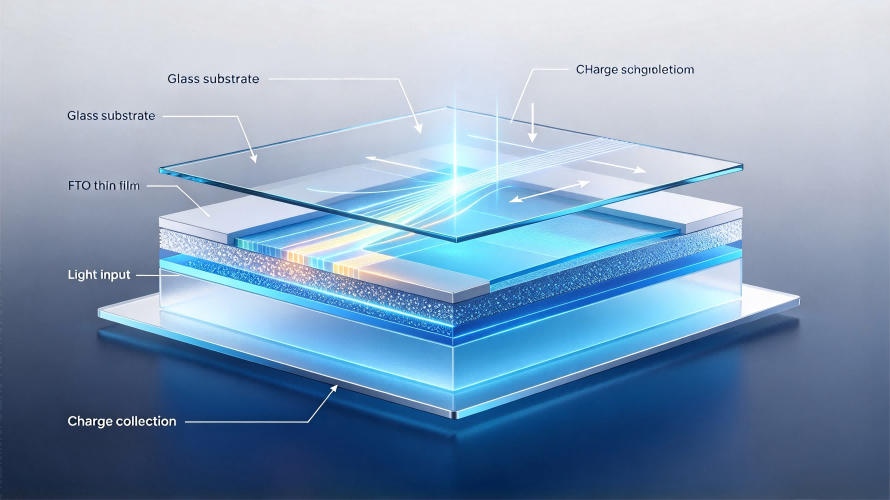
1. Photovoltaic Devices: FTO thin films are commonly used as transparent conducting electrodes in dye-sensitized solar cells and selected perovskite solar-cell architectures. They allow light to pass into the absorber layer while providing a conductive pathway for charge collection. Sheet resistance, optical transmittance, and surface morphology are important factors affecting device performance.
2. Conductive Glass: FTO-coated glass provides a transparent, electrically conductive surface for architectural glazing and other functional glass applications. Its combination of optical transparency and electrical conductivity makes it suitable for applications such as electrically conductive glass and heated glazing. Coating uniformity, adhesion, and electrical stability are important considerations for long-term use.
3. Optoelectronic Devices: FTO can serve as a transparent electrode in selected optoelectronic devices that require light transmission and electrical contact. Its suitability depends on the device structure, operating wavelength, required conductivity, and compatibility with adjacent functional layers.
4. Functional Coatings: FTO coatings can be used on glass and other suitable substrates when a transparent conductive surface is needed. Depending on the application, the coating may provide electrical functionality without substantially obstructing visible light. Substrate compatibility, deposition conditions, coating uniformity, and environmental stability should be considered during material selection.
FAQs
An FTO thin film is a transparent conductive coating made from fluorine-doped tin dioxide (SnO₂). It combines electrical conductivity with visible-light transmission and is used in photovoltaic devices, conductive glass, and selected optoelectronic applications.
SnO₂ is tin dioxide, while FTO is fluorine-doped tin dioxide. Fluorine incorporation can increase the free-electron concentration and modify electrical conductivity. However, the final film properties also depend on crystallinity, defects, thickness, and deposition conditions.
The electrical conductivity of FTO films depends primarily on carrier concentration and carrier mobility. Fluorine incorporation can affect carrier concentration, while defects, grain boundaries, and crystallinity influence carrier transport. Deposition conditions also play an important role in determining the final electrical performance.
FTO film thickness affects both sheet resistance and optical transmission. At a given resistivity, increasing the thickness of a uniform film generally reduces sheet resistance. However, excessive thickness may affect light transmission, so the appropriate thickness depends on the application requirements.
FTO thin films can be produced using sputtering, spray pyrolysis, and chemical vapor deposition (CVD). The appropriate method depends on substrate compatibility, required film properties, production scale, and process conditions.
Key measurements include electrical resistivity or sheet resistance, optical transmittance, and film thickness. Depending on the application, additional characterization may include surface morphology, crystallinity, adhesion, and environmental stability.
Conclusion
FTO thin films combine electrical conductivity with visible-light transmission, making them useful in photovoltaic devices, conductive glass, and selected optoelectronic applications. Their performance depends on fluorine incorporation, carrier transport, film thickness, microstructure, and deposition conditions.
No single parameter fully describes the quality of an FTO film. Electrical and optical properties should be evaluated together under defined processing and measurement conditions. Understanding the relationship between deposition methods and film characteristics helps identify suitable process conditions for the intended application.
For related material specifications, see ULPMAT’s FTO Sputtering Target and Transparent Conductive Oxide Materials pages.
References
- 1. Dalapati, G. K. et al. “Tin oxide for optoelectronic, photovoltaic and energy storage devices: a review.” Journal of Materials Chemistry A, 2021, 9, 16621–16684.
- 2. Banyamin, Z. Y. et al. “Electrical and Optical Properties of Fluorine Doped Tin Oxide Thin Films Prepared by Magnetron Sputtering.” Coatings, 2014, 4(4), 732–746.