

How to choose IGZO sputtering target depends on more than target purity alone. For reliable thin-film deposition, the target composition, purity, density, microstructure, manufacturing method, shape, dimensions, bonding configuration, and compatibility with the sputtering system should be considered together.
Indium gallium zinc oxide (IGZO) is widely investigated for oxide semiconductor applications, particularly thin-film transistors (TFTs), displays, sensors, and other electronic devices. However, an IGZO target is not simply a source of material for deposition. Its composition and physical quality can directly influence sputtering behavior, film uniformity, deposition stability, and ultimately the properties of the deposited thin film.
IGZO is primarily used as an oxide semiconductor, while ITO is generally selected for transparent conductive applications. The differences in their electrical functions and typical applications are discussed in our guide to IGZO vs ITO Sputtering Target.
How to Choose IGZO Sputtering Target: What Should You Consider?
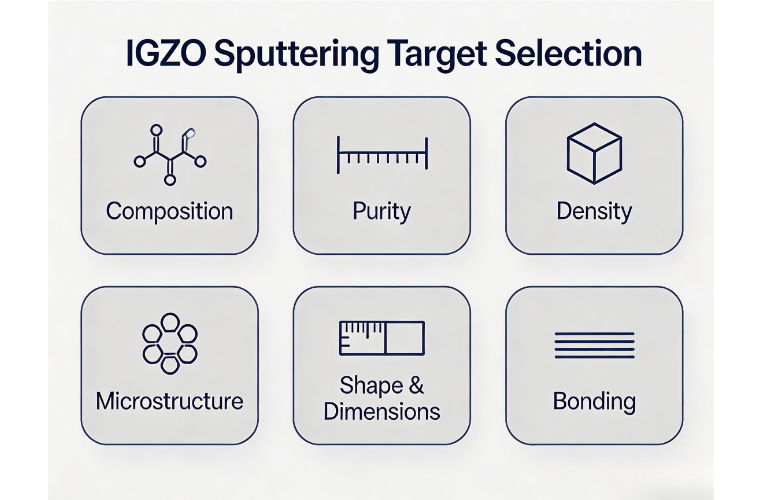
The key factors when choosing an IGZO sputtering target are composition, purity, density, microstructure, manufacturing method, shape, dimensions, thickness, bonding, and sputtering-system compatibility.
| Specification | Key Consideration |
| Composition | Select the appropriate In₂O₃-Ga₂O₃-ZnO ratio according to the required film properties and application. |
| Purity | Check nominal purity and impurity levels. 99.99% is a commonly specified grade for research and electronic-material applications. |
| Density & Microstructure | A dense and homogeneous ceramic structure can support stable sputtering and more consistent target erosion. |
| Manufacturing Method | The sintering process affects target density, microstructure, phase structure, and mechanical integrity. |
| Shape & Dimensions | The target geometry must match the sputtering cathode and target holder. |
| Thickness | The target thickness must be compatible with the equipment and mounting configuration. |
| Bonding & Backing Plate | Confirm whether the ceramic target requires bonding and a backing plate, such as copper. |
| Sputtering Compatibility | Verify compatibility with the intended RF or DC magnetron sputtering system. |
The right IGZO sputtering target is therefore determined by the combination of material composition, target quality, physical dimensions, and equipment requirements—not by purity alone.
How Does IGZO Target Composition and Purity Affect Film Performance?
The composition of an IGZO sputtering target can influence the properties of the deposited film. IGZO is based on the In₂O₃-Ga₂O₃-ZnO system, and different ratios of these oxide components have been studied for oxide-semiconductor applications.
The relative amounts of indium, gallium, and zinc can affect the target phase structure and the resulting film’s electrical, optical, structural, and deposition characteristics. Studies using different In₂O₃-Ga₂O₃-ZnO ratios have reported differences in film morphology, optical properties, and electrical performance.
For applications where film properties need to be reproduced consistently, the target composition should therefore be clearly defined rather than treated simply as a generic “IGZO” material. When following a published process, using the same or an equivalent target composition as the reference can help reduce variation between experiments.
Purity is another important specification. A 99.99% IGZO target provides a controlled starting material with low levels of unwanted impurities. However, purity alone does not determine target performance. Composition, density, microstructure, and manufacturing quality should also be considered as part of the overall target specification.
The appropriate composition and purity can also depend on the intended application and deposition process. For customers who are still evaluating target specifications, ULPMAT can provide technical support during material selection, including recommendations based on the required composition, target dimensions, application, and sputtering-system requirements.
ULPMAT supplies 99.99% IGZO sputtering targets with controlled composition and ceramic quality. COA and impurity data can be provided for applications where detailed material characterization is required.For more information on how composition, purity, density, and microstructure relate to IGZO target quality, see IGZO Sputtering Target Quality.
Why Do IGZO Target Density, Microstructure, and Manufacturing Method Matter?
IGZO is normally supplied as a ceramic sputtering target, so its physical structure is an important part of target quality.
IGZO target density affects the compactness of the ceramic body and can influence sputtering behavior and mechanical integrity. A dense target with a homogeneous microstructure can provide more consistent material removal during sputtering.
The microstructure is also relevant because variations in phase distribution, grain structure, or local defects can contribute to differences in erosion behavior. Research on IGZO targets has specifically investigated high-density and uniform microstructures in relation to sputtering target performance.
However, density should not be considered independently from composition and manufacturing method. There is no single universal density value that guarantees suitable performance for every IGZO target.
ULPMAT uses hot press sintering to produce IGZO ceramic sputtering targets. Key production conditions, including raw-material quality, temperature, pressure, and holding time, are controlled to obtain dense and uniform ceramic targets.The finished target should also be inspected for visible defects such as cracks, abnormal spots, or significant surface irregularities. These checks are particularly relevant for ceramic targets intended for repeatable PVD processing.
How Do IGZO Target Shape, Size, and Thickness Affect Selection?
The physical dimensions of an IGZO target must match the sputtering equipment. Even a target with the correct composition and purity cannot be used effectively if its geometry is incompatible with the target holder or cathode.
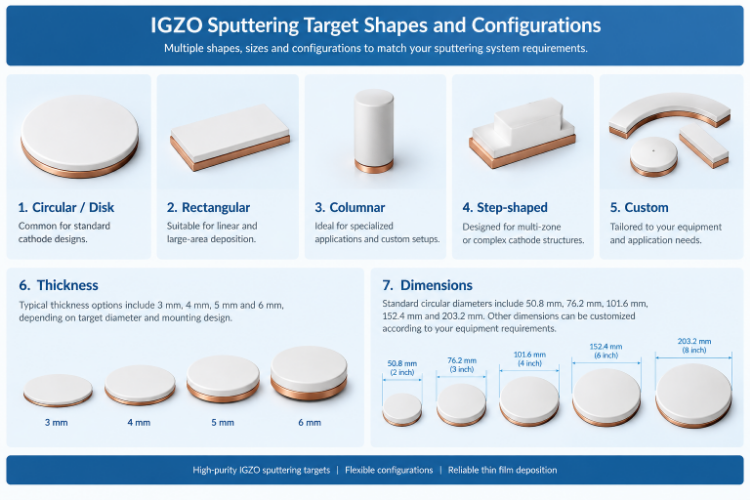
Common IGZO sputtering target
- shapes include:
- Circular or disk
- Rectangular
- Columnar
- Step-shaped
- Custom geometries
For circular targets, commonly requested diameters include 1 inch, 2 inch, 3 inch, and 4 inch, as well as metric dimensions such as approximately 50 mm, 60 mm, 80 mm, and 100 mm. Other dimensions can be customized according to equipment requirements.Thickness is another important specification. Typical target thicknesses can include approximately 3 mm, 4 mm, 5 mm, and 6 mm, depending on target diameter and mounting design.
ULPMAT currently lists several standard circular IGZO target configurations, including 50.8 mm, 76.2 mm, 101.6 mm, 152.4 mm, and 203.2 mm diameters with different thickness options. Custom dimensions can also be produced.For rectangular and other non-standard geometries, dimensions should be specified according to the actual target holder rather than selected only by a nominal product size.
Does IGZO Target Need Bonding or Backing Plate?
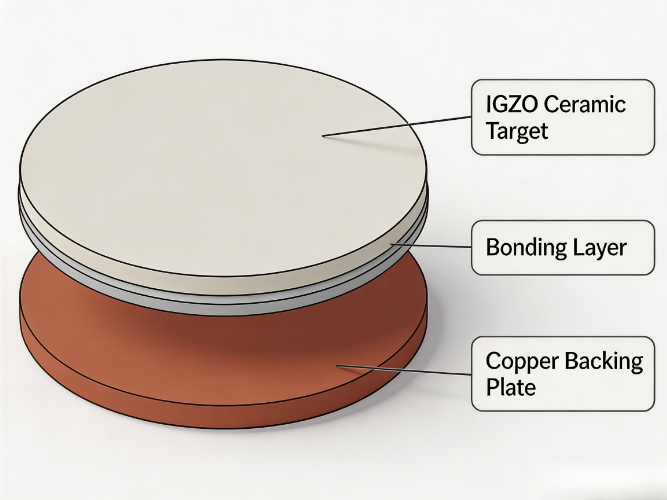
Ceramic IGZO targets may require a backing plate depending on the sputtering equipment and target mounting configuration.A copper backing plate can be used when required by the system. The bonding configuration provides the mechanical connection between the ceramic target and the backing assembly and should therefore be considered when specifying the target.
The required configuration may depend on:
- Target dimensions
- Cathode design
- Mounting method
- Cooling configuration
- Backing plate dimensions
- Equipment manufacturer requirements
We can provide bonded IGZO sputtering targets with copper backing plates when required. Bonding and backing-plate configurations can be customized according to the target and equipment specifications.This is particularly important for custom targets. The target material, dimensions, bonding method, and backing plate should be treated as one complete assembly rather than as independent specifications.
What Should You Check When Comparing IGZO Sputtering Target Suppliers?
When comparing an IGZO sputtering target supplier, price and nominal purity should not be the only criteria. A useful comparison should include four areas.
1. Material specifications:
Check the IGZO composition, purity, and available impurity data. If a specific In₂O₃-Ga₂O₃-ZnO ratio is required, confirm that the supplier can provide the specified composition.
2. Physical target quality:
Check density, microstructure, surface condition, dimensional accuracy, and manufacturing method. These factors are particularly important for ceramic targets used in repeatable deposition processes.
3. Customization capability:
A capable supplier should be able to provide different shapes, dimensions, thicknesses, compositions, and bonding configurations when standard targets do not match the equipment.
4. Technical documentation:
Useful documents may include COA, TDS, SDS/MSDS, impurity analysis, dimensional specifications, and third-party test reports where applicable.
For research and development, consistency is especially important. If the same target specification needs to be reordered, the supplier should be able to reproduce the required composition and physical dimensions with appropriate quality control.
ULPMAT IGZO Sputtering Targets
ULPMAT supplies 99.99% IGZO sputtering targets for thin-film deposition, materials research, TFT development, and related applications.IGZO targets are produced using hot press sintering, with control of raw materials and key processing conditions to obtain dense and uniform ceramic targets.
Available configurations include circular/disk, rectangular, columnar, step-shaped, and custom shapes. Circular targets can be supplied in commonly used diameters such as 1 inch, 2 inch, 3 inch, and 4 inch, as well as metric and custom dimensions.Typical thickness options include approximately 3 mm, 4 mm, 5 mm, and 6 mm, depending on the target design. Custom dimensions and configurations can be discussed according to the requirements of the sputtering equipment.
For systems requiring a bonded assembly, ULPMAT can provide copper backing plates and customized bonding configurations.The targets can be used with suitable RF or DC magnetron sputtering systems, depending on the equipment configuration and deposition process.
Technical documents such as COA, TDS, SDS/MSDS, and available inspection or third-party test reports can be provided according to product and project requirements.
For current specifications and available configurations, see the ULPMAT IGZO sputtering target product page.
Conclusion
Choosing an IGZO sputtering target is ultimately about matching material specifications with deposition requirements. Composition and purity determine the characteristics of the starting material, while density, microstructure, geometry, and bonding configuration affect its suitability for the sputtering process.
For research and process development, clearly defined target specifications are important for maintaining consistent and reproducible deposition results. When standard configurations do not match the equipment or application, customized composition, shape, dimensions, thickness, or bonding can provide a more suitable option.
The best target is therefore not simply the one with the highest purity or the lowest price, but the one that meets the technical requirements of the intended deposition process. If the required specifications are not yet fully defined, working with an experienced target supplier can help identify a suitable composition and configuration before production.
FAQs
When choosing an IGZO sputtering target, consider composition, purity, density, microstructure, target dimensions, thickness, shape, bonding configuration, and sputtering-system compatibility. The required In₂O₃-Ga₂O₃-ZnO ratio is particularly important because IGZO does not have one universal composition. For repeatable deposition, the target specification should also match the reference process and equipment.
IGZO sputtering targets are available in different purity grades depending on the application. 99.99% purity is commonly specified for research, thin-film deposition, and oxide-semiconductor applications where controlled impurity levels are important. The actual impurity profile should also be considered rather than relying on the nominal purity value alone. COA and impurity analysis can be provided according to product requirements.
Yes. IGZO sputtering targets can be customized in composition, purity, shape, diameter or length, thickness, and bonding configuration. Customization is useful when a standard target does not match the sputtering cathode, target holder, deposition process, or required film composition. The required specifications should be confirmed before production.
IGZO sputtering targets can be supplied in circular or disk, rectangular, columnar, step-shaped, and other custom geometries. Circular targets are commonly specified by diameter and thickness, while rectangular and custom targets are normally designed according to the dimensions of the sputtering equipment and target holder.
Yes. IGZO ceramic sputtering targets can be supplied with copper backing plates and a bonded target assembly when required by the sputtering system. The backing plate and bonding configuration should be selected according to the target dimensions, cathode design, mounting method, and cooling requirements. Custom bonded configurations can be discussed based on the equipment specifications.
No. IGZO does not have one single fixed In₂O₃-Ga₂O₃-ZnO composition. Different ratios of indium oxide, gallium oxide, and zinc oxide can be used for different thin-film and oxide-semiconductor requirements. Therefore, an IGZO sputtering target should be specified by its actual composition or molar ratio rather than simply by the name “IGZO.” When reproducing a published process, using the same or an equivalent composition can help improve process consistency.
Technical Consultation
Please send us your specifications to receive tailored technical support.