

NFPP cathode material is an iron-based phosphate-pyrophosphate material with the chemical formula Na₄Fe₃(PO₄)₂P₂O₇, primarily investigated for sodium-ion batteries. Its polyanionic framework, iron-based chemistry, and potential for particle and surface engineering make NFPP an active research material for sodium-ion battery cathodes and energy-storage systems.
What Is NFPP Cathode Material?
NFPP cathode material, also known as sodium iron phosphate pyrophosphate, has the chemical formula Na₄Fe₃(PO₄)₂P₂O₇ and is primarily investigated as a cathode material for sodium-ion batteries. NFPP belongs to the polyanionic sodium-ion cathode family and contains both phosphate (PO₄) and pyrophosphate (P₂O₇) groups within its crystal framework. These polyanionic units contribute to the material’s structural characteristics and influence sodium-ion storage behavior, ion transport, and electrochemical stability.
The NFPP structure consists of sodium (Na), iron (Fe), phosphate groups (PO₄), and pyrophosphate groups (P₂O₇). During battery operation, Na⁺ ions are reversibly extracted from and inserted into the NFPP framework, while iron redox reactions provide charge compensation. The practical performance of NFPP depends not only on its chemical composition but also on factors including crystal structure, phase purity, sodium-ion diffusion pathways, particle size, morphology, electronic conductivity, surface chemistry, and electrode formulation.
Because different NFPP powders with the same nominal formula may show different electrochemical behavior, material evaluation should consider both structural characteristics and physical properties. Recent research has focused on phase control, conductivity enhancement, particle engineering, and scalable processing to improve NFPP performance for sodium-ion battery applications.ULPMAT currently supplies NFPP powder (Na₄Fe₃(PO₄)₂P₂O₇) with an orthorhombic crystal structure (Pn2₁a space group) for sodium-ion battery research and provides customization options related to particle size, morphology, tap density, and surface modification.
How Does NFPP Work in a Sodium-Ion Battery?
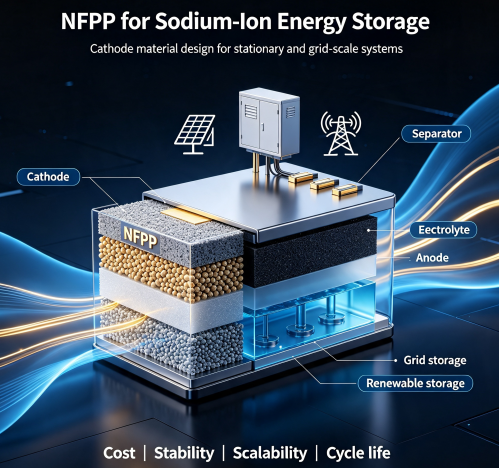
In a sodium-ion battery, Na⁺ ions move between the cathode and anode through the electrolyte during charging and discharging.For NFPP-based cathodes, sodium ions are reversibly extracted from and inserted into the host structure. The associated charge compensation involves the redox activity of iron within the material.
The practical electrochemical behavior is influenced by several material and electrode parameters:
- Crystal structure
- Phase composition
- Sodium-ion diffusion pathways
- Particle size
- Particle morphology
- Electronic conductivity
- Surface chemistry
- Electrode formulation
This is why two NFPP powders with the same nominal chemical formula may not produce identical electrochemical results.
Key Properties of NFPP Cathode Material
When evaluating NFPP cathode materials, chemical composition alone is insufficient to determine material suitability. Several other parameters should also be considered, including phase purity, particle characteristics, conductivity, and powder handling performance.
| Property | Description | Importance for NFPP Selection |
| Chemical Composition | NFPP has the chemical formula Na₄Fe₃(PO₄)₂P₂O₇, consisting of sodium (Na), iron (Fe), phosphate groups (PO₄), and pyrophosphate groups (P₂O₇). | The chemical composition defines the material category, but battery performance also depends on phase composition, impurities, and physical characteristics. |
| Phase Purity | Phase purity refers to the presence of the intended NFPP crystal phase without significant secondary phases formed during synthesis. XRD is commonly used for phase identification. | Different sodium-iron-phosphate phases may influence electrochemical behavior. High phase consistency is important for reproducible battery research results. |
| Crystal Structure | NFPP is a polyanionic material with a phosphate-pyrophosphate framework. ULPMAT currently supplies NFPP powder with an orthorhombic crystal structure (Pn2₁a space group). | Crystal structure affects sodium-ion diffusion pathways, structural stability, and electrochemical behavior during charge and discharge cycles. |
| Particle Size | Particle size influences diffusion distance, surface area, electrode processing, and powder packing behavior. | Smaller particles may improve sodium-ion diffusion kinetics, while larger particles may provide advantages in handling and packing density. The optimal size depends on electrode design requirements. |
| Particle Morphology | Particle morphology describes the shape and surface characteristics of NFPP powder particles. SEM analysis is commonly used for morphology evaluation. | Morphology affects surface area, slurry processing, particle contact, and the distribution of conductive additives within electrodes. |
| Electronic Conductivity | NFPP is being studied with conductivity-enhancement approaches such as carbon coating, elemental substitution, and surface modification. | Improved electronic transport can support better electrode performance, especially for high-rate applications. |
| Tap Density | Tap density describes the packing density of powder after mechanical tapping and is related to electrode compaction behavior. | Higher tap density can contribute to improved volumetric energy density, while particle size and morphology strongly influence powder packing. |
| Surface Modification | Surface modification methods such as carbon coating are used to optimize conductivity and interfacial behavior. | Surface engineering can improve electron transport and stabilize electrode/electrolyte interactions depending on the battery design. |
From a material supplier’s perspective, NFPP should be specified based on a combination of chemical composition, phase purity, particle size, morphology, and application requirements. A powder with the same nominal formula may show different performance characteristics if its physical properties and crystal phase differ.
What Are the Advantages of NFPP?
Iron-Based Chemistry
NFPP uses iron as its transition metal. Iron is relatively abundant and widely available, making iron-based cathode chemistry relevant to sodium-ion battery systems where raw-material availability and cost are important considerations.
Polyanionic Framework
NFPP contains both phosphate and pyrophosphate groups within its crystal framework. This polyanionic structure provides a stable framework for sodium-ion storage and is one of the key reasons NFPP continues to attract research interest as a sodium-ion battery cathode.
Potential for Material Engineering
NFPP offers several possibilities for material optimization. Researchers can adjust particle size and morphology or use carbon coating, elemental substitution, surface modification, defect engineering, and phase regulation to improve conductivity, sodium-ion transport, structural stability, and overall electrode performance.
Relevance to Large-Scale Energy Storage
NFPP is also being investigated for sodium-ion battery applications in stationary and large-scale energy storage. As sodium-ion technology develops, research is increasingly focusing on scalable synthesis, practical electrode design, and material consistency for larger-scale battery systems.
What Are the Limitations of NFPP?
NFPP is a promising sodium-ion cathode material, but its practical performance still depends on several material and processing factors.
Phase Control
Obtaining phase-pure NFPP can be challenging because related sodium-iron-phosphate phases may form during synthesis. Phase purity is therefore an important consideration when evaluating NFPP powder.
Electronic Conductivity
Electronic conductivity is an important factor in NFPP electrode design. Carbon coating, conductive additives, doping, and other surface modifications can be used to improve electronic transport.
Sodium-Ion Transport
Sodium-ion transport depends on the crystal structure, diffusion pathways, particle size, and morphology of NFPP. These parameters should be considered together when selecting material for a specific electrode design.
Energy Density
The practical energy density of an NFPP-based battery depends on more than the cathode material. Cell voltage, reversible capacity, electrode loading, electrode density, anode, electrolyte, and cell design all contribute to the final energy density.
Moisture and Air Stability
Moisture and air stability should also be considered during NFPP storage, handling, and electrode processing, particularly when moving from laboratory research toward larger-scale battery production.
What Is NFPP Used For?
NFPP is mainly investigated as a cathode material for sodium-ion batteries, with research covering stationary energy storage, grid-scale storage, renewable-energy storage, and battery electrode development. Its iron-based composition and phosphate-pyrophosphate framework make it relevant to sodium-ion battery systems where material cost, resource availability, and long-term performance are important considerations.
NFPP is also being studied for large-scale and solid-state sodium battery systems. The suitability of NFPP depends on the complete battery configuration, including the anode, electrolyte, electrode formulation, and operating conditions. Recent research is increasingly focused on improving NFPP performance and evaluating its potential for practical sodium-ion battery applications.
NFPP Compared With Other Sodium-Ion Cathode Materials
NFPP is one of several cathode material families being studied for sodium-ion batteries.
| Material | Material Family | Main Research Interest | Key Considerations |
| NFPP | Phosphate-pyrophosphate | Cost-conscious sodium-ion storage | Phase purity, conductivity, particle engineering |
| Sodium Vanadium Phosphate | NASICON-type phosphate | Na⁺ transport and rate performance | Vanadium chemistry and cost |
| Prussian Blue / Prussian White | Open-framework cyanide | Sodium-ion transport | Defects, water content, phase control |
| NaFeMnPO₄ | Iron-manganese phosphate | Iron-based sodium cathodes | Kinetics and structural stability |
| Layered Sodium Transition-Metal Oxides | Layered oxide | Higher-energy sodium-ion systems | Structural evolution during cycling |
There is no single cathode material that is best for every sodium-ion battery.The appropriate choice depends on the required combination of:energy density, rate capability, cycle life, cost, raw-material availability, processing requirements, and system design.
How to Select NFPP Cathode Material?
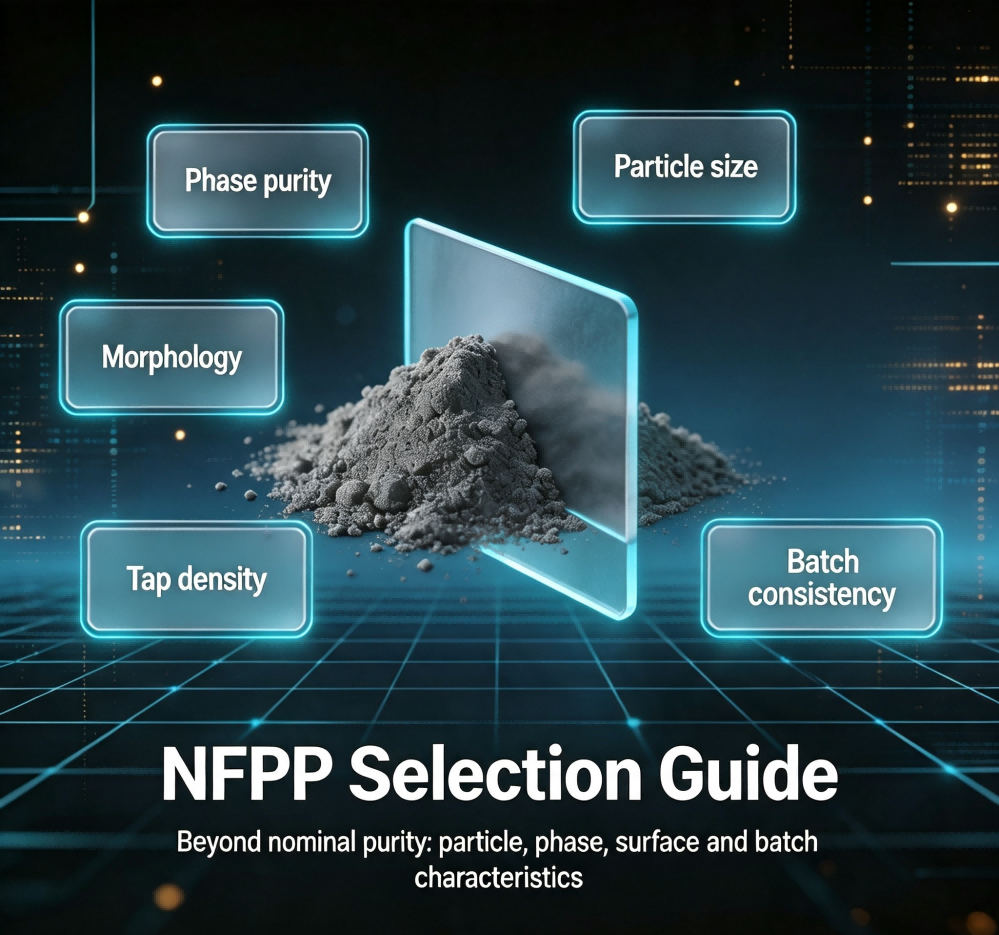
When sourcing NFPP cathode material, we recommend defining the specification according to the intended electrode and research requirements rather than selecting the powder based only on nominal purity.
Chemical Formula and Phase Purity
The required composition is Na₄Fe₃(PO₄)₂P₂O₇, but the chemical formula alone does not describe the complete material. Phase purity should also be checked because related phosphate and pyrophosphate phases may form during synthesis. XRD data or other suitable phase-characterization results can help confirm the crystalline phase.
Particle Size and Morphology
Particle size and morphology should be selected according to the intended electrode application, taking into account sodium-ion diffusion, surface area, slurry processing, electrode loading, and powder packing. SEM analysis can be used to evaluate particle morphology and compare material from different suppliers or batches. ULPMAT currently supplies NFPP powder with 99% purity , with particle size and morphology available for discussion based on specific requirements.
Conductivity and Surface Modification
Electronic conductivity should also be considered when selecting NFPP. Depending on the electrode formulation, carbon coating, conductive additives, or other surface modifications may be considered to improve electronic transport. The appropriate modification should be determined together with the intended electrode design rather than specified independently.
Tap Density and Batch Consistency
Tap density is relevant to powder packing, electrode compaction, and volumetric energy density, so it should be evaluated together with particle size and morphology. For research applications, we also recommend checking chemical purity, phase composition, particle-size distribution, SEM morphology, tap density, carbon content where applicable, and moisture content. Batch documentation such as COA and TDS can help researchers maintain consistency between material batches.
NFPP for Battery Research
NFPP is used in both academic research and industrial battery-material development, with research covering sodium-ion cathodes, electrode formulation, phase regulation, particle engineering, carbon coating, and full-cell development. For laboratory work, batch consistency is important because powders with the same nominal chemical formula may behave differently when their phase composition, particle size, morphology, or surface characteristics differ.
When comparing NFPP batches, we recommend keeping key material parameters consistent and checking the relevant characterization data before starting electrochemical testing.
NFPP Cathode Material from ULPMAT
At ULPMAT, we supply NFPP cathode material, Na₄Fe₃(PO₄)₂P₂O₇, for sodium-ion battery research and energy-storage material development.
Our current standard NFPP powder is available with 99% purity. The material is listed with an orthorhombic crystal structure (Pn2₁a), while particle morphology, tap density, and surface modification can be discussed according to specific research requirements.
| Parameter | ULPMAT NFPP |
| Chemical Formula | Na₄Fe₃(PO₄)₂P₂O₇ |
| Purity | 99% (Customized) |
| Form | Powder |
| Particle Size | D50 is approximately 10μm (Customized) |
| Crystal Structure | Orthorhombic, Pn2₁a |
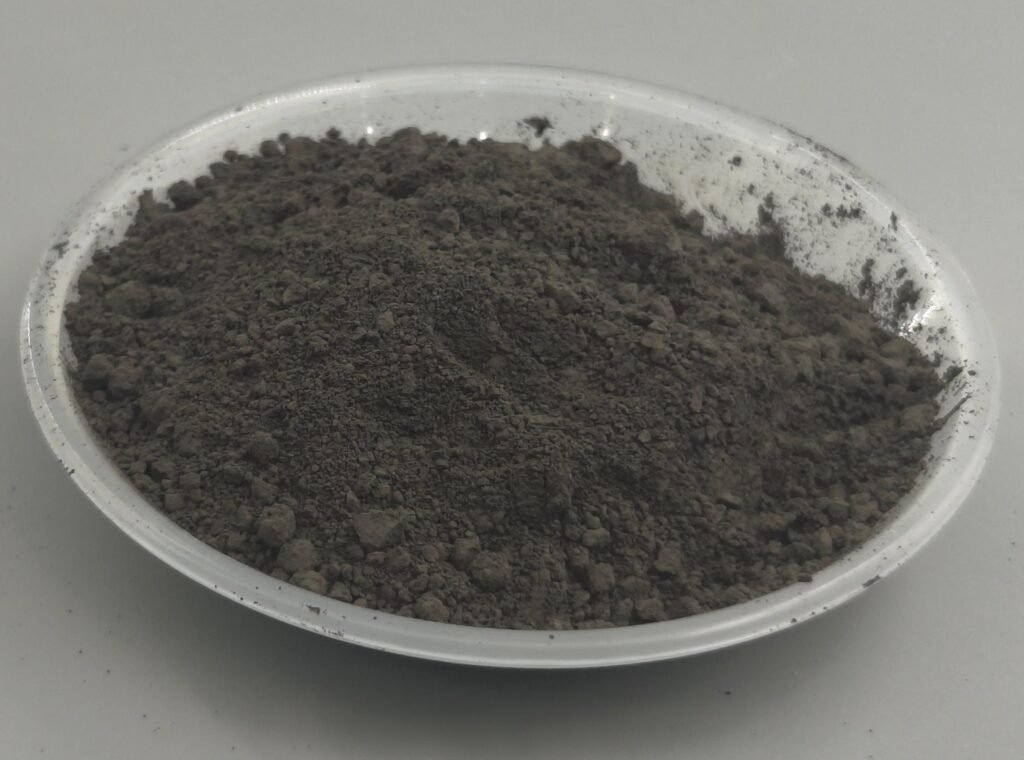
| Appearance | Gray to black powder |
| Density | 3.3–3.5 g/cm³ |
| Tap Density | Customized |
| Particle Morphology | Customized |
| Surface Modification | Carbon coating / conductivity enhancement available |
For projects with specific electrode-processing requirements, ULPMAT can discuss particle-size adjustment, morphology control, tap-density optimization, carbon coating, and conductivity enhancement. When requesting NFPP material, it is useful to provide the required purity, particle size, application, morphology, surface modification, quantity, and characterization requirements.
FAQs
NFPP cathode material is an iron-based phosphate-pyrophosphate material with the chemical formula Na₄Fe₃(PO₄)₂P₂O₇, primarily investigated as a cathode material for sodium-ion batteries.
NFPP stands for sodium iron phosphate pyrophosphate, referring to the compound Na₄Fe₃(PO₄)₂P₂O₇.
NFPP is primarily investigated as a cathode material for sodium-ion batteries.
The chemical formula of NFPP is Na₄Fe₃(PO₄)₂P₂O₇.
NFPP is mainly researched for sodium-ion battery cathodes, including applications related to stationary energy storage, grid-scale storage, and advanced battery-material development.
NFPP combines iron-based chemistry with a phosphate-pyrophosphate framework and offers opportunities for particle engineering, surface modification, and phase optimization.
Key challenges include phase purity, electronic conductivity, sodium-ion transport, energy density, air stability, and scalable processing.
Yes. ULPMAT can discuss particle size, morphology, tap density, carbon coating, and conductivity enhancement according to specific research and electrode requirements.
ULPMAT currently supplies NFPP powder with 99% purity and a particle size of 1–3 μm. The listed material has an orthorhombic Pn2₁a crystal structure, with additional customization options available.
Conclusion
NFPP cathode material, Na₄Fe₃(PO₄)₂P₂O₇, is an iron-based phosphate-pyrophosphate material being actively investigated for sodium-ion batteries. Its polyanionic framework and iron-based chemistry make it relevant to research into cost-conscious and large-scale energy-storage systems.For practical material selection, however, the chemical formula is only the starting point. Phase purity, particle size, morphology, electronic conductivity, tap density, surface modification, and batch consistency can all influence the behavior of NFPP in an electrode.
At ULPMAT, we approach NFPP selection from both the material and application sides. Rather than relying on nominal purity alone, we work with customers to define the particle, phase, surface, and processing characteristics required for their specific battery research or development program. ULPMAT currently supplies Na₄Fe₃(PO₄)₂P₂O₇ NFPP powder and supports customized material specifications for different R&D requirements.
Technical References
- 1.Na₄Fe₃(PO₄)₂P₂O₇ cathode for sodium-ion batteries: Critical technologies and progress from fundamental advances to industrialization challenges. Energy Storage Materials, Vol. 84, 2026, Article 104788. DOI: 10.1016/j.ensm.2025.104788.
- 2.Fei, W., Wang, Y., Sui, Y., & Wu, L. Na₄Fe₃(PO₄)₂(P₂O₇) cathode for sodium-ion batteries: From crystal structure to high-energy-density design and solid-state battery application prospects. Materials Horizons, 2026. DOI: 10.1039/D5MH02190A.
- 3.Gao, J., Zhang, J., Zeng, J., et al. Phase regulation of Na₄Fe₃(PO₄)₂P₂O₇ for advanced sodium-ion batteries. Nano Energy, Vol. 152, 2026, Article 111918. DOI: 10.1016/j.nanoen.2026.111918.