

1. What is Zirconium Boride (ZrB2) Powder?
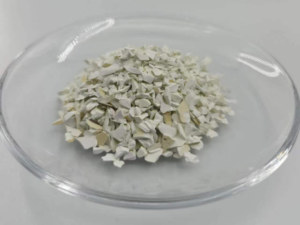
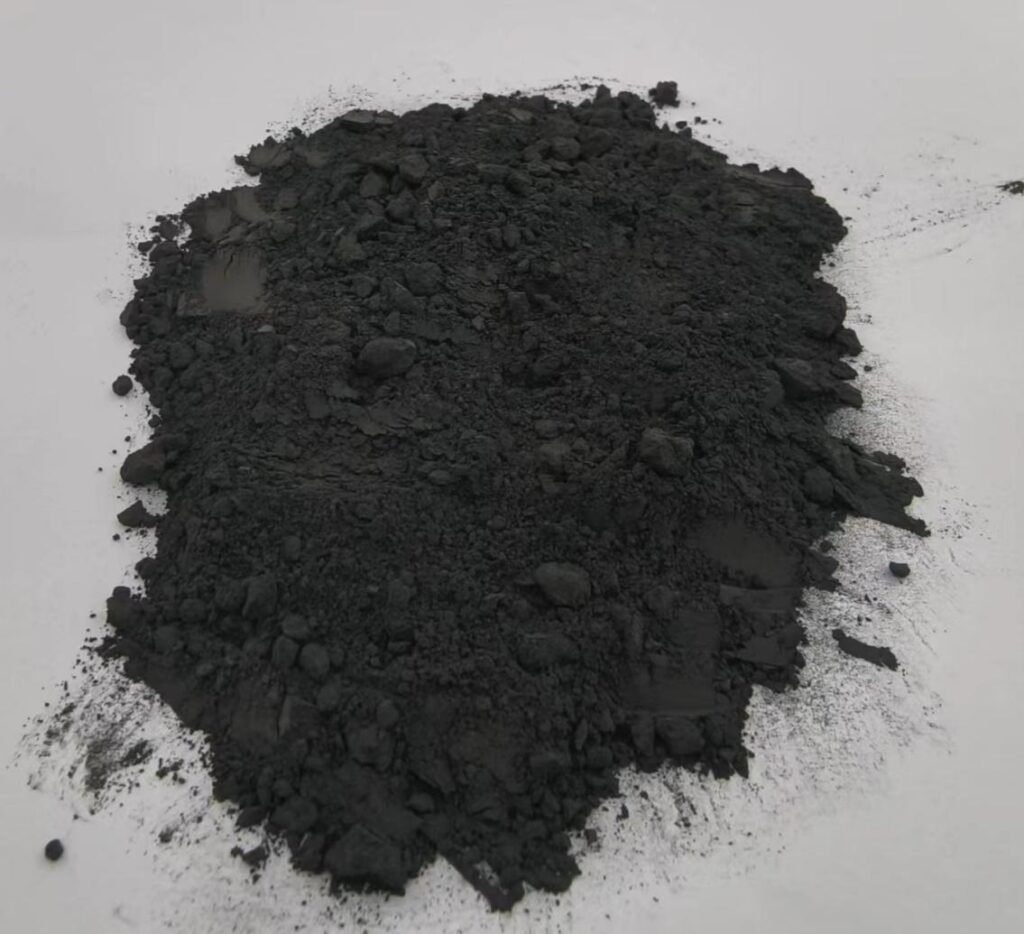
Zirconium Boride (ZrB₂) powder is a typical ultra-high temperature ceramic (UHTC) material composed of zirconium and boron in a 1:2 stoichiometric ratio. It belongs to the transition metal boride family and exhibits a unique combination of ceramic stability and metallic-like conductivity.
ZrB2 is mainly used in extreme environments where conventional ceramics fail, such as aerospace thermal protection systems, high-temperature structural components, and conductive ceramic systems.Unlike oxide ceramics such as zirconia (ZrO2) or alumina (Al2O3), ZrB2 does not rely purely on ionic bonding. Instead, it combines covalent B–B bonding and metallic Zr–Zr interactions, which gives it both high thermal stability and electrical conductivity.
2. Properties of Zirconium Boride Powder
2.1 Key Properties
| Property | Value |
| Chemical formula | ZrB₂ |
| Crystal structure | Hexagonal (AlB₂-type) |
| Density | ~6.09 g/cm³ |
| Melting point | ~3040°C |
| Thermal conductivity | ~56–133 W/m·K |
| Electrical resistivity | ~10⁻⁵–10⁻⁶ Ω·m |
| Vickers hardness | ~20–25 GPa |
| Thermal expansion coefficient | ~5.9 × 10⁻⁶ /K |
2.2 Functional Characteristics
ZrB2 powder shows several important functional properties:
- High temperature stability above 2000°C in inert atmosphere
- Metallic-like electrical conductivity among ceramics
- High hardness and wear resistance
- Moderate oxidation resistance (improved in composites)
- Excellent thermal shock resistance
3. Processing Routes and Formation Mechanisms
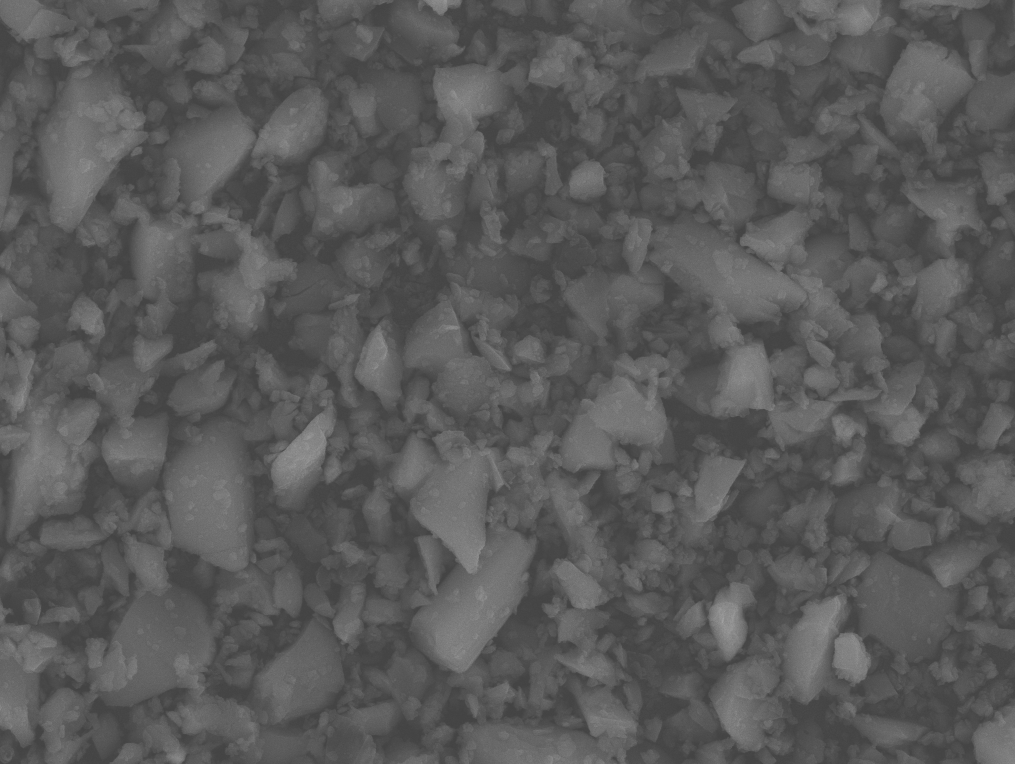
Although ZrB2 is defined by a stable AlB₂-type crystal structure, its final powder characteristics—such as particle size, purity level, agglomeration behavior, and sintering performance—are strongly influenced by the synthesis route. These routes do not change the crystal structure itself, but they strongly determine microstructure, grain size, and defect density.
From a materials science perspective, ZrB2 formation is governed by four main mechanisms: solid-state diffusion, combustion-driven synthesis, gas-phase nucleation, and defect-assisted reaction. Each mechanism leads to distinctly different powder behavior.
3.1 Carbothermal Reduction Route
Carbothermal reduction is the most widely used for Zirconium Boride (ZrB₂) powder production. It is based on high-temperature reactions between zirconium oxide, boron sources, and carbon, where atomic diffusion through solid phases controls phase formation.
This process typically requires temperatures above 1500–2000°C to overcome diffusion barriers. Because crystal growth occurs under near-equilibrium conditions, the resulting powders tend to show micro-scale particle sizes and relatively stable phase composition.
From a structural perspective, this method often produces powders with moderate agglomeration and grain sizes typically in the 1–10 μm range, depending on processing conditions and post-treatment.
Process flow:
ZrO₂ + B₂O₃ + C precursor system→ Raw material weighing and stoichiometric control→ High-energy ball milling (homogenization)→ Formation of mixed precursor powder→ High-temperature solid-state reaction (1500–2000°C)→ ZrB₂ phase formation through diffusion-controlled reaction→ Cooling and solidification→ Crushing and classification
3.2 Self-Propagating High-Temperature Synthesis (SHS)
SHS is a highly exothermic reaction method where ZrB₂ is formed through a self-sustaining combustion wave once initiated. The reaction temperature can locally exceed 2000°C within milliseconds, enabling extremely fast phase formation.
This mechanism is dominated by rapid heat release and reaction front propagation. Because the reaction time is extremely short, grain growth is limited, but thermal gradients may introduce porosity or non-uniform microstructures.SHS-derived ZrB₂ powders are often characterized by relatively high reactivity and moderate porosity, which can be beneficial for subsequent densification processes.
Process flow:
Powder mixture preparation (Zr + B-containing precursors)→ Compaction into green body→ External ignition (thermal or electrical trigger)→ Combustion wave propagation through material→ Instant ZrB₂ phase formation→ Rapid self-cooling→ Crushing and powder conditioning
3.3 Chemical Vapor Deposition
CVD-based synthesis produces ZrB₂ through gas-phase reactions involving volatile metal and boron precursors. In this process, atoms are first generated in the gas phase and then recombine to form solid clusters through nucleation and growth.Because the process operates at atomic scale, it can produce very high-purity powders with extremely fine particle sizes. Typical particle sizes are often in the submicron range, and in optimized systems can reach below 500 nm.
Experimentally, thermal conductivity of dense ZrB₂ materials has been reported in the range of ~56 to 133 W/m·K at room temperature, depending strongly on purity and microstructure, highlighting how sensitive this material is to defect and impurity levels.
Process flow:
Zr- and B-containing precursor gases→ Gas transport into reaction chamber→ High-temperature decomposition (1000–1500°C)→ Formation of atomic species (Zr, B radicals)→ Nucleation of ZrB₂ clusters→ Controlled particle growth via residence time→ Cooling and powder collection
3.4 Mechanochemical / Mechanical Activation Route
This method relies on mechanical energy input to introduce lattice defects and structural disorder into the reactant system. These defects significantly increase chemical reactivity by lowering the activation energy required for phase formation.
Unlike conventional solid-state synthesis, this route is driven by defect-assisted diffusion rather than thermal equilibrium alone. As a result, ZrB₂ formation can occur at relatively lower effective temperatures compared to pure carbothermal routes.
This mechanism is particularly useful for improving sinterability and reducing particle coarsening during formation.
Process flow:
Zr + B precursor powders→ High-energy ball milling (mechanical activation)→ Defect accumulation and partial amorphization→ Thermal annealing / heat treatment→ Solid-state reaction completion→ ZrB₂ phase formation→ Powder refinement and classification
4. Process Comparison and Powder Characteristics
| Method | Mechanism | Particle Size | Purity | Key Feature |
|---|---|---|---|---|
|
Carbothermal reduction |
Solid-state diffusion |
1–10 μm |
Medium–high |
Industrial standard |
|
SHS |
Combustion reaction |
1–5 μm |
Medium |
Fast synthesis |
|
CVD |
Gas-phase nucleation |
50–500 nm |
Very high |
Ultra-pure nano powder |
|
Mechanochemical |
Defect-assisted reaction |
0.5–5 μm |
Medium |
Low-temperature activation |
5. Applications of Zirconium Boride (ZrB2) Powder
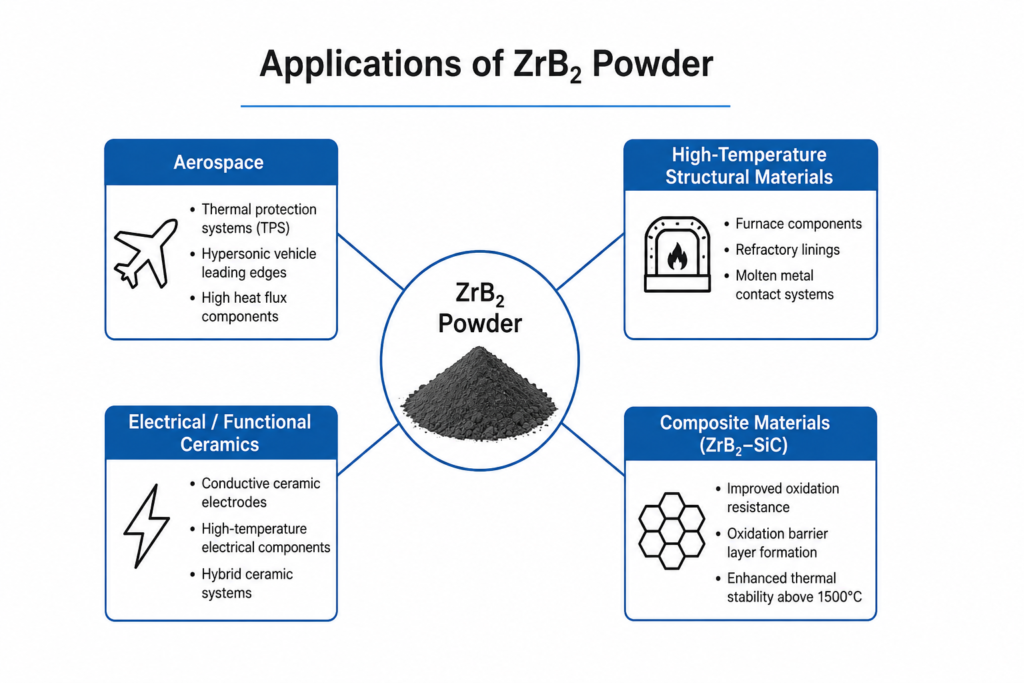
Zirconium Boride (ZrB₂) powder is widely used in ultra-high temperature ceramic (UHTC) applications and extreme environment engineering. In aerospace thermal protection systems (TPS), hypersonic vehicle leading edges, and high heat flux structural components, ZrB₂ is valued for its ability to maintain stability under extreme aerodynamic heating conditions.
In high-temperature structural applications such as furnace components, refractory linings, and molten metal contact systems, zirconium boride powder is used due to its high melting point and excellent thermal stability.
As a conductive ceramic powder, ZrB₂ is also applied in high-temperature electrical components and conductive electrodes, where both thermal resistance and electrical conductivity are required.
In advanced materials engineering, ZrB₂–SiC composite ceramics are widely used to improve oxidation resistance and high-temperature stability above 1500°C, making them important materials for next-generation aerospace and extreme environment applications.
FAQs
Q1: What is Zirconium Boride (ZrB2) Powder used for?
It is mainly used in aerospace thermal protection, high-temperature ceramics, and conductive ceramic systems.
Q2: Why is Zirconium Boride (ZrB2) Powder important in UHTC materials?
Because it combines extremely high melting point with electrical conductivity, which is rare in ceramics.
Q3: Is ZrB2 oxidation resistant?
It is moderately oxidation resistant, but typically requires SiC or protective coatings.
Q4: What affects ZrB2 performance most?
Particle size, purity, and microstructure are the most critical factors.
Conclusion
Zirconium Boride (ZrB2) powder is a critical ultra-high temperature ceramic material that combines extreme thermal stability with metallic-like conductivity. Its performance depends not only on its crystal structure but also on its synthesis route and resulting powder characteristics.
Different production mechanisms lead to different particle sizes, purity levels, and microstructures, which directly influence its behavior in aerospace, refractory, and advanced structural applications.
As demand for extreme environment materials increases, ZrB2 continues to play a key role in next-generation high-temperature engineering systems.optimizing ZrB2-based materials in aerospace, energy, and advanced engineering systems.