

Molybdenum trioxide powder (MoO₃) powder is a high-value transition metal oxide widely used in thin film deposition, vacuum evaporation, OLED hole injection layers, optical coatings, semiconductor interfaces, and electronic materials research.For advanced thin film applications, selecting MoO₃ powder requires more than checking chemical composition. Material characteristics such as purity, particle size distribution, crystal phase, oxygen stoichiometry, morphology, and thermal behavior directly affect deposition stability, film uniformity, and final device performance.A suitable MoO₃ powder supplier should provide not only material availability but also reliable characterization data, including COA, SEM, XRD, and technical specifications.
Why MoO₃ Powder Quality Matters for Thin Film Deposition?
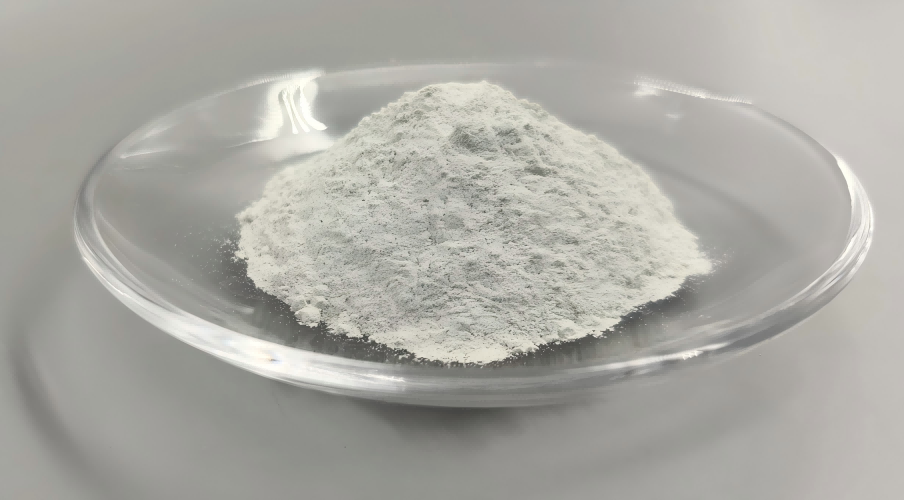
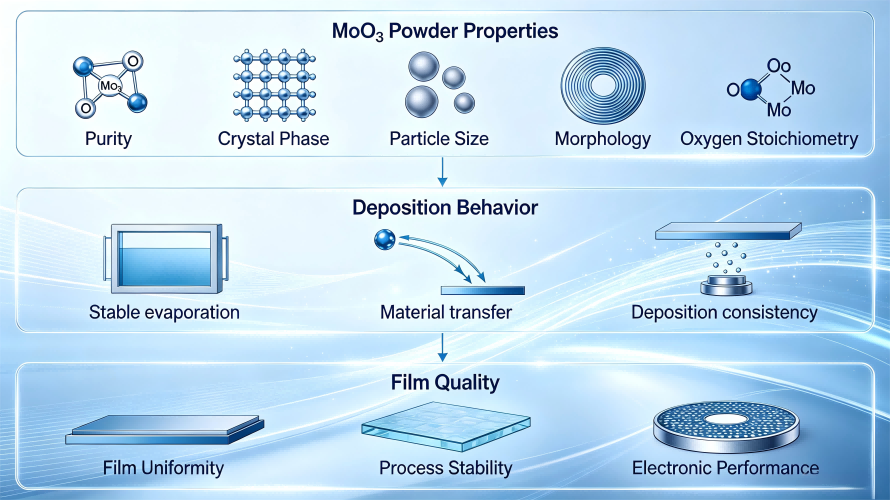
The quality of molybdenum trioxide powder directly affects thin film deposition stability, film uniformity, and device performance. For applications such as OLED devices, semiconductor interfaces, and optical coatings, material consistency is essential because variations in purity, structure, and physical characteristics can influence evaporation behavior and deposited film properties.
The key relationship between MoO₃ powder characteristics and thin film performance is summarized below:
| MoO₃ Powder Parameter | Impact on Thin Film Deposition |
| Purity and impurity control | Reduces contamination and improves electrical and optical consistency |
| Crystal phase | Influences structural stability and electronic properties |
| Particle size distribution | Affects material handling and evaporation uniformity |
| Powder morphology | Impacts packing behavior and deposition repeatability |
| Oxygen stoichiometry | Controls defect concentration and electronic behavior |
| Thermal stability | Determines evaporation consistency during vacuum processing |
For high-performance thin film applications, MoO₃ powder should be evaluated based on both chemical and physical characteristics. Reliable suppliers typically provide characterization data such as COA, SEM, XRD, and particle size analysis to verify material quality.
Key Factors for Selecting Molybdenum Trioxide Powder
Selecting molybdenum trioxide (MoO₃) powder for thin film applications requires a comprehensive evaluation of both chemical composition and physical properties.Although all MoO₃ materials share the same chemical formula, differences in purity, crystal structure, particle characteristics, and thermal behavior can significantly affect deposition stability and thin film performance.For example, MoO₃ used as an evaporation source for OLED or electronic applications typically requires strict impurity control and stable sublimation behavior, while research applications may place more emphasis on particle size, morphology, and structural characteristics.
The main parameters to evaluate when selecting MoO₃ powder include:
- purity and impurity control
- crystal phase and crystallinity
- particle size distribution
- powder morphology
- oxygen stoichiometry
- thermal evaporation behavior
1. Purity and Impurity Control
Purity is one of the most important factors when selecting MoO₃ powder for electronic materials and thin film deposition. During thin film processing, trace impurities may be incorporated into the deposited layer and influence electrical characteristics, optical properties, charge transport behavior, and long-term device reliability.For sensitive applications such as OLED hole injection layers, semiconductor interfaces, and optical coatings, high-purity MoO₃ is generally preferred because even small amounts of metallic contamination may affect device performance.
When evaluating MoO₃ powder quality, customers should consider not only the stated purity level but also the supplier’s analytical capability. Reliable material documentation typically includes purity specifications, elemental impurity analysis, batch consistency information, and a Certificate of Analysis (COA).Common impurity elements requiring attention include Fe, Na, K, Si, and other metallic contaminants. A qualified supplier should be able to provide traceable quality data to support application evaluation and process development.
2. Crystal Phase and Structural Stability
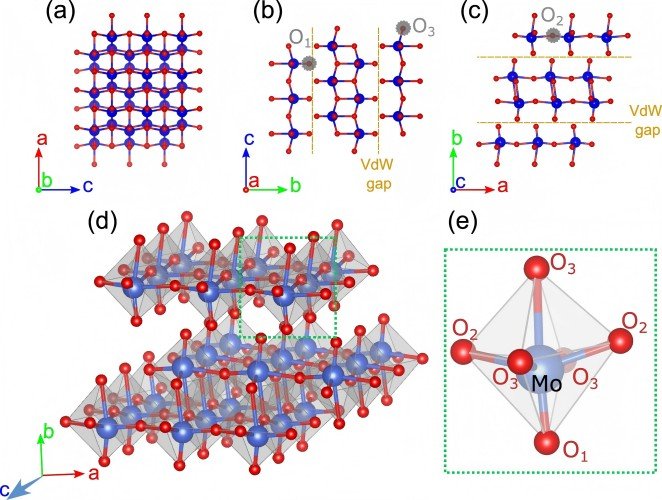
The crystal structure of MoO₃ plays an important role in determining its electronic properties, thermal behavior, and interaction with thin film deposition processes.The most commonly studied and applied phase is α-MoO₃ (orthorhombic molybdenum trioxide). This layered structure consists of distorted MoO₆ octahedral units, which contribute to its high work function, anisotropic electronic behavior, and favorable interface characteristics in electronic devices.When selecting MoO₃ powder, phase composition and crystallinity should be carefully evaluated. The presence of unwanted molybdenum oxide phases may influence material consistency and deposition performance.X-ray diffraction (XRD) analysis is commonly used to confirm α-MoO₃ phase formation, evaluate crystallinity, and verify batch-to-batch structural consistency.
For more information, please visit: Molybdenum Oxide: MoO₂ vs MoO₃ Differences, Properties, Applications and Selection Guide
3. Particle Size Distribution and Powder Processing Behavior
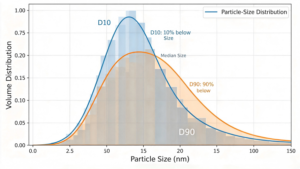
Particle size is another important parameter because it directly affects powder handling, material transfer, and deposition stability.Fine MoO₃ powder generally provides a larger surface area and can be advantageous for material synthesis, chemical processing, and laboratory research. However, excessively fine particles may increase agglomeration tendency, reduce powder flowability, and create challenges during material feeding.
For vacuum evaporation applications, controlled particle size or granulated MoO₃ materials are often preferred because they provide improved handling characteristics and more stable material delivery.Therefore, particle size should not be considered as an independent specification. The optimal particle distribution depends on the deposition method, evaporation source design, and process requirements.
4. Powder Morphology and Material Uniformity
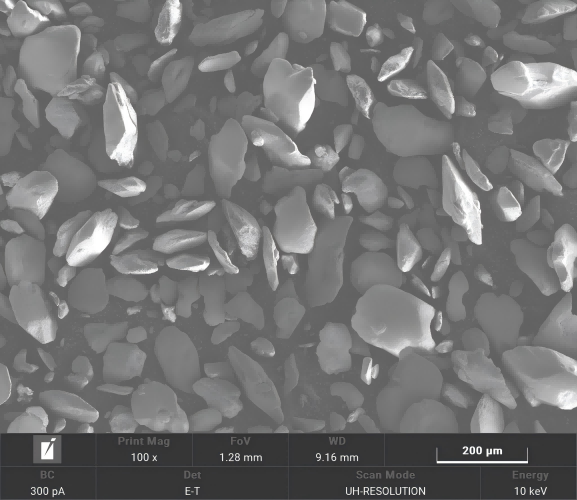
Powder morphology provides additional information beyond particle size distribution and is an important indicator of material consistency.MoO₃ powder commonly exhibits plate-like crystal features, layered structures, and anisotropic particle growth due to its intrinsic crystal structure. These characteristics can influence powder packing behavior, evaporation consistency, and material utilization efficiency during processing.
For thin film applications, suppliers should provide morphology characterization, such as SEM images and particle size analysis, to help evaluate powder uniformity and identify potential aggregation issues.A consistent powder morphology contributes to more predictable material behavior during storage, handling, and deposition.
5. Oxygen Stoichiometry and Defect Control
As a transition metal oxide, MoO₃ properties are closely related to oxygen composition and defect structure.Oxygen vacancies can modify electrical conductivity, optical absorption, electronic structure, and interface behavior. During thin film deposition, excessive oxygen deficiency may cause MoO₃ to transition toward MoO₃₋ₓ characteristics, resulting in changes in electronic and optical performance.
For applications requiring stable and predictable properties, controlling oxygen stoichiometry is an important consideration during material selection.Advanced characterization techniques such as XPS can be used to analyze oxygen chemical states and evaluate defect-related changes when required.
6. Thermal Evaporation Behavior of MoO₃ Powder
MoO₃ is widely used as an evaporation material because of its suitable sublimation characteristics under vacuum conditions. However, evaporation performance depends on multiple material factors, including purity, particle characteristics, morphology, packing condition, and thermal stability.High-quality MoO₃ powder helps maintain stable material evaporation, consistent deposition rates, and improved film thickness control during vacuum processing.
These characteristics make MoO₃ suitable for OLED deposition, optical thin films, electronic interface layers, and PVD-related research applications.In practical deposition processes, material performance should always be evaluated together with process parameters such as vacuum level, source temperature, deposition rate, and substrate conditions.
Selecting the Right MoO₃ Material Form
Molybdenum trioxide can be supplied in different physical forms depending on the deposition process, equipment configuration, and application requirements.
| Material Form | Characteristics | Typical Applications |
| MoO₃ Powder | Flexible processing and suitable for research-scale applications | Laboratory research and material synthesis |
| MoO₃ Granules | Improved handling and more stable material feeding behavior | Vacuum evaporation processes |
| MoO₃ Pellets / Custom Shapes | Designed for controlled feeding and industrial deposition requirements | Large-area coating systems |
The appropriate material form should be selected according to the deposition equipment, evaporation source design, feeding method, and production scale. Choosing the correct material form can improve material utilization efficiency and process consistency.
How to Evaluate a MoO₃ Powder Supplier?
Selecting the right MoO₃ powder supplier requires evaluating not only the material specifications but also the supplier’s technical capability, documentation quality, and consistency control.For thin film deposition and electronic applications, a reliable supplier should be able to provide comprehensive material information, including technical data sheets (TDS), safety data sheets (SDS), certificates of analysis (COA), SEM images, XRD characterization, and particle size information.
These documents help customers verify key material parameters such as purity, phase composition, morphology, and particle characteristics before application testing.Beyond documentation, supplier capability is also an important consideration. Depending on application requirements, customers may need customized purity levels, specific particle size ranges, different material forms such as powder or granules, and technical support during material evaluation.Batch-to-batch consistency is particularly important for thin film applications because variations in material quality can affect deposition stability and film performance. Suppliers should therefore demonstrate effective quality control procedures, analytical testing capability, and reliable production management.
ULPMAT provides high-purity molybdenum trioxide (MoO₃) powder for thin film deposition, vacuum evaporation, electronic materials research, and advanced coating applications. Material information such as purity specifications, particle size data, and technical documentation can be provided according to application requirements.Choosing a supplier with reliable characterization capability and consistent material quality helps improve process stability and supports successful MoO₃ thin film development.
Conclusion
Selecting the appropriate molybdenum trioxide (MoO₃) powder for thin film applications requires a comprehensive understanding of how material properties affect deposition performance. Parameters such as purity, crystal phase, grain size, morphology, oxidation stoichiometry, and thermal behavior should be evaluated based on the specific requirements of the deposition process. Different applications, such as OLED devices, semiconductor interfaces, optical coatings, and electronic materials, may require different material specifications and morphologies. By matching the properties of the MoO₃ powder to the intended application and process conditions, deposition consistency can be improved, film quality optimized, and more reliable material properties obtained.
FAQs
Molybdenum trioxide (MoO₃) powder is widely used in thin film deposition, vacuum evaporation, OLED hole injection layers, optical coatings, semiconductor interfaces, electronic materials research, and functional oxide applications.
Its high work function, semiconductor characteristics, and compatibility with vacuum processing make MoO₃ an important material for advanced thin film technologies. The final application determines the required material specifications, such as purity, particle size, and physical form.
Selecting MoO₃ powder requires evaluating both chemical and physical properties. The key factors include purity, impurity control, crystal phase, particle size distribution, morphology, oxygen stoichiometry, thermal behavior, and material characterization data.
For thin film and electronic applications, these parameters influence evaporation stability, film uniformity, interface performance, and process repeatability. Therefore, MoO₃ powder should be selected according to the specific deposition method and application requirements.
The required purity of MoO₃ powder depends on the sensitivity of the application and the deposition process.
For OLED devices, semiconductor interfaces, and other electronic applications where contamination control is important, high-purity MoO₃ powder is generally preferred to minimize the influence of metallic impurities on electrical and optical performance.
When evaluating purity, customers should also consider impurity analysis, batch consistency, and supporting quality documentation rather than only the nominal purity value.
For vacuum evaporation applications, MoO₃ powder selection should consider purity, particle characteristics, morphology, crystal phase, sublimation behavior, and material form.
Powder or granule forms may be selected depending on the evaporation source design and processing requirements. Materials with consistent physical characteristics can help achieve stable evaporation behavior, uniform deposition rates, and improved film thickness control.
When purchasing molybdenum trioxide powder, customers should typically request technical documentation to verify material quality and consistency.
Common documents include:
- Technical Data Sheet (TDS)
- Safety Data Sheet (SDS)
- Certificate of Analysis (COA)
- SEM characterization
- XRD analysis
- Particle size information
These documents help confirm purity, crystal phase, morphology, and other important material characteristics before application testing.
Yes. MoO₃ powder can be customized according to application requirements, including purity level, particle size range, material form, and packaging specifications.
Customization may be required for different processes, such as vacuum evaporation, thin film research, material synthesis, and electronic material development.
High-purity molybdenum trioxide powder is supplied by specialized advanced material suppliers for applications including thin film deposition, vacuum evaporation, electronic materials research, and optical coatings.
ULPMAT provides molybdenum trioxide powder with technical specifications, material documentation, and customized options available according to customer requirements.
MoO₂ and MoO₃ are different molybdenum oxide phases with different oxidation states and electronic properties.
MoO₂ contains Mo⁴⁺ and exhibits metallic-like conductivity, making it suitable for conductive applications such as battery materials and electrocatalysis. MoO₃ contains Mo⁶⁺ and behaves as a semiconductor with a high work function, making it widely used in thin films, OLED-related applications, vacuum evaporation, and optical coatings.
References
- 1. Recent advances of oxygen vacancies in MoO₃: preparation and roles
- 2. Molybdenum oxide anode buffer layers for solution processed, blue phosphorescent small molecule organic light emitting diodes
- 3. Improvement of Performance of Organic Light-Emitting Diodes with Both a MoO₃ Hole Injection Layer and a MoO₃ Doped Hole Transport Layer
- 4. Enhancing hole injection by processing ITO through MoO₃ and self-assembled monolayer hybrid modification for solution-processed OLEDs
- 5. A review of molybdenum oxide materials and their electronic applications
- 6. Strain tuning MoO₃ vibrational and electronic properties