

Silicon sputtering target specifications play an important role in determining thin film deposition performance, sputtering stability, and final film quality. Silicon sputtering targets are high-purity silicon materials used as source materials in physical vapor deposition (PVD) processes, where silicon atoms are released from the target surface through plasma ion bombardment and deposited onto substrates.
Although purity is usually the first specification considered when selecting a silicon sputtering target, experienced engineers evaluate a broader range of factors, including target density, oxygen content, crystal structure, electrical properties, manufacturing process, bonding quality, and dimensional accuracy.
A target with high purity but unsuitable density, excessive oxygen content, or poor thermal performance may still create challenges during long-duration sputtering operation.
This article provides a technical overview of silicon sputtering target specifications and explains how these parameters influence material selection, sputtering behavior, and quality evaluation.
1. Silicon Sputtering Target Specifications Overview
Silicon sputtering targets are evaluated through both material characteristics and manufacturing quality.
The major specifications include:
- Purity grade
- Density
- Oxygen and trace
- impurity levels
- Crystal structure
- Electrical resistivity
- Target dimensions
- Bonding structure
- Surface quality
These specifications are interconnected.For example, density is not only a physical parameter. It directly influences sputtering behavior because pores or weak internal structures may become sources of particle generation during ion bombardment.Similarly, purity alone does not guarantee stable deposition. The manufacturing process and quality control methods determine whether the target can maintain consistent performance during actual sputtering.
2. Silicon Material Properties and Purity Specifications
Silicon is a semiconductor material widely used in thin film deposition due to its electrical, optical, and chemical properties. When evaluating silicon sputtering targets, both fundamental material characteristics and purity level are important factors affecting sputtering behavior and deposited film performance.
| Category | Specification | Details |
| Chemical Information | Chemical Symbol | Si |
| CAS Number | 7440-21-3 | |
| Atomic Weight | 28.085 | |
| Physical Properties | Density | Approximately 2.33 g/cm³ |
| Melting Point | Approximately 1414°C | |
| Band Gap | Approximately 1.12 eV at room temperature | |
| Purity Grade | 3N | 99.9% purity, commonly used for general industrial and research applications |
| 4N | 99.99% purity, suitable for standard thin film deposition | |
| 5N | 99.999% purity, used for applications requiring improved impurity control | |
| 6N | 99.9999% purity, selected for high-purity deposition requirements | |
| Impurity Control | Main Controlled Elements | Metallic impurities, oxygen, carbon, and other trace elements |
| Quality Analysis | GDMS | Used for trace metallic impurity analysis |
| ICP-MS | Used for elemental composition and impurity detection | |
| Chemical Composition Analysis | Used for material composition verification |
The required purity level depends on the final film requirements, deposition conditions, and acceptable contamination limits. Higher purity silicon targets generally provide better impurity control, but the optimal specification should always be determined according to the actual application rather than purity level alone.
3. Silicon Target Density, Oxygen Content, and Defect Control
Silicon target density and oxygen content are important factors in evaluating sputtering target quality because they directly influence erosion behavior, particle generation, and deposition stability. During magnetron sputtering, energetic argon ions continuously bombard the target surface. If internal pores, weak bonding areas, or structural defects exist, fragments may be released during erosion, increasing the possibility of particle contamination and film defects.
Target density is strongly influenced by the manufacturing process, especially for silicon targets produced by thermal spray methods. Factors such as silicon powder characteristics, spray atmosphere, thermal history, and deposition parameters can affect the final microstructure and density of the target. A well-controlled target structure helps maintain uniform erosion and stable sputtering performance during long-term operation.
Oxygen content is another important consideration during silicon target evaluation. Oxygen may be introduced from raw silicon materials, powder handling, manufacturing atmosphere, or thermal processing steps. Excess oxygen can influence target electrical properties, sputtering stability, and the characteristics of deposited silicon films. Therefore, oxygen content should be reviewed together with density, impurity distribution, and manufacturing method rather than evaluated as an isolated parameter.
For silicon sputtering targets used in demanding thin film applications, a complete evaluation of density, oxygen control, and structural quality provides a more reliable basis for material selection and process qualification.
4. Manufacturing Processes of Silicon Sputtering Targets
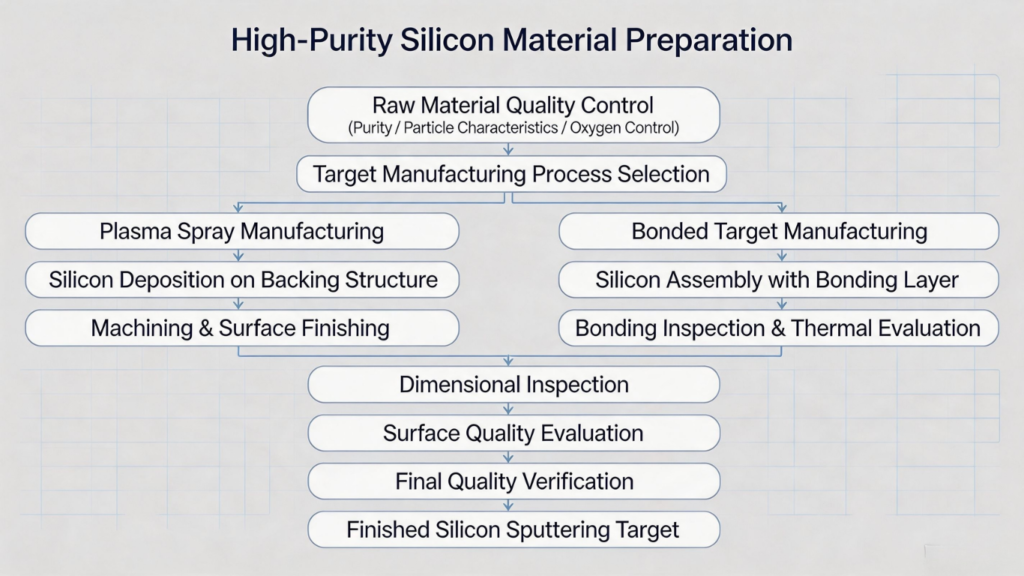
The manufacturing process of silicon sputtering targets directly influences target density, microstructure, bonding strength, surface quality, and sputtering stability. Different manufacturing methods are selected according to target structure, application requirements, and production conditions.
Key Manufacturing Considerations
For plasma-sprayed silicon sputtering targets, the final target quality depends on several process factors, including silicon powder characteristics, spraying atmosphere, thermal history, and deposition parameters. These factors influence the resulting density, oxygen content, microstructure, and adhesion between the silicon layer and backing structure.
For bonded silicon targets, the bonding layer plays an important role in thermal management and mechanical stability. During sputtering operation, especially under high power conditions, effective heat transfer between the silicon material and backing structure helps prevent overheating and premature target failure.
In practical target evaluation, the manufacturing method should be considered together with material specifications such as purity, density, oxygen content, dimensions, and the requirements of the sputtering system.
5. Crystal Structure, Resistivity, and Sputtering Method Selection
Silicon sputtering targets are available in polycrystalline and monocrystalline grades. Multi-grain polycrystalline silicon balances stable sputtering behaviour and cost efficiency for general use, while monocrystalline silicon with an uninterrupted crystal lattice should be specified when improved thin-film uniformity is required. Film specifications, process parameters and installed hardware determine the suitable crystal structure. Electrical resistivity also governs sputtering technique selection: high-resistivity intrinsic silicon requires RF magnetron sputtering, and doped silicon targets with lower resistivity can operate with DC magnetron sputtering. Selection should account for target conductive properties, expected deposition rates and existing equipment configurations.
6. Additional Considerations for Silicon Rotary Target Structures
Silicon sputtering target specifications are applicable to both planar and rotary configurations. However, rotary targets used in continuous sputtering systems require additional attention to target structure, thermal management, and mechanical compatibility.
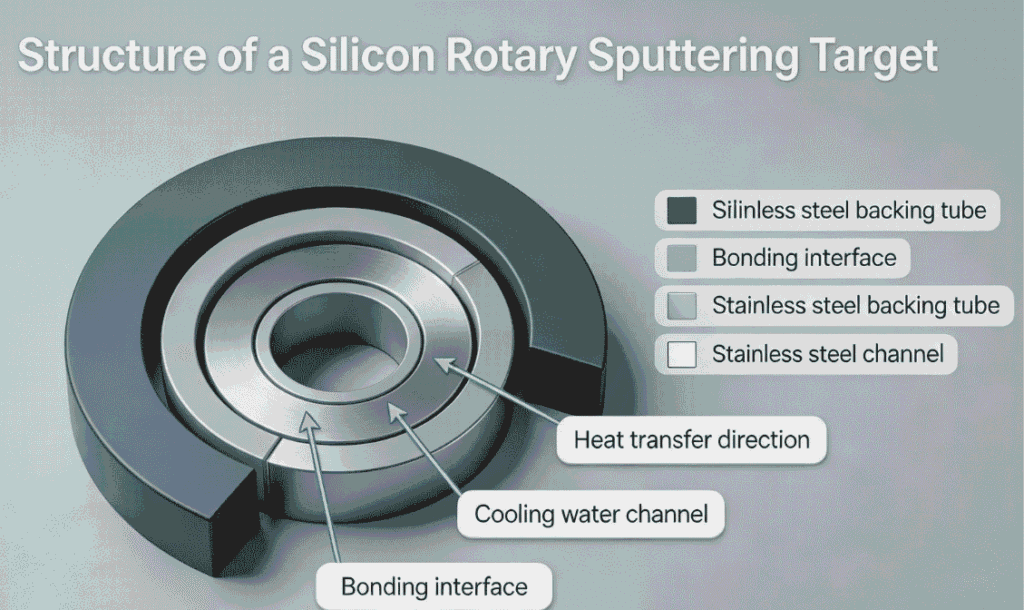
A silicon rotary target generally consists of four main components:
- Silicon target material layer
- Bonding layer
- Backing tube structure
- Internal cooling system
Compared with planar targets, rotary designs operate under continuous rotation and extended sputtering cycles. Therefore, the bonding quality, cooling efficiency, and dimensional accuracy of the target structure directly influence operating stability and service lifetime.
When selecting a silicon rotary target, key parameters include:
- Target diameter and length
- Compatibility with the rotary cathode system
- Cooling channel design and heat transfer capability
- Bonding layer reliability
- Erosion behavior during long-term sputtering operation
The final target design should be evaluated according to the sputtering equipment configuration, operating power, cooling conditions, and required film performance.
7. Silicon Sputtering Target Quality Evaluation and Supplier Selection
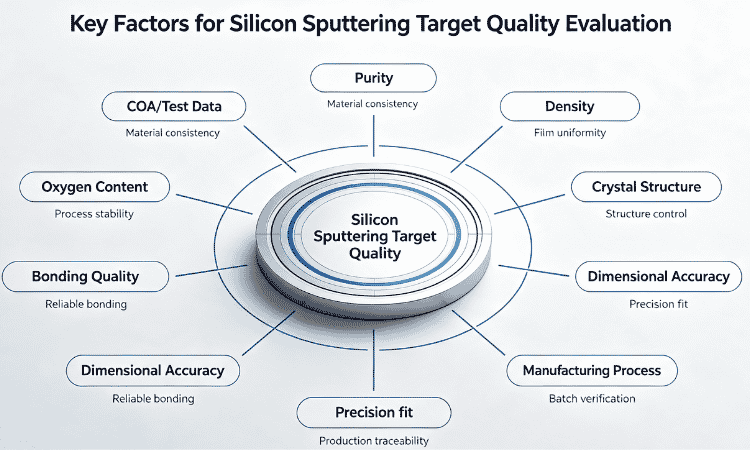
Silicon sputtering target qualification usually begins with a review of material specifications and technical documentation. The evaluation process focuses on whether the target properties, manufacturing quality, and supplied data meet the requirements of the deposition system.
A typical evaluation sequence includes:
Application Requirements
↓
Target Specification Review (Purity / Chemical Composition / Resistivity)
↓
Physical Property Evaluation (Density / Dimensions / Surface Condition / Crystal Structure)
↓
Manufacturing Process Review (Production Method / Bonding Technology / Quality Control)
↓
Technical Documentation Verification (COA / Inspection Reports / Test Data)
↓
Target Qualification for Deposition Process
The material specification review confirms whether the silicon target meets the required purity grade, impurity control level, and electrical properties. Physical characteristics such as density, dimensions, surface condition, and crystal structure are evaluated to ensure compatibility with the sputtering system.
Manufacturing-related information, including production method, bonding technology, and inspection procedures, provides additional insight into target reliability and consistency.
Technical documents such as certificates of analysis (COA), inspection reports, and test data are important references for verifying batch consistency before production use.
8. Practical Evaluation Notes for Silicon Sputtering Targets
In silicon sputtering target qualification, material selection is usually based on a combination of specifications rather than a single parameter.
For example, a high-purity silicon target may still require additional evaluation when other factors do not meet the deposition requirements. Common considerations include:
- Target density and internal structure, which influence particle generation and sputtering stability
- Bonding quality, which affects heat transfer under different sputtering power conditions
- Dimensional accuracy, which determines compatibility with the cathode system
- Thermal management performance, which influences target lifetime during continuous operation
A suitable silicon sputtering target needs to provide a balance between material properties and the operating conditions of the deposition equipment. Purity, density, electrical characteristics, structure, and equipment compatibility should be evaluated together during the qualification process.
Conclusion
Silicon sputtering target specifications determine how reliably a target performs during thin film deposition.While purity remains an essential factor, density, oxygen control, manufacturing process, electrical properties, bonding quality, and dimensional accuracy all contribute to sputtering stability and film performance.A comprehensive evaluation approach allows engineers to select silicon sputtering targets that match their deposition requirements and production objectives.
FAQs
Silicon sputtering target specifications typically include purity, density, oxygen content, crystal structure, resistivity, dimensions, bonding structure, and manufacturing method. These parameters together determine sputtering stability, target lifetime, and deposited film quality.
Silicon sputtering targets are commonly supplied in purity grades ranging from 99.9% (3N) to 99.9999% (6N). The suitable purity level depends on film requirements, impurity limits, deposition conditions, and application requirements.
Target density influences erosion behavior and particle generation during sputtering. A well-controlled target structure with low internal defects helps maintain stable plasma conditions and reduces the risk of particle contamination during film deposition.
Silicon sputtering targets are usually evaluated through material specifications, physical properties, manufacturing information, and inspection data. Common evaluation items include purity analysis, impurity testing, density measurement, dimensions, surface quality, and technical documentation such as COA reports.
To select a suitable silicon sputtering target, customers typically provide target dimensions, sputtering system information, deposition method, required purity, operating power, cooling conditions, and film performance requirements.
About ULPMAT
ULPMAT provides high-purity sputtering materials and customized target solutions for thin film deposition applications.With experience in sputtering material supply and technical specification evaluation, ULPMAT supports customers in selecting suitable target materials according to purity requirements, dimensions, bonding structures, and deposition conditions.
For silicon sputtering targets, customers can provide technical specifications and process requirements for evaluation.
References and Technical Sources
- CRC Handbook of Chemistry and Physics — Silicon physical properties
- ASM Handbook — Semiconductor materials and thermal spray technologies
- Society of Vacuum Coaters (SVC) Technical Proceedings — Sputtering target technology
- Journal of Vacuum Science & Technology — Thin film deposition studies
- Thin Solid Films — Research on sputtering processes and thin film materials