

Titanium Dioxide Thin Films are used in optical coatings, photocatalytic surfaces, sensors, and other functional coatings. Their performance depends not only on the material itself, but also on how the film is deposited, structured, and characterized.
For engineers developing thin-film processes, inconsistent optical properties, unstable deposition rates, and differences between production runs can be difficult to diagnose. Changing the source material may not solve the problem if the underlying cause lies in oxygen conditions, substrate temperature, equipment configuration, or film thickness.
1. What Determines the Quality of a Titanium Dioxide Thin Film?
A successful deposition process must produce a film that meets the requirements of its intended application. For optical coatings, these may include refractive index, transmittance, thickness, and uniformity. For functional surfaces, surface morphology, crystal structure, and photocatalytic performance may be more important.
Several variables work together during film formation.
Source material and deposition method. Thermal evaporation, electron-beam evaporation, magnetron sputtering, and chemical deposition methods do not transfer material to a substrate in the same way. The source form and suitable process parameters therefore depend on the selected technique.
Oxygen conditions. Oxygen availability can affect film composition, optical properties, and structure. Research on electron-beam-evaporated TiO2 films has shown that oxygen partial pressure can influence transmittance, refractive index, and film packing density.
Substrate temperature. Temperature affects surface mobility and film growth. Its influence depends on the deposition method and the required film structure.
Deposition rate and thickness. Variations in deposition rate can change the time required to reach a target thickness and may affect the resulting microstructure. A stable rate is useful, but it does not guarantee that every film property will meet specification.
These relationships are important because a coating that looks acceptable may still fail an optical or functional test. Process evaluation should therefore rely on measurements relevant to the application rather than visual inspection alone.
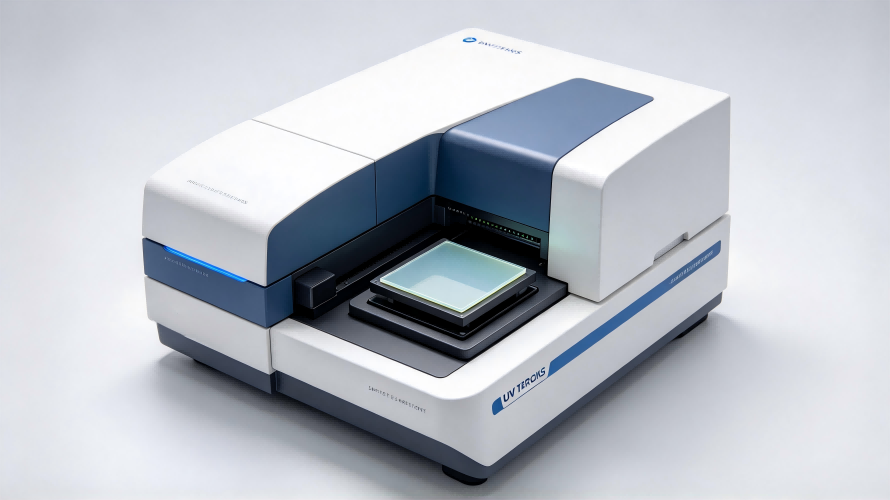
2. Why Can TiO2 Deposition Produce Inconsistent Results?
A common challenge in thin-film processing is obtaining comparable results across repeated deposition runs. The same nominal source material may produce films with different optical or structural properties when process conditions change.
When a result differs from the previous run, review the following areas before assuming the material is defective.
Check the process history. Compare chamber pressure, heating conditions, deposition rate, substrate temperature, and deposition time. Small differences in the operating conditions may be relevant, especially when the process window is narrow.
Review the oxygen environment. Where oxygen partial pressure or reactive gas flow is part of the process, verify that the relevant settings and monitoring records are consistent. Do not assume that a change in refractive index or transmittance has a single cause.
Confirm the thickness measurement. Differences in film thickness can affect optical measurements. Check the rate monitor, thickness monitor, calibration procedure, and source-to-substrate geometry where applicable.
Compare film characterization results. Depending on the application, useful measurements may include UV–Vis transmission, refractive index, thickness, surface morphology, or crystal structure.
The practical approach is to compare the process records and final measurements together. If the equipment settings were consistent but the results changed, material lot information and available quality documentation become more useful in the investigation.
3. Oxygen Pressure and Optical Properties: Why They Matter
Oxygen conditions deserve particular attention when TiO₂ is used in optical coatings. Film properties are influenced by the deposition environment, and the relationship between oxygen availability and optical performance is not necessarily identical across different equipment configurations.
The important takeaway is not to copy a pressure value from a published experiment into another deposition system. Results depend on the source material, equipment, substrate, temperature, and other experimental conditions.
Instead, engineers should establish a suitable process window for their own equipment and application. Record oxygen settings alongside deposition rate, substrate temperature, and film measurements so that changes can be interpreted in context.
For applications requiring a particular refractive index or transmission spectrum, the target should be confirmed through film characterization. The nominal purity of the source material alone cannot establish the final optical performance.
4. Outgassing and Pre-Melting: What Should Be Checked?
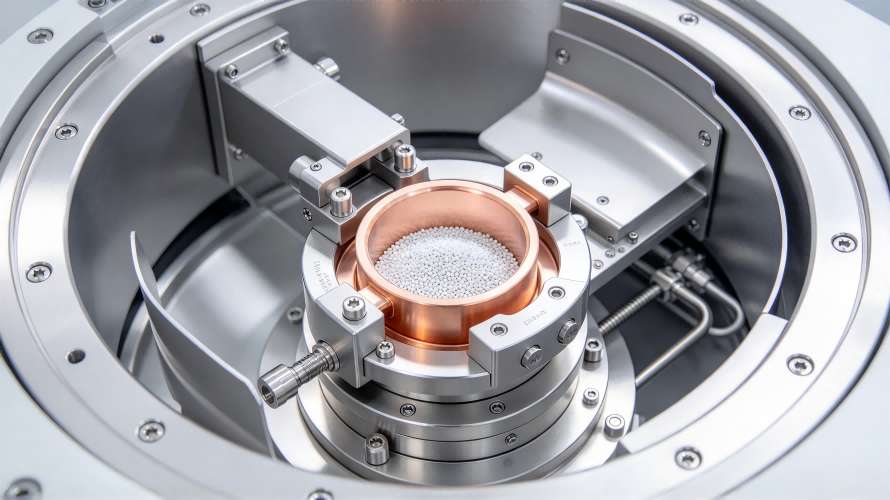
During evaporation, heating the source may cause gas release or changes in chamber pressure. Such behavior can complicate process control, but a pressure increase does not automatically prove that the source material is defective.
Begin by checking the vacuum system and process history. Review the chamber’s pressure before heating, changes during the heating cycle, source condition, and any relevant equipment alarms. Where possible, compare the results with previous runs performed under similar conditions.
For electron-beam evaporation, follow the equipment manufacturer’s recommended pre-melting and power-ramping procedure. Avoid applying a generic heating recipe to every source, since the appropriate procedure depends on the material, crucible, equipment, and operating conditions.
The source holder or crucible also matters. Confirm that the selected configuration is suitable for the material and intended process. If the pressure does not stabilize as expected, investigate the complete system rather than attributing the issue to one factor without supporting evidence.
A useful record includes the source lot, loading method, heating sequence, pressure history, and deposition-rate behavior. These details make it easier to compare runs and identify recurring patterns.
5. How Should Engineers Evaluate Evaporation Source Form?
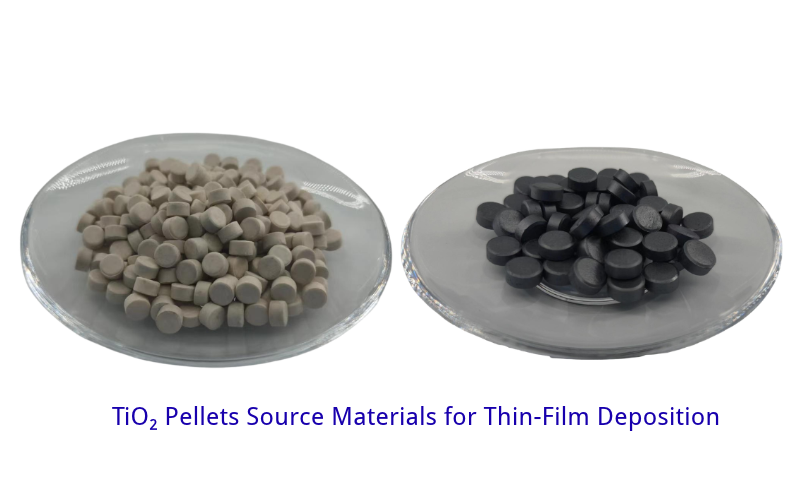
The physical form of a source material affects handling, loading, and compatibility with the deposition equipment. Depending on the application, source materials may be supplied as powder, granules, pellets, or other defined shapes.
Pellets can be convenient when a defined geometry is required and may be easier to handle than loose fine powder. However, pellet form does not automatically guarantee a stable deposition rate, eliminate outgassing, or produce a better film. Those outcomes depend on the material and process conditions.
Before selecting a source form, consider five practical points:
Dimensions: Confirm that the material fits the source holder or crucible and suits the intended loading method.
Purity and composition: Select a grade consistent with the application and its acceptance criteria.
Deposition method: Verify compatibility with the intended thermal or electron-beam evaporation process. Do not assume that a material suitable for one technique is automatically suitable for another.
Handling and heating: Consider how the source is loaded, heated, and monitored under the equipment manufacturer’s instructions.
Quality documentation: Check which specifications, lot information, and supporting documents are available.
The best source form is the one that meets the requirements of the actual deposition setup. Particle size or nominal purity alone is not enough to determine suitability.
6. A Practical Troubleshooting Checklist
When a TiO2 coating fails to meet its target, separate the observed symptom from the possible cause.
| Observed issue | Initial checks |
| Chamber pressure rises during heating | Vacuum-system condition, heating sequence, source condition, and possible gas release |
| Deposition rate fluctuates | Power control, source loading, source behavior, and rate-monitor readings |
| Film thickness varies between runs | Deposition time, source geometry, rate history, and monitor calibration |
| Refractive index or transmittance changes | Film thickness, oxygen conditions, substrate temperature, deposition rate, and measurement method |
| Results differ between material lots | Lot traceability, available quality documentation, storage, dimensions, and process records |
These checks are starting points, not definitive diagnoses. Several factors can contribute to the same symptom.For more useful comparisons, change one relevant process variable at a time where practical, while keeping other conditions consistent. Record the source lot and equipment settings alongside the final film measurements. This makes it easier to distinguish a process change from a potential material-related issue.
7. What Should You Confirm Before Purchasing TiO2 Source Material?
Material selection should begin with the application and equipment requirements, not simply a product name.
Before requesting a quotation, confirm the required purity, source dimensions, deposition method, and intended coating application. If repeatability is important, ask how the material is identified by lot and what quality documentation is available.
It is also useful to confirm whether the listed geometry fits the source holder and whether the material is intended for the proposed deposition route. If a standard dimension does not fit the setup, discuss the required dimensions with the supplier rather than assuming that another form will behave identically.
These checks help reduce avoidable mismatches between the material received and the process in which it will be used.
8. TiO2 Source Material Selection with ULPMAT
At ULPMAT, material selection should be considered alongside the requirements of the deposition process. Purity, physical form, dimensions, available quality documentation, and equipment compatibility all contribute to assessing whether a source material is suitable for a particular application.
Engineers evaluating TiO2 evaporation materials can review the currently listed specifications before ordering. The product page provides the available grade and dimensional information, which can be compared with the requirements of the intended setup.
View the ULPMAT TiO2 product specifications or contact the team with your required purity, dimensions, deposition method, and application.
Providing these details helps clarify whether the listed material is a suitable option for further evaluation.
FAQs
Oxygen conditions, substrate temperature, deposition rate, film thickness, and film structure can all influence optical properties. The relative importance of each variable depends on the deposition method and application.
No. Purity is an important source-material specification, but the final film also depends on process control, equipment configuration, and the properties required by the application.
Pressure monitoring helps identify changes during heating and deposition. A pressure rise is a signal to investigate the vacuum system, heating procedure, and source condition rather than proof of a material defect.
Check the purity, dimensions, physical form, deposition method, equipment constraints, and available quality documentation. Suitability should be assessed against the actual process requirements.
Provide the required purity, dimensions, deposition method, equipment constraints, and intended application. Include any specific documentation or acceptance requirements so that the supplier can assess the request more accurately.
References
- 1. Lehmann, H. W., & Frick, K. “Optimizing Deposition Parameters of Electron Beam Evaporated TiO₂ Films.” Applied Optics 27 (1988): 4920–4924.
- 2. Shen, Y., et al. “Properties of TiO₂ Thin Films Deposited at Different Oxygen Pressures.” Optics & Laser Technology 40 (2008): 550–554.
- 3. Mulus, D. A. S., et al. “TiO₂ Thin Films: Synthesis, Modification, and Photocatalytic Activity.” Applied Surface Science Advances 27 (2025): 100746.