

Nanopowder is used in a wide range of research and engineering applications, including ceramics, electronic materials, catalysts, coatings, energy materials, and advanced composites. However, selecting a suitable nanopowder involves more than choosing a material with a small particle size. Material composition, particle size distribution, agglomeration, purity, morphology, and surface properties can all influence how a powder behaves during processing and how it performs in a particular application. Measurement methods and sample preparation also matter because the reported particle size may not represent the same physical characteristic in every test.
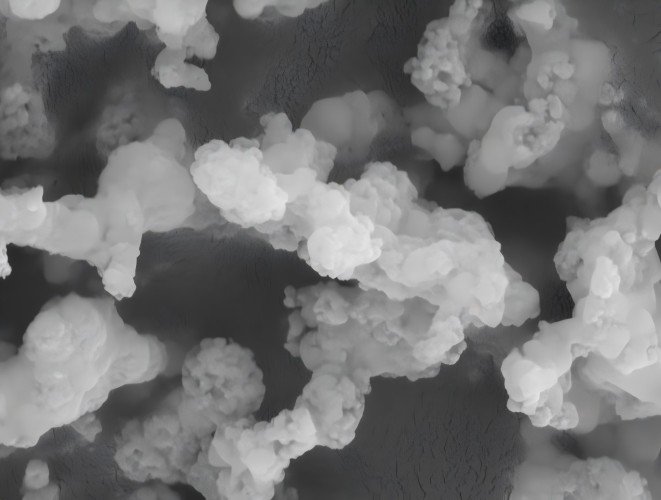
What Is Nanopowder, and When Is It Needed?
Nanopowder generally refers to a powder containing particles in the nanoscale range. In nanomaterial terminology, nanoscale dimensions are commonly associated with approximately 1–100 nanometers, although the exact terminology used in product specifications, standards, and individual applications may differ.
The nanoscale can influence material behavior because surface-related effects become increasingly important as particle dimensions decrease. Depending on the material and application, a smaller particle size may affect surface reactivity, sintering behavior, optical response, catalytic activity, or interactions with other components.However, nanoscale dimensions do not automatically guarantee better performance. The appropriate particle size depends on the material, processing method, required properties, and intended use.
For example, a nanopowder designed for a research study may require a carefully characterized particle-size distribution, while a powder intended for a ceramic formulation may also require attention to agglomeration, purity, morphology, and compatibility with the processing route.The most suitable nanopowder is therefore the one that meets the application’s technical requirements—not necessarily the one with the smallest nominal particle size.
Which Materials Are Used for Nanopowder Applications?
Nanopowders are available across a wide range of inorganic material families. Their properties and characterization requirements vary by composition and application. The following are representative examples; availability in a specific nanoscale grade should be confirmed with ULPMAT.
1. Metal and Alloy Nanopowders
Metal and alloy nanopowders are investigated for electrical and thermal applications, catalysis, powder processing, and advanced materials research. Examples include copper, nickel, silver, iron, and selected alloys. Key considerations may include particle-size distribution, composition, morphology, oxidation sensitivity, and storage conditions.
Oxide nanopowders are studied and used in ceramics, coatings, catalysts, electronic materials, polishing systems, and other functional-material applications.
Representative oxides include:
-
Aluminum oxide (Al₂O₃)
-
Zinc oxide (ZnO)
-
Titanium dioxide (TiO₂)
-
Zirconium dioxide (ZrO₂)
-
Silicon dioxide (SiO₂)
Depending on the material and application, particle size, phase composition, surface area, morphology, and agglomeration can affect processing and final properties. Explore ULPMAT’s oxide powder category for relevant material options. Confirm the specifications of the individual product before selecting a nanoscale grade.
3. Carbide Nanopowders
Carbide materials are relevant to research and engineering applications requiring combinations of hardness, wear resistance, thermal stability, or other specialized properties.
Representative examples include:
-
Silicon carbide (SiC)
-
Titanium carbide (TiC)
-
Boron carbide (B₄C)
-
Tungsten carbide (WC)
Particle-size distribution, purity, morphology, and agglomeration may affect powder handling and subsequent processing. Requirements should be defined according to the intended application.
Nitride materials are investigated for advanced ceramics, thermal management, electronic materials, and specialized coatings.
Representative examples include:
-
Boron nitride (BN)
-
Aluminum nitride (AlN)
-
Silicon nitride (Si₃N₄)
-
Titanium nitride (TiN)
Important specifications may include particle-size distribution, phase composition, purity, morphology, and surface condition. The appropriate combination depends on the material and manufacturing process. See ULPMAT’s boron nitride powder product page for product-specific information. Check the listed grade and measurement details to determine whether it matches your requirements.
5. Boride and Silicide Powders
Borides and silicides are studied for high-temperature applications, advanced ceramics, and specialized functional materials.
Representative examples include:
-
Hafnium diboride (HfB₂)
-
Zirconium diboride (ZrB₂)
-
Titanium diboride (TiB₂)
-
Molybdenum disilicide (MoSi₂)
-
Titanium disilicide (TiSi₂)
Depending on the compound, relevant requirements may include chemical purity, phase composition, particle size, morphology, and agglomeration. Confirm the availability and feasibility of the required nanoscale grade before specifying a custom material.
6. Rare Earth Compounds
Rare earth compounds are investigated for functional ceramics, optical materials, catalysts, and electronic applications. Specifications depend on the exact compound and its intended use, with chemical composition, phase purity, particle size, and surface properties among the possible considerations. When requesting a rare earth nanopowder, specify the exact compound rather than only the element name.
7. Halides and Chalcogenides
Halides and chalcogenides encompass diverse inorganic compounds studied for optical, electronic, catalytic, and energy-related applications. Material selection depends on the exact composition, environmental stability, and processing conditions. Purity, storage, handling, and characterization requirements should be assessed for the specific compound.
8. Battery-Related and Other Functional Compounds
Certain inorganic compounds are investigated for batteries, electrochemical systems, and other energy-related applications. Beyond particle size, relevant specifications may include composition, phase structure, impurity levels, morphology, surface condition, and compatibility with subsequent processing. Requirements should reflect the material’s intended role and the performance objectives of the application.
Why Nanopowder Particle Size Is More Than a Single Number
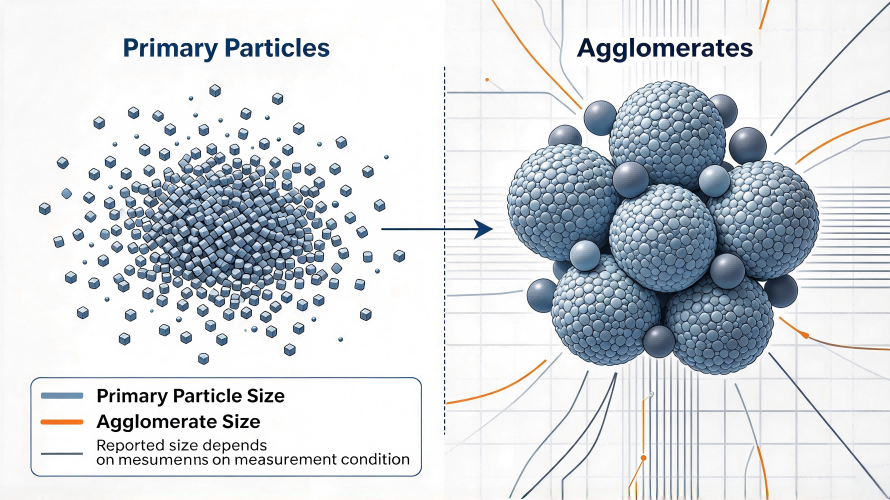
Particle size is one of the most frequently requested nanopowder specifications, but a single number may not fully describe a powder.Before comparing suppliers or grades, it is important to understand what the reported size represents and how it was measured.
Primary Particle Size vs. Agglomerate Size: Primary particles are the individual particles that make up a powder. Agglomerates are groups of particles associated with one another. A powder may contain nanoscale primary particles while forming larger agglomerates during production, storage, sample preparation, or dispersion. Consequently, a reported nanoscale value does not necessarily mean that all particles will remain individually dispersed during processing.
When reviewing a particle-size claim, clarify whether it refers to primary particle dimensions, a measured particle-size distribution, or the size of dispersed particles or agglomerates under specified test conditions.
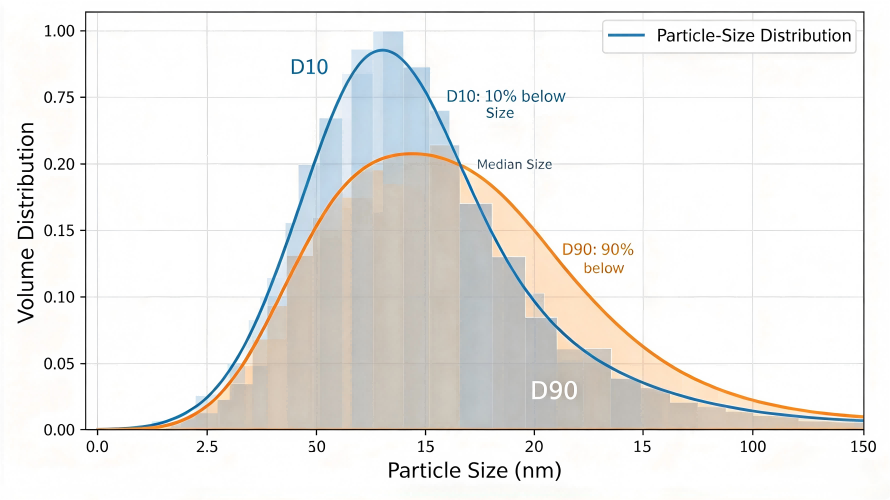
Average Particle Size and Particle-Size Distribution: An average particle size is useful, but it does not show the entire distribution.
Where appropriate, distribution parameters such as D10, D50, and D90 provide additional information:
- D10: The size below which 10% of the measured distribution falls.
- D50: The median size of the measured distribution.
- D90: The size below which 90% of the measured distribution falls.
These values must be interpreted in the context of the measurement method and the distribution basis used. For example, number-based, volume-based, and intensity-based distributions are not interchangeable. Two powders with the same D50 may have different distribution widths and therefore behave differently during processing.
How Is Nanopowder Particle Size Measured?
Different characterization methods measure different physical characteristics and have different limitations.
| Method | Common purpose | Important consideration |
| SEM | Examining particle morphology and dimensions in images | Results depend on image quality, sampling, particle identification, and analysis procedures |
| TEM | Examining very small particles and fine structural details | Sample preparation and the selected image fields can affect interpretation |
| Dynamic light scattering (DLS) | Measuring the hydrodynamic size of particles dispersed in a liquid | Results depend on dispersion conditions, concentration, and the interpretation of scattering data |
| Laser diffraction | Measuring particle-size distributions over a method-dependent size range | Dispersion and agglomeration can affect the reported distribution |
| Surface-area-based methods | Estimating an equivalent size under appropriate assumptions | The estimate depends on assumptions about density, shape, porosity, and surface characteristics |
These methods should not be treated as interchangeable. A size measured from microscopy images is not necessarily equivalent to a hydrodynamic size measured in a liquid dispersion or a size estimated from specific surface area.
Why Do Nanopowders Agglomerate?
Agglomeration is a common consideration in nanopowder handling and processing. Small particles have substantial surface area relative to their mass, and interactions between particles can make it difficult to maintain a uniformly dispersed system. Depending on the material and environment, agglomeration may be influenced by surface forces, moisture, electrostatic interactions, storage conditions, and the preparation or mixing procedure.
Agglomeration can affect how a nanopowder behaves during:
- Mixing with liquids, binders, or other powders
- Preparation of suspensions and coatings
- Forming and compaction
- Ceramic processing and sintering
- Preparation of composite or functional materials
For example, a powder that forms persistent agglomerates may be difficult to distribute uniformly in a formulation. This can affect local composition and processing consistency.
However, the effect is application-dependent. Agglomeration does not necessarily make a powder unsuitable; the key question is whether the powder can be handled and processed adequately for the intended use.
How Can Agglomeration Be Evaluated?
A practical evaluation may include microscopy, particle-size measurements under defined dispersion conditions, and application-specific dispersion or processing tests. The test should reflect how the powder will actually be used. A dispersion procedure suitable for one material may not be appropriate for another, and strong sample preparation can alter the state being measured. For this reason, particle-size results should be interpreted together with the test method and preparation conditions rather than viewed as an isolated value.
How Purity, Morphology, and Surface Properties Affect Nanopowder Performance
Particle size is only one factor in nanopowder selection.
Purity and Chemical Composition: Purity requirements depend on the material and application. Trace impurities may affect performance in electronic, ceramic, catalytic, and other high-performance systems. When specifying purity, clarify how it is measured and identify any critical impurities that require verification.
Morphology: Particle morphology refers to particle shape, such as spherical, irregular, plate-like, or rod-like. It can influence packing, flow, dispersion, and processing behavior. If particle shape is important, include it in the specification.
Surface Area and Surface Condition: Specific surface area, surface chemistry, moisture, oxidation, and surface treatments can influence nanopowder behavior. A higher surface area is not always better; the appropriate properties depend on the material and intended application.
Why These Specifications Matter Together: Two nanopowders with similar particle sizes may differ in purity, morphology, surface area, and agglomeration. Comparing powders by particle size or price alone may overlook important performance factors. Consider the full specification, measurement methods, and application requirements when evaluating options.
How to Specify a Nanopowder for Your Application
A clear request for quotation or technical inquiry helps a supplier evaluate the material and determine which available options may be suitable. The following checklist can be used when preparing a nanopowder inquiry.
| Specification | What to provide |
| Material | Exact chemical name, formula, and composition |
| Target particle size | Desired size or acceptable range, with units |
| Particle-size distribution | D10, D50, D90, or another relevant distribution requirement, if needed |
| Measurement method | Preferred test method, if specified by your application |
| Purity | Required purity level and any critical impurity limits |
| Morphology | Required particle shape or structural characteristics, if important |
| Surface area or treatment | Required specific surface area, coating, or surface condition, if applicable |
| Quantity | Required sample quantity or order quantity |
| Intended application | Research, ceramics, coatings, catalysis, electronics, energy materials, or another use |
| Documentation | Required test reports, certificates, or other quality documents |
Not every specification is required for every application. Prioritize essential requirements, such as the target particle-size range, and distinguish them from preferences, such as a preferred measurement method.
Can a Supplier Provide a Custom Nanopowder?
Custom nanopowder requests should be evaluated material by material. Feasibility can depend on chemical composition, the requested particle-size range, purity, morphology, production route, quantity, and verification requirements.
Before placing an order, clarify which specifications can be met, which can be measured, and what documentation can be supplied. Do not assume that every material can be produced at every requested nanoscale size or with every combination of properties.
Providing the intended application and the most important technical requirements at the beginning can help make the discussion more efficient.
Explore Nanopowder Materials and Custom Options at ULPMAT
Selecting a suitable nanopowder depends on the material, particle-size requirements, and intended application.
ULPMAT supplies a range of inorganic powder materials. Explore our oxide powder category or view specifications on the boron nitride powder page.
Looking for a nanopowder for your application? Contact ULPMAT with your target material, particle-size range, purity requirements, quantity, and intended use. Our team can review your requirements and discuss possible options based on material availability and technical feasibility.
FAQs
A nanopowder is a powder containing particles with nanoscale dimensions. In general, the term refers to materials with particle dimensions in the nanometer range, but the exact particle-size definition and measurement method should be considered when evaluating a specific product.
Primary particle size refers to the size of individual particles, while agglomerate size describes groups of particles that are held together. A nanopowder may contain nanoscale primary particles but form larger agglomerates during production, storage, or dispersion. Understanding this distinction helps avoid misleading comparisons between products.
Not always. D50 represents the median of a measured particle-size distribution, but it does not describe the full distribution or identify every large particle or agglomerate. Depending on the application, D10, D90, measurement method, and sample preparation conditions may also need to be specified.
Provide the material name and chemical formula, target particle-size range, required purity, quantity, and intended application. If relevant, also specify particle-size distribution, morphology, specific surface area, surface treatment, preferred measurement method, and documentation requirements. Distinguishing mandatory specifications from preferences can help clarify feasibility.
No. Availability depends on the material, target particle size, purity, morphology, production capabilities, and other technical requirements. Some materials may be available in specific nanoscale grades, while others may require further feasibility evaluation. Confirm the available specifications with the supplier before placing an order.
Compare suppliers using consistent technical criteria rather than particle size or price alone. Review chemical composition, purity, particle-size distribution, measurement methods, available test documentation, packaging, and quantity requirements. Confirm that reported specifications apply to the specific grade being quoted and are supported by appropriate documentation where available.