

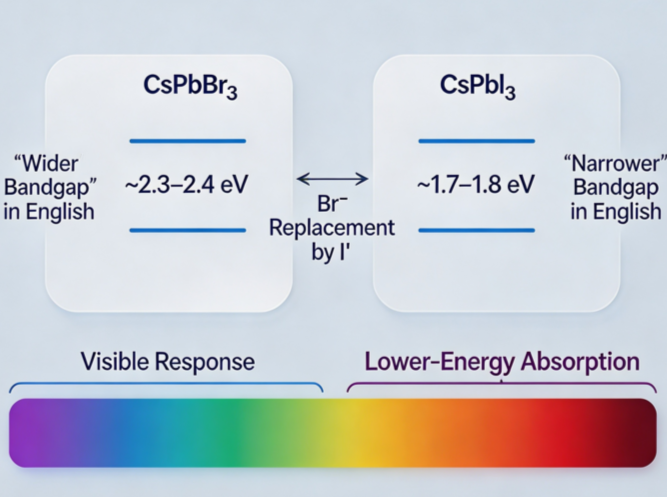
CsPbBr₃ Vs CsPbI₃ are two important all-inorganic lead halide perovskites for optoelectronic and thin-film research. They share the same CsPbX₃ perovskite framework, but replacing Br⁻ with I⁻ produces significant differences in bandgap and phase stability.CsPbBr₃ generally has a bandgap of approximately 2.3–2.4 eV, while the photoactive black phases of CsPbI₃ are generally in the 1.7–1.8 eV range. The exact value depends on crystal phase, film structure, temperature, and measurement method.For sputtering applications, bandgap is only one selection factor. Phase stability, substrate conditions, sputtering parameters, film thickness, and post-deposition treatment can also influence the final thin film.
CsPbBr₃ vs CsPbI₃: Key Differences
| Property | CsPbBr₃ | CsPbI₃ |
| Chemical composition | Cesium lead bromide | Cesium lead iodide |
| Halide | Br⁻ | I⁻ |
| Representative bandgap | ~2.3–2.4 eV | ~1.7–1.8 eV |
| Bandgap type | Wider | Narrower |
| Perovskite phase stability | Comparatively favorable | Black phase is metastable |
| Main optical advantage | Higher-energy visible response | Lower-energy absorption |
| Main materials challenge | Process-dependent phase behavior | Black-to-yellow phase transition |
| Sputtering consideration | Suitable for perovskite thin-film research | Requires careful phase-control strategy |
Bandgap and Optical Properties
One of the main differences between CsPbBr₃ and CsPbI₃ is their bandgap. CsPbBr₃ generally has a bandgap of around 2.3–2.4 eV, while the black perovskite phases of CsPbI₃ are typically around 1.7–1.8 eV. The exact value can vary with crystal phase, film structure, sample form, and measurement conditions.The difference is related to the halide ion in the perovskite lattice. I⁻ has a larger ionic radius than Br⁻, which changes the Pb–halide bond environment and the electronic structure near the band edges. Replacing Br⁻ with I⁻ therefore results in a narrower bandgap.
For thin-film applications, this difference affects the wavelength range of light that the material can absorb. CsPbBr₃, with its wider bandgap, is commonly investigated for visible-light optoelectronic applications, including photodetectors, light-emitting devices, and perovskite thin films. CsPbI₃, with its narrower bandgap, is of particular interest for photovoltaic and tandem-device research, where lower-energy photon absorption is important.For sputtering target selection, the bandgap requirement should be considered together with the intended application and deposition process. CsPbBr₃ is a suitable choice when a wider-bandgap perovskite is required, while CsPbI₃ is more appropriate when a narrower bandgap is needed.
Phase Stability and How to Control the Black Phase
Phase stability is an important difference between CsPbBr₃ and CsPbI₃ in thin-film applications. CsPbBr₃ generally has a more stable perovskite phase at room temperature, whereas CsPbI₃ requires closer control during film formation and subsequent processing.
CsPbI₃ can form several perovskite phases. The black α-, β-, and γ-phases have reported bandgaps of approximately 1.73, 1.68, and 1.75 eV, respectively. The yellow δ-phase has a different crystal structure and different optical and electronic properties. Under unfavorable conditions, black CsPbI₃ can transform into the δ-phase, and moisture is one of the factors that can accelerate this transition.
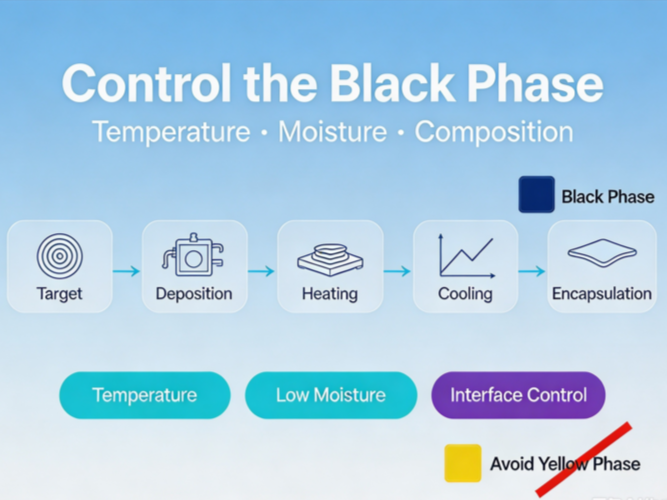
How to Control the CsPbI₃ Black Phase?
For sputtered CsPbI₃ films, several processing factors can affect phase formation and stability:
- Temperature: Heating influences crystallization and phase formation. During cooling, reported transitions include α → β at about 281 °C and β → γ at about 184 °C. These temperatures describe the phase-transition behavior of CsPbI₃ and should not be treated as a universal annealing schedule.
- Moisture: Humid conditions can accelerate the transformation from the black phase to the yellow δ-phase. Controlled deposition, storage, and handling are therefore important.
- Composition: The Cs–Pb–I ratio affects crystallization and phase stability. Alloying or additives may improve stability, but they also change the material composition and should not be considered equivalent to pure CsPbI₃.
- Substrate and interface: The substrate and underlying layers can affect nucleation, film structure, and phase stability.
- Film thickness and post-treatment: These parameters can influence crystallization and should be optimized together with the deposition conditions.
How to Verify the Phase?
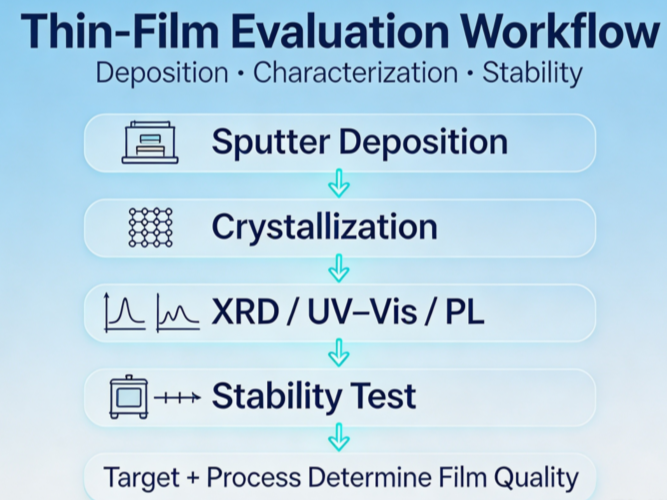
A dark or black film does not by itself confirm the desired CsPbI₃ phase. X-ray diffraction (XRD) can be used to identify the crystal structure and distinguish perovskite phases from the δ-phase. UV–Vis absorption and photoluminescence (PL) can provide additional information about the optical properties of the deposited film.
A typical evaluation sequence is:
CsPbI₃ Target → Sputter Deposition → Crystallization → XRD / Optical Characterization → Stability Evaluation
The sputtering target determines the starting Cs–Pb–I composition, while the final phase is also influenced by deposition conditions, substrate, thermal treatment, and environmental exposure. CsPbBr₃ generally presents fewer phase-stability challenges, while CsPbI₃ requires greater attention to black-phase formation and retention.
Sputtering Considerations
CsPbBr₃ has been successfully deposited by RF magnetron sputtering. A reported study prepared CsPbBr₃ films of about 70 nm on glass substrates and evaluated their structure and morphology. Other sputtering studies also found that substrate type and film thickness can influence film texture and morphology.For CsPbBr₃ and CsPbI₃ sputtering targets, target purity and stoichiometry are important, but the deposited film also depends on the RF power, working pressure, substrate temperature, film thickness, substrate, and post-deposition treatment.These parameters affect deposition rate, crystallization, morphology, and phase formation. Therefore, target selection should be considered together with the intended substrate, film thickness, sputtering system, and processing conditions rather than target composition alone.
CsPbBr₃ vs CsPbI₃: Which Sputtering Target Should You Choose?
The choice between CsPbBr₃ and CsPbI₃ sputtering targets mainly depends on the required bandgap, phase stability, and thin-film process.
| Requirement | Recommended Target | Reason |
| Bandgap around 2.3–2.4 eV | CsPbBr₃ | Wider-bandgap perovskite |
| Bandgap around 1.7–1.8 eV | CsPbI₃ | Narrower-bandgap perovskite |
| Greater phase stability at room temperature | CsPbBr₃ | Comparatively more stable perovskite phase |
| Lower-energy photon absorption | CsPbI₃ | Narrower bandgap |
| Visible-light optoelectronic research | CsPbBr₃ | Suitable for wider-bandgap applications |
| Photovoltaic or tandem-device research | CsPbI₃ | Suitable for narrow-bandgap research |
| Magnetron-sputtered CsPbBr₃ films | CsPbBr₃ | Demonstrated by RF magnetron sputtering |
| Applications requiring black CsPbI₃ | CsPbI₃ | Requires appropriate phase-control strategy |
CsPbBr₃ is a practical choice when a wider bandgap and comparatively favorable phase stability are required. CsPbI₃ is more suitable when a narrower bandgap is important and the deposition process can provide adequate control of the black perovskite phase.The target should ultimately be selected together with the substrate, film thickness, sputtering system, and post-deposition treatment. Neither composition should be considered universally superior; the appropriate choice depends on the requirements of the intended thin film.
Conclusion
CsPbBr₃ and CsPbI₃ sputtering targets are suited to different thin-film requirements. CsPbBr₃ has a wider bandgap of about 2.3–2.4 eV and generally shows better phase stability at room temperature. The black phases of CsPbI₃ have lower bandgaps, typically around 1.7–1.8 eV, but require more careful control during processing.For sputtering, the target composition is only one part of the process. Target purity, substrate, film thickness, sputtering conditions, thermal treatment, and environmental exposure can all affect the deposited film.In general, CsPbBr₃ is a practical choice for wider-bandgap applications, while CsPbI₃ is better suited to applications requiring a narrower bandgap and controlled black-phase formation.ULPMAT supplies CsPbBr₃ and CsPbI₃ sputtering targets for thin-film and perovskite research. Contact ULPMAT.
FAQs
The main differences are bandgap and phase stability. CsPbBr₃ generally has a bandgap of about 2.3–2.4 eV, while the black phases of CsPbI₃ are typically around 1.7–1.8 eV. CsPbI₃ also requires more careful phase control to maintain the desired black perovskite structure.
The difference is mainly caused by replacing Br⁻ with the larger I⁻ ion in the CsPbX₃ lattice. This changes the Pb–halide bonding environment and electronic structure, resulting in a narrower bandgap for CsPbI₃.
CsPbBr₃ generally shows more favorable phase stability at room temperature. CsPbI₃ black perovskite phases are more sensitive to temperature, moisture, and processing conditions and may transform into the yellow non-perovskite δ-phase.
The stability of black CsPbI₃ depends on several factors, including temperature, moisture control, composition, substrate/interface structure, film thickness, and post-deposition treatment. The optimal process conditions depend on the specific deposition system and film requirements.
The CsPbI₃ phase is commonly evaluated using X-ray diffraction (XRD) to identify crystal structures. Additional optical characterization methods, such as UV–Vis absorption and photoluminescence (PL), can provide information about optical properties and phase evolution.
Yes. RF magnetron sputtering has been demonstrated for CsPbBr₃ thin films, including reported films with a thickness of approximately 70 nm on glass substrates.
No. Target purity and composition provide the starting material, but the final film properties also depend on sputtering parameters, substrate conditions, film thickness, atmosphere, and post-deposition treatment.
CsPbBr₃ is generally suitable when a wider bandgap and comparatively favorable phase stability are required. CsPbI₃ is more suitable for applications requiring a narrower bandgap and controlled black-phase formation. The final selection should match the target with the intended substrate and deposition process.
References
- 1. CsPbI₃ Phase Stability and Phase Transitions Recent research on CsPbI₃ phase stability, black α/β/γ phases, the δ-phase transition, and environmental effects.
- 2. CsPbI₃ Phase Engineering and Stabilization Research covering thermal processing, compositional modification, interface engineering, and strategies for stabilizing black-phase CsPbI₃.
- 3. CsPbBr₃ Thin Films by Magnetron Sputtering Experimental studies demonstrating RF magnetron sputtering of CsPbBr₃ thin films and investigating the effects of substrate and film thickness.
- 4. CsPbBr₃ and CsPbI₃ Optical Properties Research reporting the optical bandgaps and phase-dependent properties of inorganic cesium lead halide perovskites.