

What Is CsPbBr₃ Sputtering Target?
CsPbBr₃ Sputtering Target(Cesium Lead Bromide) is an all-inorganic halide perovskite material with an ABX₃ crystal structure. As a sputtering target material, CsPbBr₃ is investigated for vacuum deposition of perovskite thin films used in optoelectronic and semiconductor-related research.Compared with organic-inorganic hybrid perovskites, CsPbBr₃ contains inorganic Cs⁺ ions, which provides advantages in material stability and makes it an important candidate for perovskite thin-film development.
What Are the Key Characteristics of CsPbBr₃ Sputtering Target?
The performance of a CsPbBr₃ sputtering target is determined by its chemical composition, physical properties, purity, microstructure, and compatibility with the sputtering process. As a multi-component halide perovskite material, accurate composition control is essential for achieving stable sputtering performance and consistent thin-film properties.
| Performance Parameter | Typical Value |
| Material Name | Cesium Lead Bromide |
| Chemical Formula | CsPbBr₃ |
| Crystal Structure | ABX₃ perovskite structure |
| Appearance | Yellow to orange-yellow solid |
| Molecular Weight | Approximately 579.8 g/mol |
| Purity | ≥99.99% (4N) commonly available |
| Theoretical Density | Approximately 4.44 g/cm³ |
| Bandgap | Approximately 2.3–2.4 eV |
| Emission Wavelength | Around 520–530 nm (green emission) |
| Optical Properties | Strong visible-light absorption and photoluminescence characteristics |
| Electrical Properties | Semiconductor properties with tunable charge transport behavior |
| Composition Control | Accurate Cs/Pb/Br ratio and phase control are important for sputtering performance |
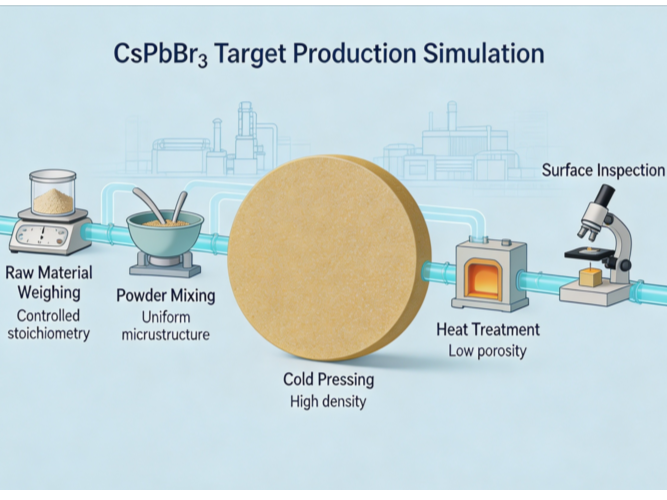
| Target Density and Porosity | High density and low porosity are preferred for stable sputtering |
| Microstructure | Uniform structure and good mechanical integrity support consistent material erosion |
| Thermal Stability | Depends on composition, atmosphere, and deposition conditions |
| Sputtering Compatibility | Mainly used for RF magnetron sputtering and perovskite thin-film research |
What Affects CsPbBr₃ Sputtering Target Quality?
The quality of a CsPbBr₃ sputtering target depends mainly on composition accuracy, purity, density, and structural consistency. As a multi-element halide perovskite material, CsPbBr₃ requires precise control of the Cs/Pb/Br ratio to maintain the desired phase composition and ensure stable thin-film deposition.
High-purity materials help reduce impurity-related defects and improve film reproducibility, which is important for optoelectronic and semiconductor-related research. Target density and microstructure also affect sputtering behavior. A dense target with low porosity can provide more uniform erosion and reduce particle generation during the deposition process.Because CsPbBr₃ contains halide components, thermal stability and processing conditions should also be considered. The target performance depends not only on the material itself but also on the compatibility between the target and the selected sputtering process.
CsPbBr₃ Thin Film Deposition Considerations
CsPbBr₃ sputtering targets are mainly used in vacuum-based deposition processes, especially RF magnetron sputtering. During sputtering, plasma ions bombard the target surface and release Cs, Pb, and Br-containing species, which then deposit onto the substrate to form a thin film.
The deposition process :
CsPbBr₃ Target → Plasma Generation → Material Sputtering → Thin Film Growth → Post-Treatment
Film properties are influenced by sputtering power, working pressure, substrate temperature, deposition rate, and post-deposition treatment. For CsPbBr₃ films, maintaining composition stability during deposition is particularly important because changes in elemental ratio may affect optical and electronic properties.
Applications of CsPbBr₃ Sputtering Target
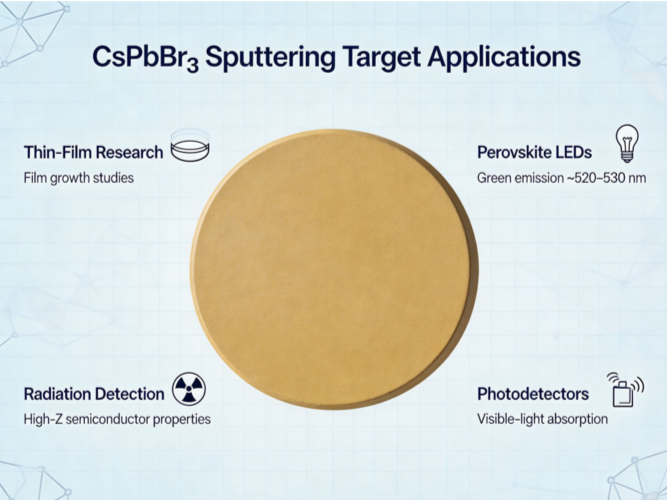
CsPbBr₃ sputtering targets are mainly used for research and development of functional perovskite thin films.
Perovskite LEDs:CsPbBr₃ has a green emission range of approximately 520–530 nm, making it an important material for studying perovskite light-emitting layers.
Photodetectors:Its strong visible-light absorption and semiconductor properties make CsPbBr₃ suitable for research into optical sensing and photodetection devices.
Radiation Detection:CsPbBr₃ is also investigated for X-ray and gamma-ray detection due to its high atomic number elements and semiconductor characteristics.
Thin-Film Research:CsPbBr₃ targets support studies on perovskite film growth, interface engineering, and material optimization.
How to Select CsPbBr₃ Sputtering Target?
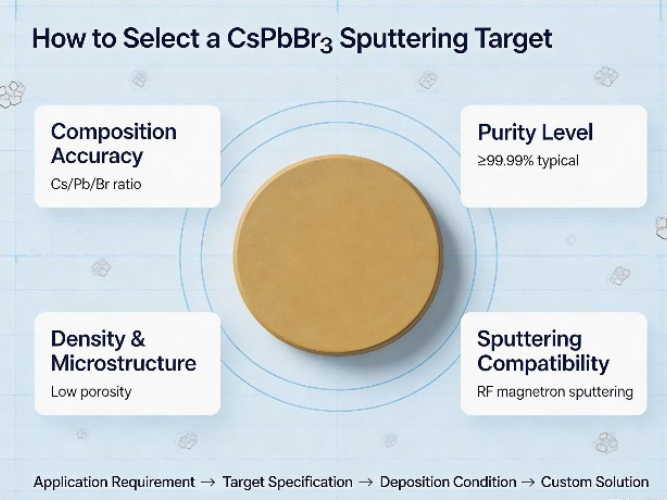
Selecting and customizing a CsPbBr₃ sputtering target requires matching the material composition, target specifications, and sputtering system with the intended thin-film application.
The process :
Application Requirement → Material Composition → Target Specification → Sputtering Compatibility → Custom Target Solution
Step 1: Define the Material Requirements
Confirm the required CsPbBr₃ composition, Cs/Pb/Br ratio, purity level, and whether a customized composition is needed for the specific research purpose.
Step 2: Match the Target Specifications
Select suitable target dimensions, shape, thickness, and mounting configuration according to the RF magnetron sputtering system. Customized target geometries can be considered for different equipment requirements.
Step 3: Confirm Deposition Conditions
Provide information about the sputtering method, equipment configuration, substrate type, and expected thin-film properties to ensure compatibility between the target and deposition process.
Step 4: Evaluate Custom Target Requirements
For application-specific requirements, CsPbBr₃ sputtering targets can be customized according to chemical composition, purity, dimensions, and sputtering configuration. Providing details such as application purpose, deposition method, target specifications, and required quantity helps define a suitable target solution.
FAQs
CsPbBr₃ sputtering target is an all-inorganic halide perovskite sputtering material used as a source material in PVD processes, especially RF magnetron sputtering, for depositing CsPbBr₃-based perovskite thin films.
CsPbBr₃ features an ABX₃ perovskite structure, a bandgap of approximately 2.3–2.4 eV, and green emission around 520–530 nm. These properties make CsPbBr₃ suitable for research on optoelectronic devices, photodetectors, and functional thin films.
The main factors include chemical composition, Cs/Pb/Br ratio, purity, target density, dimensions, sputtering system compatibility, and the requirements of the final thin-film application.
Yes. CsPbBr₃ sputtering targets can be customized according to chemical composition, elemental ratio, purity requirements, target size, geometry, and sputtering equipment specifications.
RF magnetron sputtering is commonly investigated for CsPbBr₃ thin-film deposition because it enables vacuum-based deposition of complex multi-element materials under controlled conditions.
References
- 1. Kojima et al. Organometal Halide Perovskites as Visible-Light Sensitizers for Photovoltaic Cells. JACS. Early research on halide perovskite photovoltaic materials.
- 2. Green et al. The Emergence of Perovskite Solar Cells. Nature Photonics. Overview of perovskite solar cell development and material properties.
- 3. Even et al. Understanding the Crystal Structure of Hybrid Organic-Inorganic Halide Perovskites. Chemical Physics Letters. Study of perovskite crystal structure and composition effects.
Related Resources
Need a customized CsPbBr₃ sputtering target? Contact ULPMAT below.