

Bismuth oxide vs lead oxide is one of the most common material comparisons in the ceramics, specialty glass, and electronics industries. While they share several functional properties, their performance, environmental impact, and regulatory considerations are not the same.
As industries continue to adopt lead-free materials and more sustainable manufacturing practices, many engineers and material developers are evaluating whether bismuth oxide can replace lead oxide in specific applications. Understanding the strengths and limitations of each material is essential for selecting the right solution.
This guide compares the key differences between bismuth oxide and lead oxide, including their physical properties, industrial applications, environmental considerations, and typical use cases, helping you make more informed material selection decisions.
Bismuth Oxide vs Lead Oxide: What's the Difference?
Although both materials belong to the heavy metal oxide family, they exhibit different physical characteristics that influence processing and final product performance.
| Property | Bismuth Oxide (Bi2O3) | Lead Oxide (PbO) |
| Molecular Weight | 465.96 g/mol | 223.20 g/mol |
| Density | ~8.9 g/cm³ | ~9.5 g/cm³ |
| Melting Point | ~820–825°C | ~888°C |
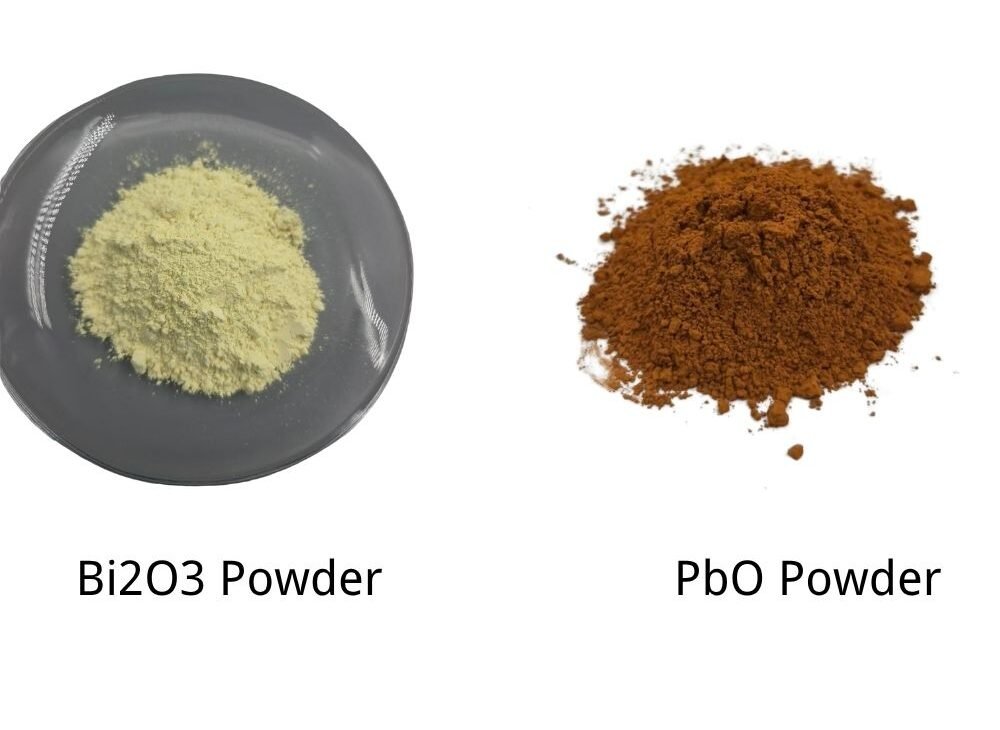
| Typical Color | Yellow | Yellow to reddish |
| Water Solubility | Practically insoluble | Slightly soluble |
| Environmental Concern | Relatively low | High due to lead toxicity |
The density of bismuth oxide is approximately 8.9 g/cm³, while lead oxide reaches about 9.5 g/cm³, making both suitable for applications requiring high-density ceramic or glass materials. Bismuth oxide melts at approximately 825°C, slightly lower than lead oxide, which can be advantageous in low-temperature ceramic sintering and specialty glass production.
Performance in Industrial Applications and Functional Comparison
Bismuth oxide (Bi2O3) is a high-purity inorganic compound used in multiple industrial fields, including electronic ceramics, optical glass, catalysts, and functional electronic materials. It is valued for its high refractive index, strong dielectric performance, thermal stability, and low toxicity compared with lead-based oxides. These properties make it suitable for high-performance and environmentally compliant material systems.
Industrial Applications Compared
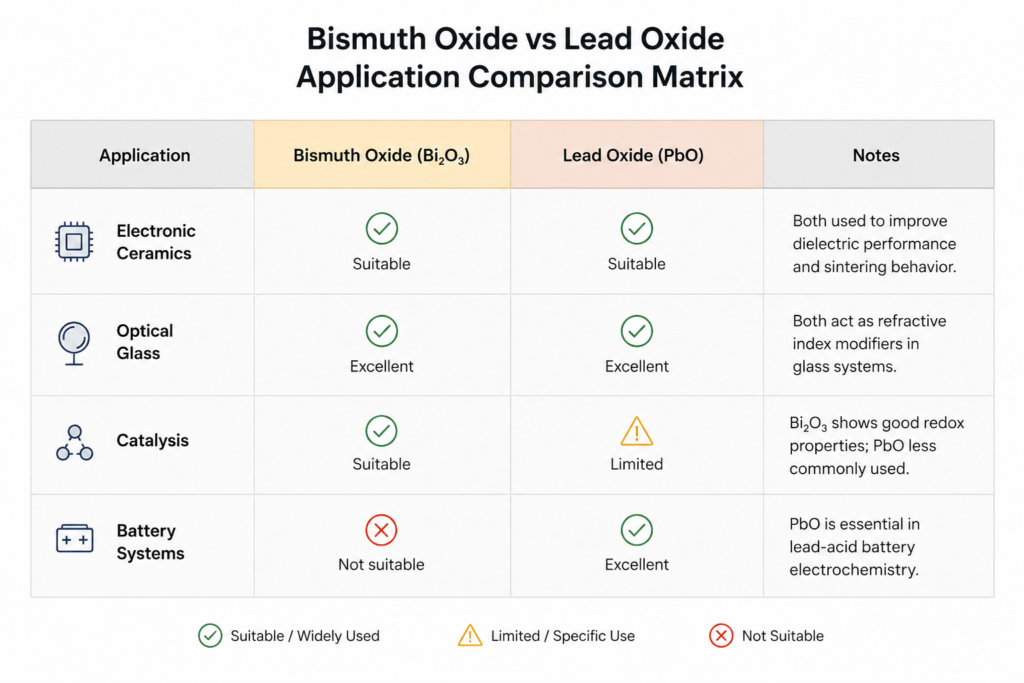
- Electronic ceramics: Bi2O3 is used to enhance dielectric constant and improve sintering behavior in capacitors and ceramic components, enabling stable electrical performance at lower processing temperatures.
- Optical glass: It functions as a refractive index modifier, allowing the development of high-index, lead-free glass systems with improved environmental safety.
- Catalysis: Bi2O3 provides active oxygen species and redox behavior, making it useful in oxidation reactions and catalytic systems.
- Electronic materials: Compared with PbO-based systems, Bi2O3 offers lower toxicity and better regulatory compliance while maintaining comparable functional performance.
Can Bismuth Oxide Replace Lead Oxide?
The feasibility of replacing lead oxide with bismuth oxide is application-dependent and should be evaluated from a functional and process-performance perspective rather than as a direct one-to-one substitution.
In glass and ceramic systems where lead oxide functions primarily as a fluxing agent, network modifier, or density adjuster, bismuth oxide can often be used as a partial or, in some cases, near-complete replacement. This is particularly common in lead-free glass formulations, electronic ceramics, and specialty oxide systems where regulatory compliance (e.g., RoHS and environmental restrictions on lead) is a key driver.
However, in systems where lead oxide is integral to electrochemical behavior, phase stability, or long-term cycling performance—such as lead-acid battery electrode chemistry—bismuth oxide cannot provide an equivalent functional replacement due to fundamentally different redox and structural characteristics.
In industrial practice, full substitution is rarely the preferred approach. Instead, engineers typically adopt optimized hybrid formulations, where bismuth oxide is introduced into lead oxide-containing systems to reduce lead content while maintaining key properties such as melting behavior, dielectric performance, and processing stability. This approach allows for a balanced trade-off between environmental compliance, cost efficiency, and material performance.
Choosing the Right Material
Material selection should be based on function + regulation + process compatibility, not a direct comparison of properties.
Simple decision logic:
- Need lead-free compliance (RoHS / REACH) → Bi2O3
- Need mature electrochemical system (batteries) → PbO
- Need low-temperature sintering → Bi2O3
- Need cost-optimized legacy system → PbO
Conclusion
Bismuth oxide and lead oxide can overlap in function, but they are not simple drop-in replacements for each other. Lead oxide is still widely used in mature systems because it performs reliably and is well understood in long-established industrial processes, especially where electrochemical behavior is critical.
Bismuth oxide is more often chosen when there is pressure to reduce lead content or meet environmental requirements. In many glass and ceramic applications, it can partially replace lead oxide without major changes to processing, which makes it a practical option for newer or adjusted formulations.