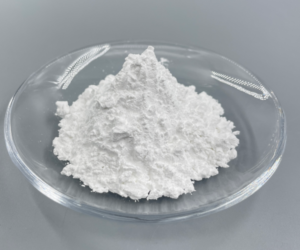


What Is Gas Atomized Powder?
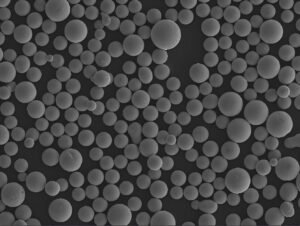
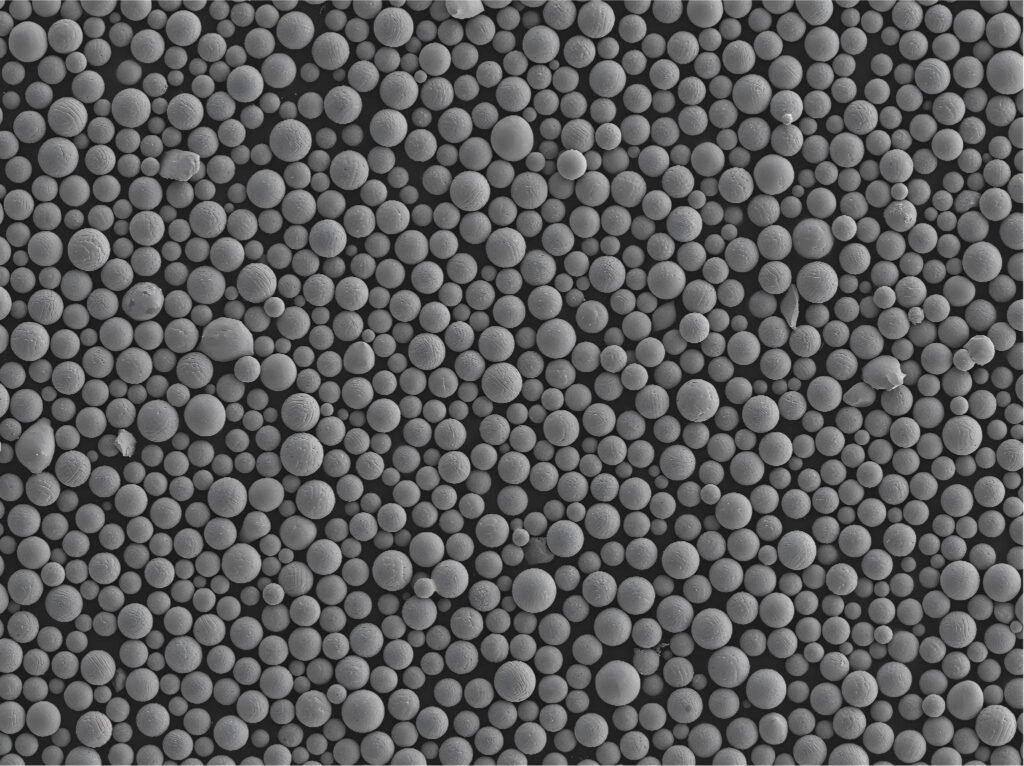
Gas atomized powder is a metal powder produced by disintegrating molten metal with high-pressure inert gas, typically argon or nitrogen. Rapid solidification during atomization results in highly spherical particles with low oxygen content and a controlled particle size distribution.
Compared with other powder production methods, gas atomization offers an excellent balance of powder quality, production efficiency and cost, making it the dominant technology for manufacturing metal powders used in additive manufacturing. Typical gas atomized materials include titanium alloys, stainless steels, aluminum alloys and nickel-based superalloys.
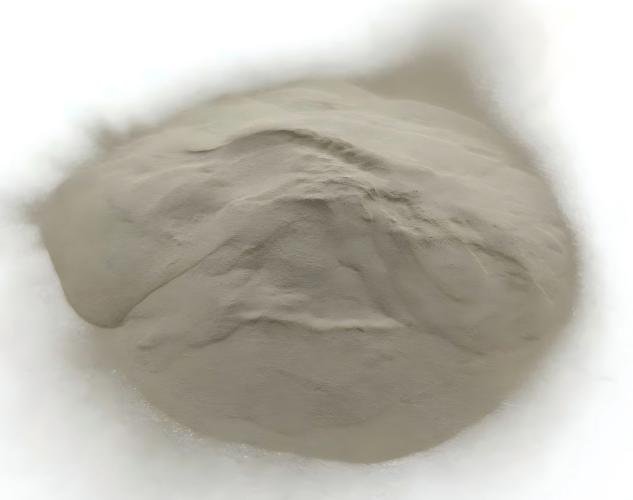
Why Gas Atomized Powder Is Widely Used in Additive Manufacturing?
The performance of metal additive manufacturing depends heavily on powder quality. Among various powder production technologies, gas atomization has become the preferred method because it produces powders with high sphericity, excellent flowability and consistent particle size distribution.
These characteristics are critical for additive manufacturing processes such as Laser Powder Bed Fusion (LPBF) and Directed Energy Deposition (DED), where uniform powder spreading directly affects layer quality and printing stability.
Compared with irregular powders, gas atomized powders typically provide:
- Higher powder bed density
- Improved powder flowability
- More consistent laser absorption
- Reduced porosity in printed parts
- Better dimensional accuracy
Typical AM-grade gas atomized powders achieve particle sphericity above 95%, making them well suited for demanding applications in aerospace, medical and industrial manufacturing.
Key Parameters to Consider When Selecting Gas Atomized Powder
| Parameter | What to Check | Typical Requirement for AM Powders | Impact on Printing Performance |
|---|---|---|---|
|
Particle Size Distribution (PSD) |
D10, D50, D90 values and particle size range |
LPBF: 15–45 μm; EBM: 45–106 μm; DED: 50–150 μm |
Influences layer thickness, powder spreading and printing resolution |
|
Oxygen Content |
Oxygen analysis report |
Ti-6Al-4V: <0.20 wt%; 316L: <0.05 wt%; Inconel 718: <0.04 wt% |
Excess oxygen can reduce ductility and mechanical properties |
|
Flowability |
Hall Flow Rate or Carney Flow Rate |
Typically 12–20 s/50 g |
Determines powder feeding consistency and recoating quality |
|
Particle Morphology |
SEM images and particle roundness |
Highly spherical particles with minimal satellites |
Improves flowability and powder bed uniformity |
|
Apparent Density |
Apparent density test report |
Typically 55–65% of theoretical density |
Affects powder packing and final part density |
|
Batch Consistency |
Quality control documentation |
Consistent PSD and chemistry between batches |
Ensures repeatable printing results |
|
Ensures repeatable printing results |
COA, chemical composition report |
ASTM/ISO compliant data preferred |
Verifies material quality and traceability |
For most additive manufacturing applications, particle size distribution, oxygen content and flowability are typically the first three parameters buyers should evaluate. These factors have the greatest influence on powder spreading behavior, part density and overall printing consistency.
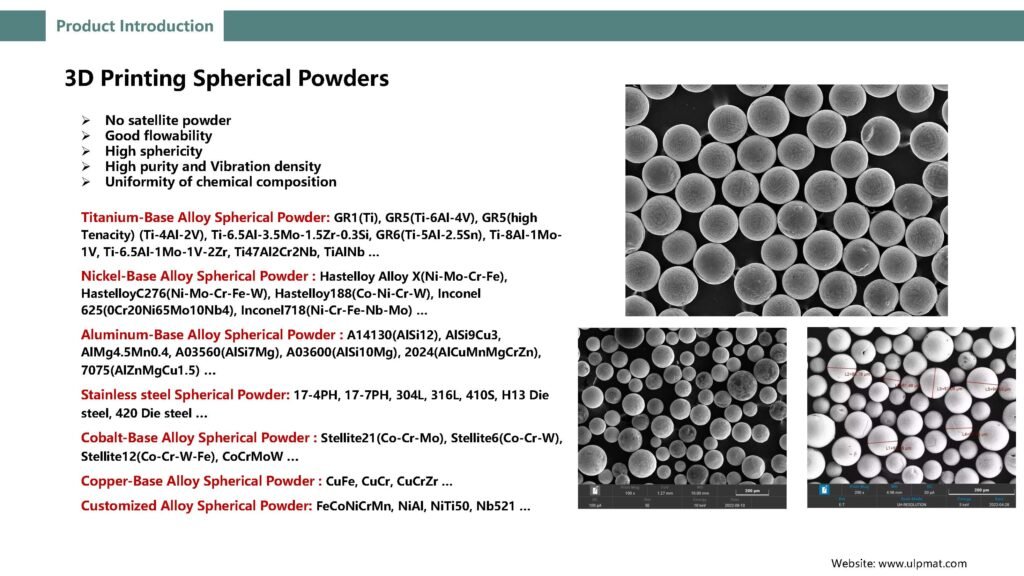
Gas Atomized Powders We Offer for Additive Manufacturing
| Material Category | Common Grades | Typical Applications |
| Titanium Alloy Powder | Ti-6Al-4V, CP Titanium | Aerospace, Medical |
| Stainless Steel Powder | 316L, 17-4PH | Industrial Manufacturing |
| Aluminum Alloy Powder | AlSi10Mg, AlSi7Mg | Lightweight Components |
| Nickel Alloy Powder | Inconel 718, Inconel 625 | High-Temperature Applications |
| Other Specialized Powders | Available upon request | Research and Custom Applications |
Additional spherical metal powders can be supplied according to specific alloy, particle size and application requirements.
How to Evaluate a Gas Atomized Powder Supplier?
Choosing a reliable gas atomized powder supplier is a critical step in ensuring stable additive manufacturing performance. Beyond material grade alone, buyers should focus on the supplier’s quality control system, testing capability and consistency across production batches.
A qualified supplier should be able to provide complete material certification, including chemical composition reports, Certificate of Analysis (COA) and full batch traceability. These documents ensure that the powder meets required industry standards and can be reliably used in aerospace, medical or industrial applications.
In addition to certification, detailed powder characterization data is essential for evaluating product quality. This typically includes particle size distribution (PSD) analysis, oxygen and nitrogen content testing, flowability measurements, and scanning electron microscope (SEM) images. Together, these parameters provide a comprehensive understanding of powder behavior during the additive manufacturing process.
Equally important is production consistency. High-quality suppliers maintain strict process control to ensure that each batch of powder exhibits stable particle size distribution, morphology and chemical composition. This consistency is crucial for repeatable printing results and reducing process variation in industrial production.
Proper packaging and storage conditions also play an important role in preserving powder quality during transportation and storage. Common industrial packaging methods include vacuum-sealed containers, inert gas (argon) protection and moisture-resistant packaging systems, all designed to minimize oxidation and contamination risks.
Finally, technical support is an important factor when selecting a supplier. Experienced suppliers can assist customers in selecting the most suitable powder grade, particle size range and specification for specific additive manufacturing processes, helping optimize printing performance and reduce trial-and-error costs.
Conclusion
Gas atomized powder has become the industry standard for metal additive manufacturing due to its high sphericity, low oxygen content, excellent flowability and compatibility with a wide range of engineering alloys. However, achieving stable and high-quality printing results requires more than simply selecting a material grade.
Key parameters such as particle size distribution, oxygen content, particle morphology, flowability and supplier quality control all have a direct impact on process stability and final part performance. Careful evaluation of these factors helps manufacturers reduce defects, improve repeatability and enhance overall production efficiency.
As additive manufacturing continues to expand across aerospace, medical, automotive and industrial sectors, the demand for high-quality gas atomized powders is expected to grow steadily. Selecting a qualified supplier and matching powder specifications to specific printing processes are essential steps for achieving reliable and scalable production.
For industrial applications, working with a supplier that provides consistent powder quality, full technical documentation and application support can significantly reduce trial-and-error costs and improve long-term manufacturing stability.
FAQs
Q1:What is gas atomized powder?
A1:Gas atomized powder is a metal powder produced by disintegrating molten metal using high-pressure inert gas. The process creates spherical particles with excellent flowability and packing density.
Q2:Why is gas atomized powder preferred for additive manufacturing?
A2:Its high sphericity, low oxygen content and consistent particle size distribution make it ideal for powder spreading and stable printing performance in processes such as LPBF and DED.
Q3:What particle size is best for laser powder bed fusion?
A3:Most LPBF systems use powders within the range of 15–45 μm or 20–63 μm, depending on machine type and application requirements.
Q4:What is the difference between gas atomized and irregular powder?
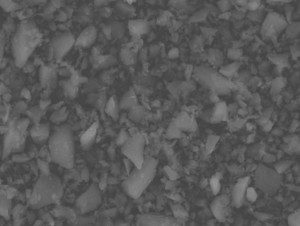
A4:Gas atomized powder has a spherical morphology with excellent flowability and uniform packing behavior, while irregular powders have angular shapes that can lead to poor spreading and higher defect risk in additive manufacturing.
Q5:Which materials are commonly produced by gas atomization?
A5:Common materials include titanium alloys (Ti-6Al-4V), stainless steels (316L, 17-4PH), aluminum alloys (AlSi10Mg) and nickel-based superalloys (Inconel 718, Inconel 625).