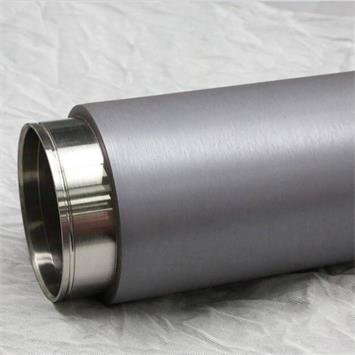
Copper Metal Rotary Target Overview
Copper Metal Rotary Targets are primarily used in large-area, long-duration continuous sputtering processes, suitable for the preparation of conductive thin films with high deposition efficiency.
We can customize the rotating target structure and parameters according to equipment size and process requirements, supporting technical collaboration and sample verification. Please contact us for solutions.
Product Highlights
High-purity copper raw material
High utilization rate of the rotating structure
Excellent thermal conductivity
Stable film composition
Suitable for industrial-grade continuous production
Customizable length and diameter
Applications of Copper Metal Rotary Targets
Flat Panel Display Coating: Used for preparing conductive lines and functional layers, meeting the requirements for uniform deposition on large-size substrates.
Semiconductor Interconnect Layers: Suitable for copper metal interconnect film deposition, processes requiring high stability and repeatability.
Solar Energy and Photovoltaic Fields: Used for electrode and current collector film preparation, supporting long-term continuous operation.
Functional Coatings and Industrial Coatings: Applied to large-area deposition scenarios for wear-resistant, conductive, and decorative coatings.
FAQs
1. Why are copper rotary targets used in high-throughput coating systems?
Copper rotary targets are used in compatible magnetron sputtering systems to deposit copper films in applications requiring continuous or high-throughput coating. Their cylindrical geometry allows the target to rotate during operation, distributing erosion over a larger target surface than many conventional planar configurations. This can improve target material utilization and support longer operating campaigns, depending on the cathode design and process conditions. Actual utilization and production efficiency depend on the erosion profile, target dimensions, power settings, cooling system, and equipment configuration.
2. Does a copper rotary target produce better film conductivity than a planar copper target?
Not necessarily. Both rotary and planar copper targets can produce conductive copper films when the target material and deposition process are properly controlled. Film conductivity depends primarily on film thickness, purity, microstructure, porosity, contamination, and deposition conditions rather than target geometry alone. Rotary targets are often selected for equipment compatibility, material utilization, and production efficiency, while planar targets suit cathodes designed for flat target assemblies. The appropriate design depends on the coating system and production requirements.
3. How does target purity influence the quality of sputtered copper coatings?
Target purity affects the potential introduction of metallic and other impurities into the deposited film. In applications such as electrical conductors, semiconductor metallization, and functional thin films, unwanted impurities can influence electrical resistivity, film composition, and process consistency. Nevertheless, a high-purity target cannot eliminate contamination originating from the chamber, substrate, process gases, or handling. Copper purity should therefore be specified according to the application, with deposition conditions and contamination control managed as part of the overall process.
4. What causes uneven erosion or localized wear on a copper rotary target?
Uneven erosion can result from the magnetic-field distribution, cathode geometry, target alignment, operating power, cooling conditions, or the way the target rotates during sputtering. Localized wear may reduce usable target material and affect process stability if it develops beyond the intended erosion profile. Diagnosing the problem requires examining the erosion pattern alongside cathode condition, target dimensions, installation accuracy, and operating history. Target geometry should match the equipment manufacturer’s requirements to help maintain consistent operation.
5. When should a manufacturer choose a copper rotary target instead of a planar target?
A copper rotary target is worth considering when the sputtering system is designed for cylindrical targets and the production process benefits from continuous rotation or improved material utilization. Planar targets may be more appropriate for systems built around flat cathodes or for applications with different equipment and maintenance requirements. The decision should consider target utilization, deposition uniformity, coating width, throughput, maintenance intervals, and the cost of the complete target assembly rather than purchase price alone.
6. Which manufacturing characteristics matter most when evaluating a copper rotary target?
The most important characteristics include copper purity, cylindrical dimensions, wall thickness, straightness, roundness, surface condition, and compatibility with the cathode assembly. Depending on the target design, joint integrity and the method used to connect target sections may also be important. Dimensional deviations or unsuitable assembly interfaces can affect installation, rotation, cooling contact, and operating stability. Buyers should evaluate these characteristics against the equipment drawing and the requirements of the intended sputtering process.
7. What information should be included in a quotation request for a copper rotary target?
A quotation request should include the required copper purity, target dimensions, quantity, and technical drawing. It should also identify the sputtering equipment or cathode interface and specify relevant requirements such as overall length, outer diameter, wall thickness, end connections, tolerances, and any backing tube or assembly requirements. If material certificates or dimensional inspection reports are needed, these should be stated before ordering. Complete specifications help establish compatibility and reduce clarification during quotation and production.
8. Can ULPMAT provide copper rotary targets made to custom dimensions?
ULPMAT can review inquiries for copper rotary targets according to the requested material grade, dimensions, geometry, and equipment requirements, subject to confirmation of manufacturing feasibility. To evaluate a custom request, provide a technical drawing, target dimensions, copper purity, quantity, and cathode-interface details. Requirements for dimensional tolerances, inspection documentation, and target assembly components should also be included where applicable. ULPMAT can then confirm which specifications can be supported for the intended application.
Reports
Each batch is supplied with:
Certificate of Analysis (COA)
Technical Data Sheet (TDS)
Material Safety Data Sheet (MSDS)
Third-party testing reports available upon request
Why Choose Us?
We have extensive experience in metal target manufacturing and rotating target structure matching, providing continuous and reliable support from materials and processing to application matching, helping customers improve coating efficiency and product consistency.