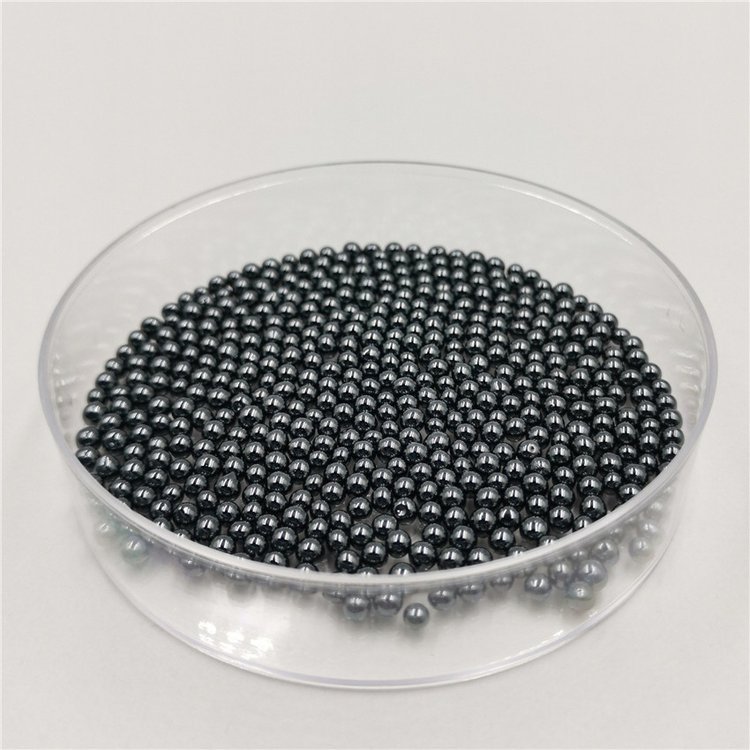
Selenium metal Granules Overview
Selenium metal granules are a crucial non-metallic semiconductor element material, typically appearing gray to black in color. They exhibit unique optoelectronic properties, with conductivity significantly increasing under illumination (photoconductive effect). Selenium shares chemical characteristics with sulfur and serves as a core raw material for producing various selenides and functional materials. It finds extensive applications in electronics, optics, metallurgy, and health sectors.
We offer gray and black selenium metal granules in different purities and particle sizes. Contact us for customized solutions.
Product Highlights of Selenium metal Granules
Multiple forms available
Multiple purity grades
Unique optoelectronic properties
Strict quality control, consistent batches
Professional light-shielding packaging
Applications of Selenium metal Granules
Optoelectronics & Semiconductors: Used in manufacturing early selenium photovoltaic cells, selenium rectifiers, and certain specialty semiconductor devices.
Glass Industry: Used as a decolorant to eliminate green tints in glass or as a colorant for producing ruby glass.
Metallurgy and Alloys: Employed as an additive to enhance machinability in stainless steel and copper alloys.
Q1: Are selenium granules toxic? What precautions are needed during handling and storage?
A1: Yes, most selenium elements and compounds are toxic. Inhaling dust or accidental ingestion is harmful. Always wear protective masks and gloves during handling, and work in well-ventilated areas. Store in sealed, light-proof containers in cool, dry locations away from acids, strong oxidizing agents, and foodstuffs.
Q2: What is the difference between gray selenium and black amorphous selenium? How should one choose?
A2: Gray selenium is a stable crystalline form with a metallic luster and semiconductor properties. Black amorphous selenium is typically powdered or glassy, exhibiting higher chemical reactivity. Selection depends on your process: gray is preferred for stable photovoltaic performance, while black amorphous selenium may be more suitable as a precursor for chemical reaction synthesis.
Q3: In the photovoltaic field, in which type of solar cell is selenium primarily used today?
A3: Currently, selenium serves as a key raw material for copper indium gallium selenide (CIGS) thin-film solar cells. These cells offer high conversion efficiency, excellent low-light response, and cost potential, making them a significant direction for next-generation photovoltaic technology.
Q4: How do I determine the required purity and particle size when ordering?
A4: This primarily depends on your end application. For instance, glass industry decolorization typically requires industrial-grade selenium above 99.5% purity; whereas synthesizing high-purity semiconductor materials demands ultra-high-purity selenium exceeding 99.999%, with specified particle sizes to control reactivity. Our technical sales team can provide selection guidance.
Report
Each batch is supplied with:
Certificate of Analysis (COA)
Technical Data Sheet (TDS)
Material Safety Data Sheet (MSDS)
Third-party testing reports available upon request
Why choose us?
Leveraging our extensive expertise in selenium materials, we offer a comprehensive product range from industrial-grade to ultra-high-purity selenium. Our professional technical support ensures you receive the most suitable solution for your needs.