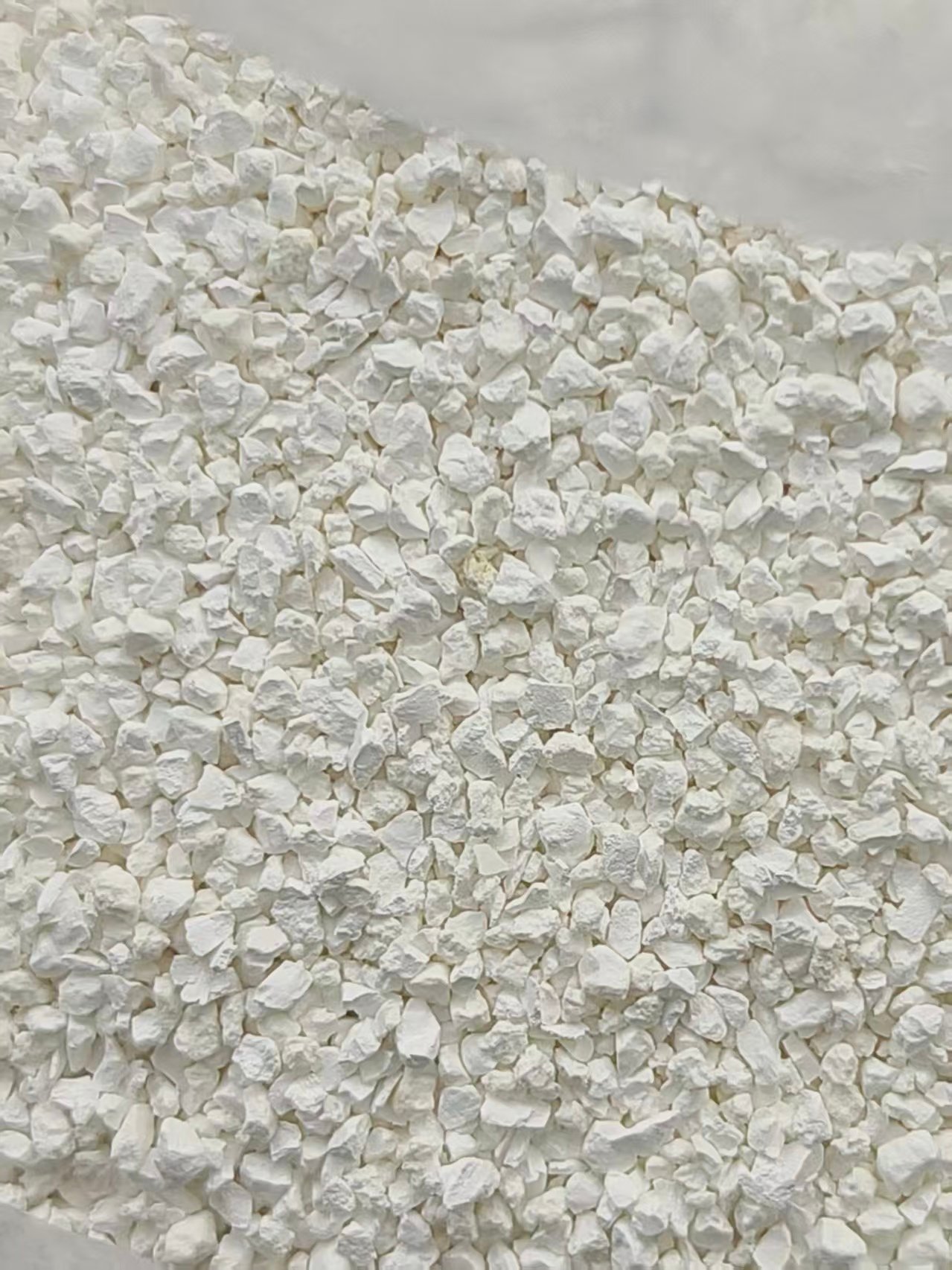
Calcium Oxide Granules Overview
Calcium oxide granules, commonly known as quicklime granules, are solid particles of specific size produced from high-purity calcium oxide. With their high chemical reactivity, strong hygroscopic and exothermic properties, and excellent physical flowability, they play a pivotal role in industrial and environmental applications such as flue gas desulfurization, wastewater treatment, metallurgical slagging, and soil remediation.
We offer calcium oxide granules in multiple specifications ranging from standard industrial grade to high-reactivity grade, with customizable particle size ranges and reactivity metrics. For samples or tailored technical solutions, please contact us at any time.
Product Highlights
High reactivity and purity
Uniform particle size
Strong hygroscopic and neutralizing capacity
Consistent batch quality and reliable supply
Applications of Calcium Oxide Granules
Environmental Protection & Exhaust Gas Treatment: Serves as a dry or semi-dry flue gas desulfurization agent, efficiently neutralizing and removing acidic gases like sulfur dioxide from exhaust streams to meet environmental emission standards.
Metallurgical Slagging Agent: Added during steel smelting to effectively remove phosphorus and sulfur, adjust slag alkalinity and fluidity, thereby enhancing metal quality and smelting efficiency.
Wastewater Treatment and Conditioning: Neutralizes acidic industrial effluents and serves as a phosphorus removal agent, eliminating phosphate pollutants through chemical precipitation.
Building Materials and Soil Conditioning: Raw material for manufacturing calcium silicate boards and other construction products; used in agriculture to condition acidic soils, adjust pH levels, and supply calcium.
Q1: What risks exist when calcium oxide granules react with water, and how should it be handled safely?
A1: This reaction is highly exothermic and may produce steam and splashes, posing a burn hazard. Full protective gear (acid/alkali-resistant suit, face shield, gloves) must be worn. Slowly add the material to a large volume of water in a well-ventilated area. Never add water to the material.
Q2: Why does the product “powderize” or clump during storage?
A2: Powderization primarily results from particles absorbing moisture and carbon dioxide from the air, causing hydration and carbonation reactions. Clumping is typically caused by moisture absorption. Therefore, strict sealing is required, and storage must be in a cool, dry warehouse.
Q3: How is the “reactivity” of calcium oxide particles assessed?
A3: Reactivity is typically characterized by measuring the temperature increase during reaction with water within a specified time or the amount of acid consumed. Higher reactivity indicates faster chemical reaction rates and greater efficiency.
Q4: What are the application differences between products of varying particle sizes (e.g., 1-3mm, 3-10mm)?
A4: Particle size affects both the reactive surface area and material flowability. Finer particles (e.g., 1-3mm) react faster and more completely, making them suitable for processes requiring rapid and efficient reactions. Coarser particles (e.g., 3-10mm) exhibit better flowability and generate less dust, making them more suitable for automated dosing and long-process reaction systems.
Report
Each batch is supplied with:
Certificate of Analysis (COA)
Technical Data Sheet (TDS)
Material Safety Data Sheet (MSDS)
Size Inspection Report
Third-party testing reports available upon request
Why Choose Us?
We specialize in the advanced processing and quality enhancement of calcium oxide products, with full-process control from raw material selection to finished granulation. We deeply understand the stringent industrial requirements for particle activity, size distribution, and low dust generation, ensuring stable and reliable product performance through advanced manufacturing techniques. We are not just suppliers but partners in optimizing your processes, offering expert technical support and efficient logistics services.