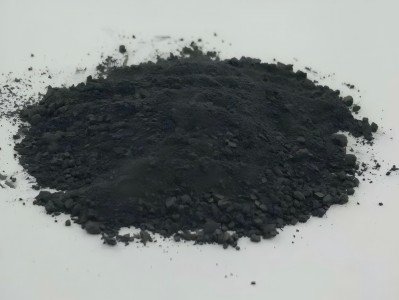
Sodium manganese iron phosphate (NMFP), with the general chemical formula NaMnₓFe₁₋ₓPO₄, is a polyanion-type cathode material developed and manufactured by ULPMAT for sodium-ion batteries. Combining manganese- and iron-based transition-metal chemistry with a phosphate framework, NMFP offers flexibility in composition design for different sodium-ion battery research and development requirements.
ULPMAT independently develops and manufactures NMFP powder in both uncoated and carbon-coated forms. The manganese-to-iron (Mn/Fe) molar ratio, particle size, and surface coating can be customized according to customer specifications. Typical product specifications include a purity of ≥99% for the specified NMFP grade and a D50 particle size below 10 μm.
For applications where improved electronic conductivity is required, carbon-coated NMFP is also available. ULPMAT provides batch-level material testing and quality documentation to support specification verification and customer evaluation.
Sodium manganese iron phosphate (NMFP) is a phosphate-based cathode material for sodium-ion batteries, generally represented by the formula NaMnₓFe₁₋ₓPO₄. It contains manganese and iron as transition-metal components within a phosphate-based material framework.
The Mn/Fe ratio can be adjusted to investigate different electrochemical characteristics. NMFP is available as uncoated or carbon-coated powder, with carbon coating used to help improve electronic conductivity. Its composition, particle size, and surface treatment can be tailored to specific battery material development and electrode preparation requirements.
The general formula of NMFP is NaMnₓFe₁₋ₓPO₄, where x represents the manganese fraction in the transition-metal composition. Adjusting this ratio changes the relative proportions of manganese and iron and provides a way to investigate the material’s electrochemical behavior.
Manganese (Mn)
Manganese is an electrochemically active transition-metal component. Its proportion in NMFP can influence the material’s redox behavior, operating voltage characteristics, and overall electrochemical response. Adjusting the Mn content is therefore an important consideration in NMFP composition design.
Iron (Fe)
Iron provides another redox-active component in the phosphate-based cathode chemistry. It is also an abundant transition metal and is frequently considered in the development of cost-conscious battery material compositions.
Phosphate (PO₄)
The phosphate group forms an important part of the material framework. Strong P–O bonds contribute to the structural stability of phosphate-based electrode materials and influence their electrochemical and thermal characteristics.
The actual crystal phase and structural characteristics of an NMFP grade should be evaluated through appropriate material characterization, including X-ray diffraction (XRD).
ULPMAT offers two NMFP powder forms to accommodate different material development and electrode processing requirements.
| Parameter | Uncoated NMFP | Carbon-Coated NMFP |
| Base composition | NaMnₓFe₁₋ₓPO₄ | NaMnₓFe₁₋ₓPO₄ with carbon coating |
| Surface condition | Without intentional carbon coating | Carbon-modified particle surface |
| Electronic conductivity | Depends on the intrinsic material and electrode formulation | Carbon coating can help improve electronic conductivity |
| Material development | Suitable for evaluating the base NMFP material | Suitable for investigating the effect of carbon modification |
| Customization | Mn/Fe ratio and particle size | Mn/Fe ratio, particle size, and coating requirements |
The choice between uncoated and carbon-coated NMFP depends on the intended electrode design, conductivity requirements, and processing conditions.
Phosphate-based cathode materials may require additional strategies to improve electronic transport. Carbon coating is one commonly used approach to address this consideration.
A carbon layer on the particle surface can provide additional conductive pathways and facilitate electron transport within the electrode. This may help reduce the impact of limited intrinsic electronic conductivity during battery operation.
The effectiveness of carbon coating depends on several factors, including:
Carbon-coated NMFP is therefore an option for customers evaluating the influence of surface modification on electrode conductivity and electrochemical behavior. Its actual performance should be assessed under the intended electrode formulation and testing conditions.
| Parameter | Specification |
| Product Name | Sodium Manganese Iron Phosphate Powder |
| Abbreviation | NMFP |
| Chemical Formula | NaMnₓFe₁₋ₓPO₄ |
| Material Category | Sodium-ion battery cathode material |
| Typical Purity | ≥99% for the specified NMFP grade |
| Appearance | Powder |
| Particle Size | D50 < 10 μm (typical) |
| Mn/Fe Molar Ratio | Customizable |
| Surface Coating | Uncoated / Carbon-coated |
| Application | Sodium-ion battery cathode material research and development |
Note: The specifications above are typical values and may vary by grade. For carbon-coated NMFP, the purity basis and carbon content should be specified separately. Customized compositions and particle size requirements can be discussed according to the intended application.
NMFP is developed for use as a cathode material in sodium-ion battery research and development. Its adjustable transition-metal composition and available surface modification options make it relevant to several material evaluation and electrode development activities.
Typical application areas include:
The suitability of a specific NMFP grade depends on its composition, phase characteristics, particle properties, electrode formulation, and battery testing conditions.
When selecting or evaluating NMFP powder, several material parameters should be considered together rather than relying on purity alone.
1. Mn/Fe Molar Ratio
The manganese-to-iron ratio influences the transition-metal composition and electrochemical characteristics of NMFP. The appropriate ratio depends on the target material design and evaluation requirements.
2. Particle Size and Distribution
Particle size can affect powder processing, electrode preparation, and the interaction between active material particles and other electrode components. Particle size distribution should be considered alongside the average particle size.
3. Carbon Coating
Carbon coating can improve electronic conductivity by providing conductive pathways around active material particles. Coating quality and carbon content are important considerations when comparing different grades.
4. Crystal Phase and Composition
Phase composition and crystallinity are important for understanding the structural characteristics of NMFP. XRD analysis can be used to evaluate phase identity and detect potential secondary phases.
5. Particle Morphology
Particle shape, surface characteristics, and particle aggregation can influence powder handling and electrode processing. SEM analysis provides useful information about particle morphology.
These factors should be evaluated together when selecting NMFP for a specific sodium-ion battery development project.
ULPMAT produces sodium manganese iron phosphate (NMFP) powders, offering customized material solutions tailored to the R&D requirements of various sodium-ion battery technologies.
Our sodium manganese iron phosphate (NMFP) product portfolio includes:
Leveraging our R&D and production capabilities, ULPMAT works directly with clients to define their precise requirements regarding material composition, powder specifications, and surface treatments.
ULPMAT performs batch-level testing and quality control for its NMFP powder to support material consistency and specification verification.
Each production batch is subject to relevant testing and characterization, including:
Particle Size Distribution (PSD)
PSD testing evaluates particle size characteristics and distribution, helping verify whether the powder meets the agreed particle size requirements.
X-Ray Diffraction (XRD)
XRD analysis is used for phase identification and crystal structure characterization. It helps evaluate the crystalline characteristics of the supplied NMFP material.
Scanning Electron Microscopy (SEM)
SEM is used to examine particle morphology, surface characteristics, and particle aggregation.
Certificate of Analysis (COA)
A batch-specific COA provides analytical results and relevant quality information for the supplied material.
These testing procedures provide customers with important information for incoming material inspection, technical evaluation, and battery development. Corresponding batch testing documentation can be provided with shipments or upon customer request.
NMFP and NFPP are both phosphate-based cathode material chemistries investigated for sodium-ion batteries. However, they differ in chemical composition and transition-metal content.
| Parameter | NMFP | NFPP |
| Full Name | Sodium Manganese Iron Phosphate | Sodium Iron Pyrophosphate Phosphate |
| General Formula | NaMnₓFe₁₋ₓPO₄ | Na₄Fe₃(PO₄)₂P₂O₇ |
| Transition Metals | Manganese and iron | Iron |
| Chemical Framework | Phosphate-based | Mixed phosphate-pyrophosphate |
| Composition Design | Adjustable Mn/Fe ratio | Iron-based composition |
| Development Focus | Investigation of Mn/Fe composition and related electrochemical characteristics | Investigation of iron-based phosphate-pyrophosphate cathode chemistry |
The two materials are not interchangeable. Their different chemical compositions and structural characteristics lead to different material design and evaluation considerations. Selection should be based on the target battery chemistry, electrode design, and performance requirements.
For more information on NFPP materials.
ULPMAT NMFP powder is packaged to help protect the material during storage and transportation.
Recommended storage conditions include:
Customized packaging options can be discussed according to order quantity and customer requirements.
ULPMAT combines in-house material development, manufacturing, and batch-level quality control to supply NMFP powder for sodium-ion battery applications.
Key advantages include:
Whether you are developing a new sodium-ion battery cathode composition or evaluating carbon-coated phosphate materials, ULPMAT can discuss NMFP specifications based on your technical requirements.
1. What is sodium manganese iron phosphate (NMFP)?
Sodium manganese iron phosphate (NMFP) is a phosphate-based cathode material developed for sodium-ion batteries. Its general chemical formula is NaMnₓFe₁₋ₓPO₄, containing manganese and iron as transition-metal components. The adjustable Mn/Fe ratio allows different compositions to be investigated for sodium-ion battery cathode development.
2. What is the chemical formula of NMFP?
The general chemical formula of sodium manganese iron phosphate is NaMnₓFe₁₋ₓPO₄. In this formula, x represents the manganese fraction in the transition-metal composition, while 1−x represents the iron fraction. The specific Mn/Fe molar ratio depends on the material grade and composition requirements.
3. Is NMFP suitable for sodium-ion battery cathodes?
Yes. Sodium manganese iron phosphate is developed for use as a cathode active material in sodium-ion batteries. It can be evaluated in cathode composition development, electrode preparation, and electrochemical testing. The selection of a specific NMFP grade depends on its Mn/Fe ratio, particle size, surface coating, and electrode formulation.
4. What is the difference between uncoated and carbon-coated NMFP?
Uncoated NMFP does not have an intentional carbon coating on its particle surface. Carbon-coated NMFP has a carbon-modified surface designed to help improve electronic conductivity and facilitate electron transport. The appropriate grade depends on the electrode formulation, conductivity requirements, and material processing conditions.
5. Can ULPMAT customize the Mn/Fe ratio of NMFP?
Yes. ULPMAT develops and manufactures NMFP powder with customizable manganese-to-iron molar ratios. Customers can provide their target composition or application requirements so that the appropriate material specifications can be evaluated.
6. What is the typical particle size of ULPMAT NMFP powder?
The typical particle size specification of ULPMAT NMFP powder is D50 below 10 μm. Particle size distribution and target D50 values can be customized according to customer requirements and the intended application.
7. What is the typical purity of NMFP powder?
The typical purity is ≥99% for the specified NMFP grade. The purity basis should be confirmed for each product specification. For carbon-coated grades, the purity of the base active material and the overall composition, including the carbon coating, should be considered separately.
8. Does ULPMAT provide batch testing reports for NMFP?
Yes. ULPMAT performs batch-level quality testing for its NMFP powder. Each production batch undergoes particle size distribution (PSD) testing, X-ray diffraction (XRD) analysis for phase characterization, and scanning electron microscopy (SEM) examination of particle morphology. A batch-specific Certificate of Analysis (COA) is also provided to document relevant quality results and verify compliance with the agreed specifications.
9. What information is required to order NMFP powder from ULPMAT?
When requesting NMFP powder, customers are encouraged to specify the target Mn/Fe molar ratio, whether uncoated or carbon-coated powder is required, particle size, purity requirements, and order quantity. Information about the intended sodium-ion battery application or electrode formulation can also help ULPMAT evaluate suitable material specifications.
10. Can I request customized carbon-coated NMFP powder?
Yes. ULPMAT offers carbon-coated NMFP powder and can discuss coating-related requirements according to customer needs. Specific requirements, such as carbon content and coating characteristics, should be confirmed during technical evaluation before ordering.
11. What is the difference between NMFP and NFPP cathode materials?
NMFP has the general formula NaMnₓFe₁₋ₓPO₄ and contains both manganese and iron. NFPP has the chemical formula Na₄Fe₃(PO₄)₂P₂O₇ and is an iron-based phosphate-pyrophosphate material. Their chemical compositions and material frameworks differ, resulting in different material design and evaluation considerations for sodium-ion battery applications.
12. Can ULPMAT provide TDS, SDS, and COA for NMFP powder?
Yes. ULPMAT provides a Technical Data Sheet (TDS) and Safety Data Sheet (SDS) for NMFP powder. A batch-specific Certificate of Analysis (COA), together with relevant PSD, XRD, and SEM testing information, is also available to support material evaluation, quality verification, and purchasing procedures.
To download the TDS, please click [Download]
To download the SDS, please click [Download]
Physical Form: Fine powder
Chemical Composition: NaMnₓFe₁₋ₓPO₄
Particle Size: Typical D50 below 10 μm
Particle Morphology: Evaluated by scanning electron microscopy (SEM)
Crystal Phase: Characterized by X-ray diffraction (XRD)
Surface Modification: Available in uncoated and carbon-coated forms
Not a dangerous good
Outer packaging: carton or fiber drum.
Inner packaging: double vacuum-sealed bags.
Packing specification: 1 kg/bag or 25 kg/drum.
Customized packaging is available upon request.
If you need any service, please contact us