

Do you know why high-performance lithium-ion batteries are increasingly reliant on lithium cobalt oxide targets? Lithium cobalt oxide targets not only improve battery capacity but also determine cycle life and thermal stability. Lithium cobalt oxide (LiCoO₂) targets are the core material for high-performance lithium-ion battery cathode thin-film deposition, possessing high purity, high density, and a uniform particle structure.

1.Overview of Lithium Cobalt Oxide Sputtering Targets
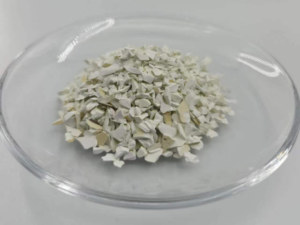
Lithium cobalt oxide (LiCoO₂) targets are high-performance functional materials with a layered crystal structure. In their crystals, CoO₂ layers alternate with lithium ions, forming stable ion channels. This allows for rapid and reversible lithium-ion migration during charge and discharge, ensuring high capacity and cycle stability of the thin-film cathode. LiCoO₂ targets typically exist as particulate powders or sintered targets, characterized by high purity, low impurity content, and high particle uniformity, which are crucial for deposition processes such as magnetron sputtering. High-density targets not only improve thin-film deposition efficiency but also ensure a dense and uniform film surface, thereby enhancing electrochemical performance. Furthermore, LiCoO₂ targets possess excellent chemical and thermal stability, maintaining crystal structure integrity at high temperatures or in complex processing environments, reducing structural collapse and performance degradation. These properties make lithium cobalt oxide targets an indispensable core material for the deposition of high-performance lithium-ion batteries, solid-state batteries, and micro-energy devices’ cathode thin films.
2.Production Process
The high performance of lithium cobalt oxide (LiCoO₂) targets relies heavily on a strictly controlled production process. Its production mainly includes three core stages: powder preparation, target forming, and high-temperature sintering. Each stage directly affects the purity, density, and deposition performance of the final target material.
Production process steps
- Raw Material Preparation
Select high-purity Li₂CO₃ and Co₃O₄ or Co(NO₃)₂·6H₂O metal salts. Accurately weigh and mix according to stoichiometric ratios to ensure the accurate chemical proportion of the final LiCoO₂.
- Powder Preparation
Method 1: Solid-phase reaction method:
Ball mill the mixed raw materials until homogeneous.Calcine at high temperature (approximately 800–900℃) to generate LiCoO₂ powder.Pulverize and sieve to obtain uniformly sized powder.
Method 2: Co-precipitation method
Mix the metal salt solution and add a precipitant to generate a precursor precipitate.Wash, dry, and calcine to obtain LiCoO₂ powder.
- Powder Drying and Homogenization
Dry the calcined powder to remove moisture. Ensure particle uniformity and compressibility through secondary ball milling or homogenization.
- Target Molding
Load the powder into a mold and perform isostatic pressing or unidirectional pressing. Controlling pressure and filler density yields green target blocks with intact shapes and smooth surfaces.
- High-Temperature Sintering:
The pressed target blocks are placed in a high-temperature furnace for sintering. During sintering, the heating rate, holding time, and atmosphere (e.g., air or oxygen environment) are controlled.
- Post-treatment and Inspection:
After cooling, the target material undergoes surface treatment to remove surface impurities or minor protrusions. Dimensions, density, hardness, and chemical purity are tested to ensure the target material’s performance indicators meet requirements.
Applications of lithium cobalt oxide sputtering targets
Lithium cobalt oxide (LiCoO₂) targets play a crucial role in the deposition of cathode thin films in lithium-ion batteries. Their high purity, high density, and uniform particle structure ensure stable film performance and high deposition efficiency. Specific applications can be categorized as follows:
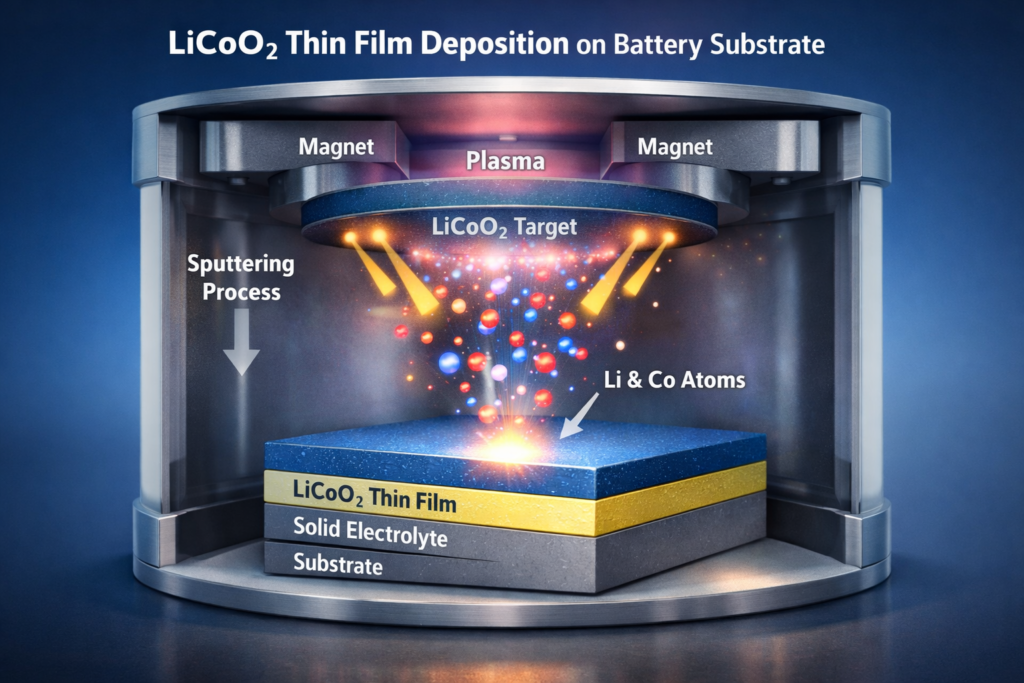
Thin-film lithium-ion batteries: LiCoO₂ targets are used for cathode thin film deposition, forming a uniform and dense film structure on the substrate surface through magnetron sputtering. High-purity targets ensure the integrity of the film’s crystal structure, improving lithium-ion migration efficiency, thereby increasing battery energy density and cycle life. This enables thin-film lithium-ion batteries to exhibit high performance in portable electronic devices and micro-energy storage applications.
Solid-state batteries: In solid-state batteries, LiCoO₂ films are typically deposited on silicon wafers or ceramic substrates, serving as a highly stable cathode material. The high density and uniform particle structure of the target ensure a smooth and tight interface between the deposited film and the substrate, thereby improving interface stability and conductivity, contributing to enhanced safety and cycle performance of solid-state batteries.
Micro-energy devices / MEMS: Lithium cobalt oxide targets can be used for cathode thin film deposition in micro-energy devices and MEMS devices, suitable for small-sized devices with high energy density requirements. High-purity targets ensure the uniformity and consistency of the thin film in the microstructure, while the stable crystal structure allows the device to maintain high electrochemical performance within a limited space.
Performance advantages of lithium cobalt oxide
Lithium cobalt oxide (LiCoO₂) targets exhibit superior performance advantages in thin film deposition due to their high purity and layered crystal structure. The combination of high capacity, long cycle life, thermal stability, and chemical stability enables LiCoO₂-deposited films to achieve high energy density and long-term stable operation in lithium-ion and solid-state batteries. Compared to other cathode materials such as NCM and LFP, LiCoO₂ targets offer a more balanced performance in terms of cycle life and thermal stability, making them particularly suitable for high-power and micro-device applications. Specific advantages can be summarized as follows:
High Capacity: Theoretical capacity of 140–160 mAh/g; high-purity targets ensure intact ion migration channels, enabling high energy storage efficiency.
Long Cycle Life: Retains ≥80% capacity after more than 500 charge-discharge cycles; stable target crystal structure reduces film performance degradation.
Strong Thermal Stability: The structure does not collapse under high-temperature conditions; the film maintains stable performance in high-temperature processes or operating environments, enhancing safety.
Chemical stability: Resistant to common solvents and process environments, reducing the risk of contamination during thin film deposition and ensuring consistent electrochemical performance.
Conclusion
Lithium cobalt oxide (LiCoO₂) targets, with their high purity, high density, and uniform particle structure, play a crucial role in the deposition of cathode thin films in lithium-ion and solid-state batteries. Their rigorous manufacturing process ensures the density and crystal stability of the target, enabling the thin films to possess high capacity, long cycle life, and good thermal stability. LiCoO₂ targets are widely used in thin-film lithium batteries, solid-state batteries, and micro-energy devices/MEMS, providing a reliable guarantee for the research and development and industrial production of high-performance batteries.